Canva revolutionizes design with its new operating system

The design platform launches its biggest update with specialized AI and free professional tools, revolutionizing visual creation.

Canva, the app that saved us from paying a fortune for Adobe, has just given its masterstroke

After more than ten years being the lifesaver for those of us who don’t know how to draw a thing, Canva has decided that being the world’s favorite design platform was not enough. His latest move: launching a creative operating system that promises to be the new best friend of every content creator, from the one who makes presentations for the office to the ‘influencer’ who lives off his ‘stories’.

This update, which could be described as “did we really need more procrastination tools?”, includes an improved visual suite, the implementation of artificial intelligence that seems to know more about design than we do, and free access to the Affinity creative software platform. Basically, Canva put on the superhero cape of digital design.

RelatedHow to use ChatGPT to detect Malwarebytes scams

The creative ecosystem you didn’t know you needed

For Mexico, which according to data has produced more than 2.35 billion designs since 2013 (yes, you read that right, one billion with an M for “very much”), this evolution represents an opportunity for exponential growth. Canva incorporates five improved resources that will allow even your aunt to create content that won’t embarrass others.

Video 2.0: Because your reels can no longer look like they were made with your feet. Canva redesigns its video editor with professional-grade tools, including a more intuitive timeline and the “Video Magic” option, which basically reads your mind (or so it promises).

Email Design: For those emails that always end up in spam. Now you can create, customize and export emails that stay true to your brand without having to change platforms. Your marketing team will thank you (and maybe even give you a raise).

Forms: The pretty cousin of Google Forms. It allows you to collect information, comments and RSVPs in a visually presentable way. The data obtained is automatically transferred to Canva Sheets, keeping everything centralized and controlled.

Canva Programming and Spreadsheets: Because Excel tables give you anxiety. These new tools will make it easier to create dashboards, calculators or learning tools that update automatically in real time.

The AI that designs better than your ex

The crown jewel is the world’s first design AI. With this resource, all you have to do is imagine a color, photo, video, texture or 3D element, and ask the tool to see it reflected in your design. As if it were a teammate (but without taking full credit), you can tag @Canva in your project to receive comments, suggestions or smart edits without interrupting your workflow.

Tools for brands that want to dominate the world

For brands and businesses using the platform, Canva implemented Canva Ads and Brand EcosystemMeta, with information tracking to improve content based on performance metrics. The brand ecosystem allows you to compile and save all visual identity resources: fonts, colors, logos and templates, to be able to work from any computer at any time. Basically, your ‘branding’ everywhere without losing your sanity.

Free Affinity: the gift you didn’t expect

Since its acquisition in March 2024, Affinity‘s photo editing, graphic and vector design tools have been taken over by Canva. This purchase included the Affinity Designer, Photo and Publisher programs. With Canva’s new creative operating system, these resources are now completely free, opening up the possibility of using the designs created with this software on the platform. It’s like Adobe gave you Photoshop, but in an alternate reality where companies are good.

Ready to explore these new tools that will likely get you even more screen time? Share this creative revolution on your social networks and discover how these advances can transform your digital workflow. And if you want to stay up to date with the latest updates in design tools, explore more related content on our platform to stay ahead.
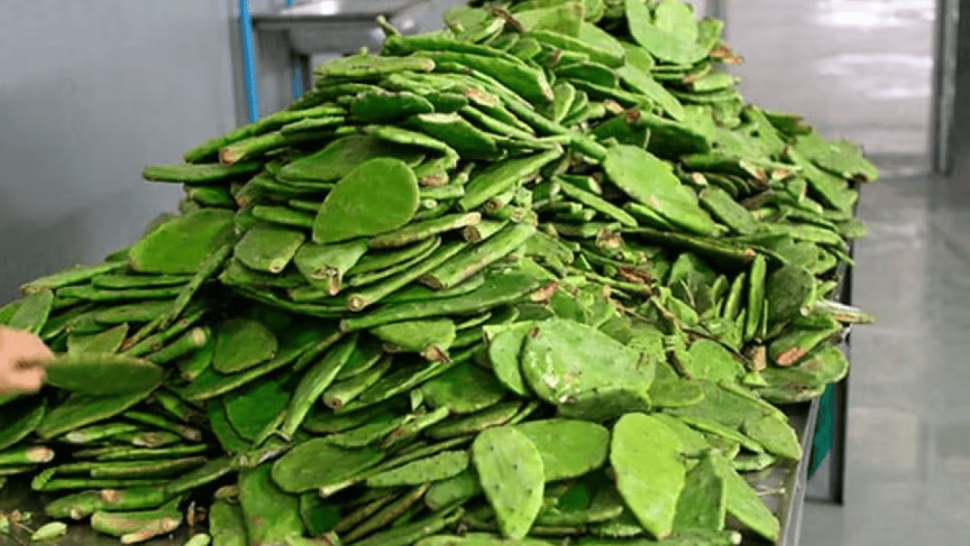

Nopal fertilizer accelerates crop growth

UNAM cactus fertilizer increases biomass by 20% and accelerates crop maturation.

The cactus waste that is usually discarded could be transformed into a tool for sustainable agriculture. UNAM researchers developed an organic fertilizer from the thorns and edges of this cactus that increased the biomass of the crops by up to 20% and accelerated their growth.

Results in Milpa Alta

The project was led by Bruno Chávez Vergara, from the UNAM Institute of Geology. Nopal digestate, a byproduct of the anaerobic digestion of organic waste, was evaluated. The research, funded between 2018 and 2020 by the Ministry of Education, Science, Technology and Innovation of Mexico City, seeks to promote sustainable practices in volcanic soils in the south of the basin.

Between 15% and 20% of the nopal processed for consumption is discarded as thorns and edges. This material is used to generate biogas and electricity, but it also produces a liquid waste that works as organic fertilizer. The tests were carried out in agricultural areas of Milpa Alta, Xochimilco and Tláhuac, in collaboration with Sustainability in Energy and Environment (SUEMA).

Chávez Vergara explained that digestate provides mineral nutrients to plants and feeds beneficial bacteria and fungi in the soil, recovering biological functions affected by years of chemical fertilizers. Unlike synthetics, this product promotes the microbial activity necessary for soil fertility. Its liquid presentation allows better use of water and faster absorption of nutrients.

In forage oat crops in Milpa Alta, the results were immediate. Since the first agricultural cycle, a 20% increase in biomass and a reduction of up to one month in maturation time was recorded. The researcher pointed out that these benefits would be especially useful for hillside and rainfed farmers, where lack of irrigation and erosion make production difficult.

Following the results, the UNAM team plans to expand the tests to corn and carrots, in addition to determining the minimum dose necessary to make the use of this fertilizer based on cactus residue profitable.

Continue reading

GTA VI scams: how cybercriminals operate

Kaspersky warns about fraud campaigns that use the anticipation of GTA VI to steal data.

The fever for the release of Grand Theft Auto VI has a dark side. Kaspersky detected multiple fraud campaigns that take advantage of expectation to compromise devices and steal personal information.

Attackers use fake pre-sales, supposed beta versions, and deceptive cryptocurrency tokens. According to the firm, the increase in reports began just after the start of the official pre-sale.

How do they deceive users?

Lisandro Ubiedo, senior analyst at Kaspersky for Latin America, explained the method. Criminals create websites that replicate the game’s visual identity. When entering data for the purchase, the information—names, emails, IDs, and card numbers—is captured. The product never arrives.

Videos are also circulating on social networks with supposed tutorials for downloading beta versions. When these files are executed, malicious programs are installed that operate in the background and facilitate access to personal accounts.

Another modality: portals that promote apocryphal cryptoassets using the brand image without authorization. This causes financial losses for investors.

Recommendations to avoid fraud

Kaspersky recommends purchasing content only from official channels. Verify URLs before entering sensitive data. Use virtual cards or prepaid methods for online transactions. And be wary of links with alleged leaks shared on digital platforms.

Continue reading

Mexico ranks 45th in AI adoption: study

Study by Accenture and IPADE places the country in 45th place globally. 66% of companies barely carry out pilot tests.

Mexico is in 45th position in the world in preparation to adopt artificial intelligence (AI), according to a study by Accenture, Empresas Globales and IPADE Business School. The report points out lags in infrastructure, research, private ecosystem and regulatory frameworks.

Business adoption still incipient

Despite the growing interest in generative AI, most organizations in Mexico are in the early stages. Of the total number of companies consulted, 66% remain in isolated tests or structured pilots. Only 34.1% have integrated or scaled technology in their processes.

The study—titled Oh, oh, oh, AI!—included interviews with CEOs and a survey of executives from 44 organizations that represent 3.3% of the national Gross Domestic Product (GDP). The business discussion is no longer whether AI will be relevant, but how quickly it will be incorporated into operations and strategic decisions.

Potential impact and challenges

Accenture Research estimates that, with a people-centered strategy, generative AI could transform 42% of working hours in Mexico and contribute up to $305 billion to GDP by 2038.

However, obstacles remain. Rafael Ramírez de Alba, professor at IPADE, pointed out that the country is in a decisive phase, but development depends on strengthening organizational, technological, regulatory and talent capabilities. The analysis identifies weaknesses in research, digital infrastructure and public policies.

At the corporate level, 43.2% of companies are still designing or adjusting their AI strategy; Only 13.8% have integrated it into the core of the business. In corporate governance, only 36.4% have a fully applied formal governance framework, and 52.3% are developing it. As a result, 68.2% report low or medium levels of confidence in using AI in relevant decisions. Furthermore, only 18% of boards of directors sufficiently understand the associated risks.

Continue reading