CAMe urges to avoid fireworks and bonfires due to air quality

The environmental authority reinforces measures ahead of the festive season, with new, stricter regulations already in force. Know the key precautions.

CAMe recommendations for a responsible celebration

The Megalopolis Environmental Commission (CAMe) has issued an urgent call to citizens to modify celebration traditions during this year-end season. The agency strongly urges people to refrain from burning fireworks and lighting recreational bonfires. This request has a clear technical basis: to prevent the concentrated emission of polluting particles (PM2.5 and PM10) and other compounds that, in winter atmospheric conditions, can generate episodes of poor air quality. These episodes not only deteriorate visibility and the environment, but also represent a tangible risk to respiratory and cardiovascular health, most severely affecting vulnerable groups such as children, older adults and people with chronic conditions.

In its official statement, the Commission detailed a protocol of specific actions for the population in the event that pollution rates reach levels classified as “very bad” or “extremely bad.” The guidelines are precise and based on the principle of minimizing exposure:

RelatedThe megalopolis is drowning under an active environmental contingency

Indoor confinement: It is recommended to remain at home by keeping windows and doors closed to establish a physical barrier against the intrusion of contaminated outdoor air. It is crucial to verify that there are no sources of internal combustion that aggravate the situation, such as wood stoves, fireplaces in use, gas heaters without adequate ventilation or excessive burning of candles.

Personal protection outdoors: If it is strictly necessary to go out, the use of high-efficiency face masks (such as models KN95 or N95) is essential. These devices offer superior filtration for the most harmful fine particles, unlike surgical or cloth masks.

Physical activity restriction: You should avoid vigorous outdoor exercise during the morning of January 1. Activities such as running, jogging or cycling increase the rate of inhalation and the depth of breathing, allowing more pollutants to enter the airways and bloodstream.

Incident reporting: Citizens play an active role in prevention. It is requested to report any outbreak of forest fire or uncontrolled burning immediately to the emergency numbers 800-737-0000 or 911.

The regulatory context: New, more protective limits

CAMe contextualized these recommendations within a strengthened regulatory framework. He recalled that the Mexican Official Standards for criteria pollutants, specifically NOM-025-SSA1-2021 (suspended particles) and NOM-020-SSA1-2021 (ozone), came into force with stricter limits on December 26 and 27, 2025, respectively. This regulatory adjustment responds to updated scientific evidence that demonstrates that lower concentrations of these contaminants have adverse impacts on health.

It is essential to perform a technical analysis of a key implication: the implementation of these more rigorous parameters will likely lead to a statistical increase in the number of days declared with poor air quality. This phenomenon should not be interpreted as a real increase in air pollution, but rather as the direct result of applying more protective measurement and evaluation standards aligned with the World Health Organization guidelines. In essence, the monitoring system is now more sensitive in identifying days that represent a risk, allowing for a more timely institutional and social response.

The combination of the holiday season, with its combustion practices, and winter weather conditions (such as thermal inversions that trap pollutants near the surface), creates a scenario ripe for severe pollution episodes. CAMe’s strategy, therefore, is dual: on the one hand, a call for citizen responsibility to reduce emission sources during the celebrations; and on the other, the application of a reinforced regulatory framework that guarantees a more precise evaluation and expanded protection of public health in the long term. The collective adoption of these recommendations is an essential component for the effective management of air quality in large cities.

Share this crucial information on your social networks to help raise awareness about the impact of our traditions on the air we breathe. Explore more content about sustainability and environmental health on our site.
INEHRM becomes a research and teaching center

The INEHRM is transformed into a research and teaching center under the new secretariat.

Transformation of the INEHRM

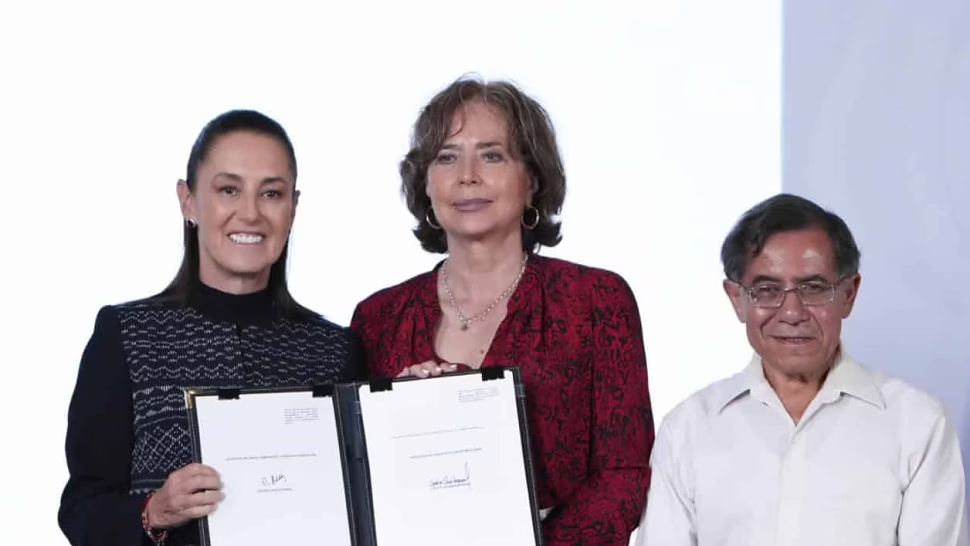
President Claudia Sheinbaum signed the decree that transfers the National Institute of Historical Studies of the Revolutions of Mexico (INEHRM) to the Secretariat of Science, Humanities, Technology and Innovation (SECIHTI). The institute becomes a decentralized public body with an academic focus.

Rosaura Ruiz Gutiérrez, head of SECIHTI, explained that the new scheme will train specialists in history to strengthen national capacities in social sciences and humanities.

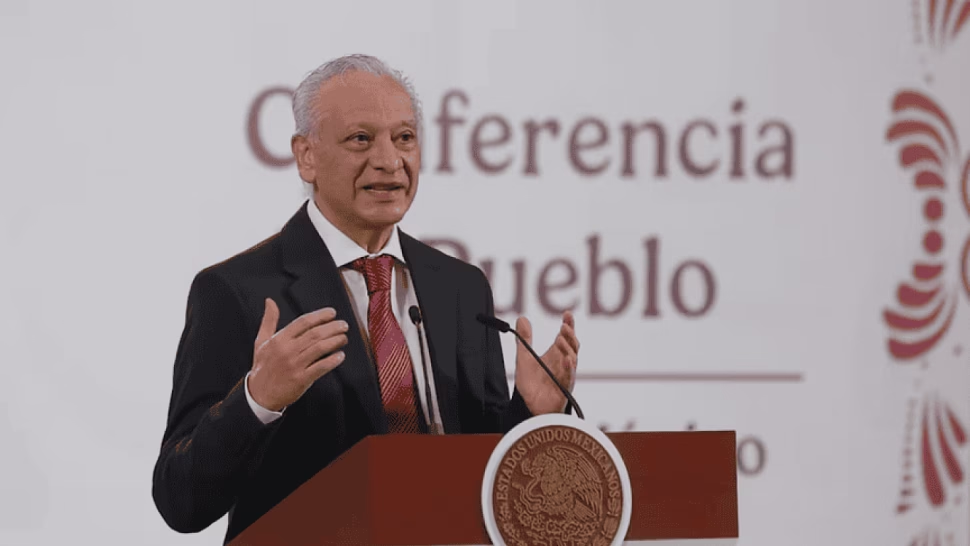
Felipe Arturo Ávila Espinosa, director of the INEHRM, explained that the study plans will link historical knowledge with social, economic, political and cultural problems of the country, and will address the needs of the Federal Public Administration.

Hybrid educational offer

The offer will include bachelor’s degrees in History, Social Sciences and Humanities, and Public Administration and Good Government. In postgraduate studies, master’s degrees will be added in Mexican Humanism, Gender and Feminism Studies, and Social Movements and Rescue of Historical Memory. There will also be specialties in Political Communication and History Teaching.

Graduates will cover topics such as agrarianism, health, migration, artificial intelligence, violence and human rights.

Headquarters and call

The new headquarters will be at 80 Guatemala Street, Historic Center of Mexico City. The first admission call will be launched in July, and classes will begin in September.

Continue reading

Prosecutor’s Office grants protection measures to victim of family violence

The Morelos Prosecutor's Office issued protection measures after a complaint of family violence against the former director of Pemex.

The Morelos Attorney General’s Office activated protection measures in favor of Felicia Jiménez Lavie, who filed a complaint for family violence against her husband, Víctor Rodríguez Padilla, former director of Pemex. This was reported by prosecutor Fernando Blumenkron Escobar.

The measures, the official explained, will be available when the victim requires them. The complaint was filed in Mexico City and the Women’s Secretariat of the Government of Mexico directly follows up on the case.

Investigation in progress

Until now, Jiménez Lavie has not gone to the local Public Ministry to contribute more elements to the investigation folder. This was initiated ex officio last Friday, June 26, after a video was broadcast with images of attacks against the woman.

Blumenkron assured that the portfolio continues its integration. “The proceedings have not stopped and we are going to continue to guarantee justice for the victim,” he said. In addition, he indicated that there is coordination with the Women’s Secretariat and the capital’s Prosecutor’s Office, under the care route for victims of family violence.

Among the actions carried out, the Morelos Prosecutor’s Office seeks to locate the address where the physical assault occurred, to carry out expert reports in accordance with the images of the video broadcast by the victim herself.

Continue reading

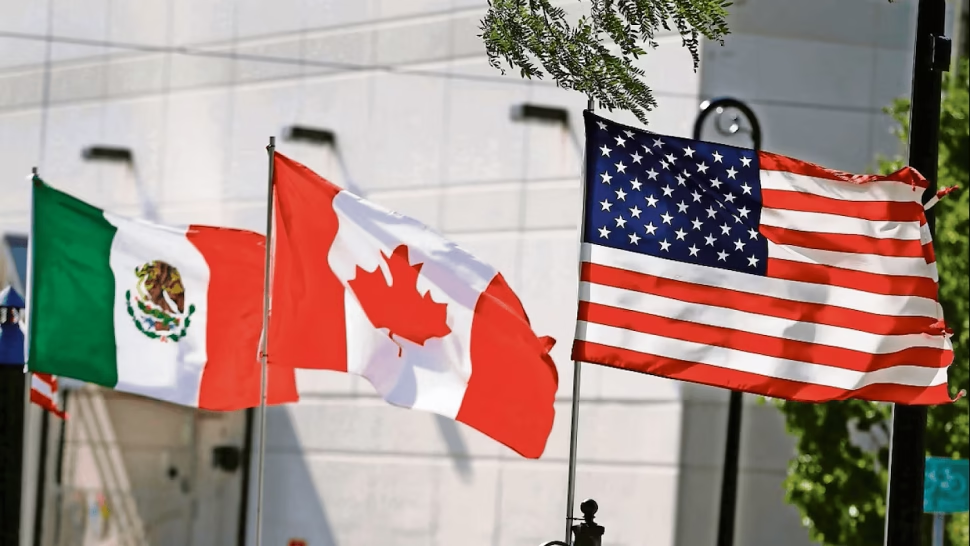
Trump does not extend T-MEC: Mexico faces annual review

US rejects automatic extension of the T-MEC; validity is reduced to 10 years with annual review.

Rejection of automatic extension

The United States decided not to automatically renew the Treaty between Mexico, the United States and Canada (T-MEC) for 16 years. This reduces its validity to a decade with an annual review. The measure generated concern among Mexican legislators.

Ricardo Monreal, coordinator of Morena in San Lázaro, explained that the treaty remains in force for another 10 years, but subject to evaluation each year. He noted that the United States presented 54 observations, including issues such as the vaquita porpoise and piracy. Mexico, for its part, raised 13 points, including clause 232 on tariffs.

“Only it will be reviewed year after year, but the Treaty is not finished, it continues for another 10 years because that is how it was signed six years ago,” declared Monreal.

The legislator warned that Donald Trump has been a constant critic of the USMCA and called for considering the benefits it has brought to the three nations.

Reactions of the opposition

Héctor Saúl Téllez, vice economic coordinator of the PAN, considered that the US position shows a lack of strategic anticipation on the part of the federal government.

“The US decision not to automatically extend the USMCA for 16 years in today’s review is not the end of the treaty, but it does reveal a lack of strategic anticipation by the federal government,” he stated.

Téllez recalled that Article 34.7 of the agreement had been known since 2018. Reaching July 1 without a clean extension represents a risk that, he said, should have been avoided.

The annual review will allow adjustments, but uncertainty about the future of regional trade persists. Mexico and Canada will seek to maintain the stability of the agreement for the next ten years.

Continue reading