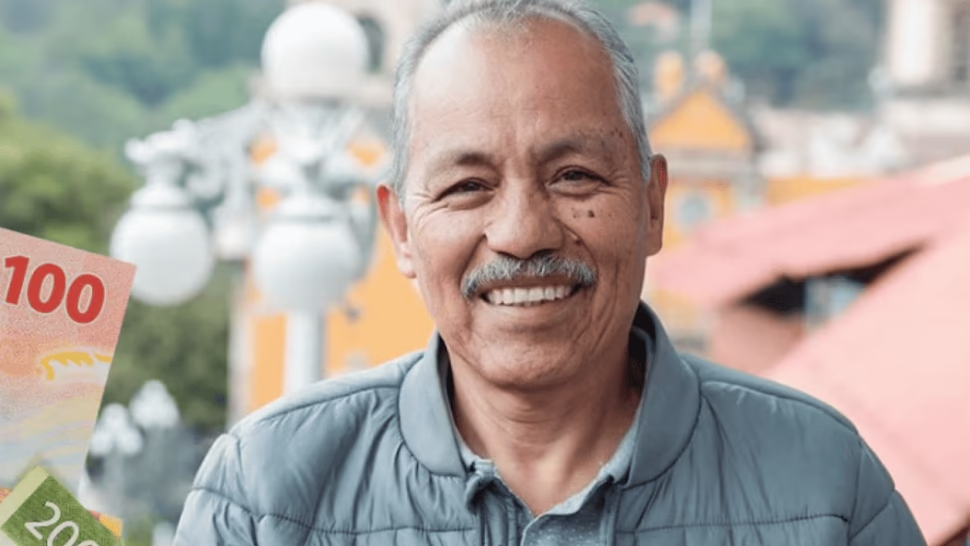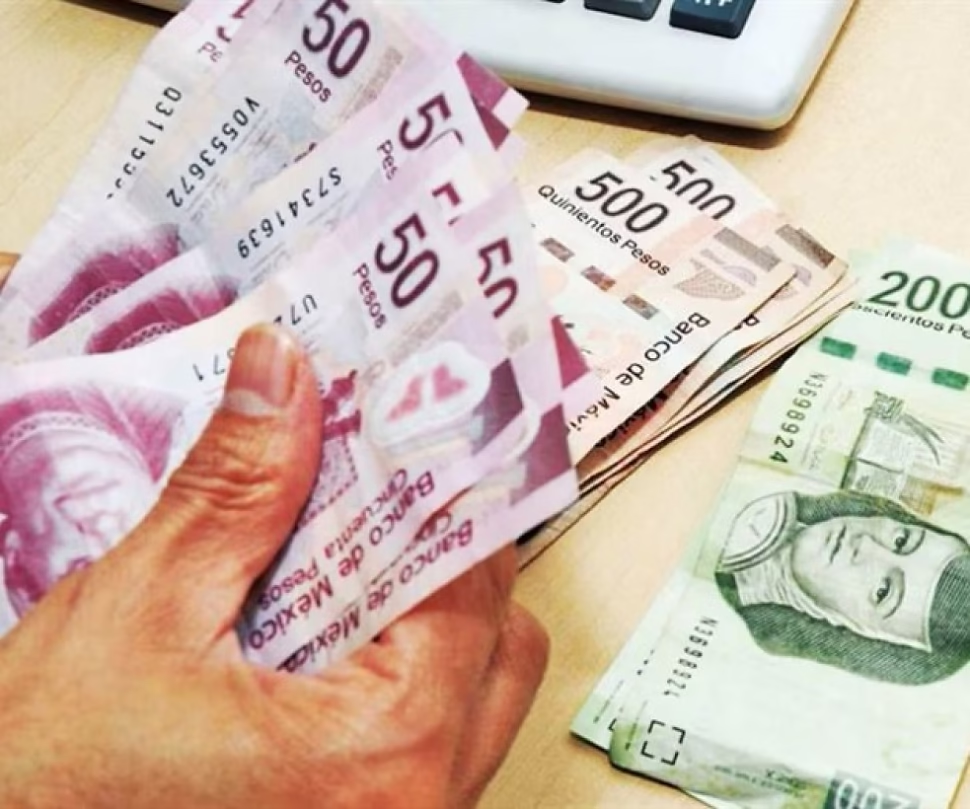
Bureaucracy receives its annual dose of happiness in vouchers

A Christmas gift that smells like a political pact and promises kept just in time for the holidays.

The epic of 14,900 pesos: a bureaucratic Christmas story

It seems that Santa Claus arrived early for government employees, although with a small detail: instead of coal, he brings grocery vouchers. The national leader of the FSTSE Central, Marco Antonio García Ayala, announced with great fanfare that bureaucratic workers will receive the astronomical amount of 14,900 pesos in vouchers this December. Because what better way to show appreciation than with paper that can only be spent in specific places, right?

According to the official statement, this economic stimulus is the result of the “permanent and purposeful dialogue” between the Federal Government and the Federation of Trade Unions. Or what is the same: after months of meetings, coffees and speeches, they finally agreed that public employees need something extra to survive the holidays. How timely, just when stores are raising their prices as if they were competing in an inflation Olympics.

RelatedAlexis Ayala prepares to succeed in La Casa de los Famosos

Christmas gift or job conquest?

The union leaders, in their infinite wisdom, have baptized this benefit as a “labor conquest.” Because receiving vouchers that you can’t use to pay rent or debts for the year is clearly comparable to winning an epic battle. The agreement, supposedly reached last May with the Secretary of Finance, seeks to “contribute to the comprehensive well-being of workers.” In other words, you can buy that luxury turkey without regrets.

And let’s not forget the job stability and the “strengthening of the ISSSTE” that the leader mentions as if it were the greatest prize. Because what would be of us without the assurance that, while you receive vouchers that expire, your health insurance is still valid. García Ayala himself solemnly declared: “It is highly satisfactory to report that Workers in the Service of the State will receive 14,900 pesos”. Of course, and who wouldn’t find it satisfying to announce that they will distribute almost fifteen thousand pesos that don’t come out of your own pocket?

Recognitions that taste like a permanent campaign

In a turn that no one saw coming, the union leader took the opportunity to recognize President Claudia Sheinbaum Pardo for the “advances in line with her national project.” What a coincidence that these praises come just when employees receive their Christmas incentive. And then we wonder why politics smacks of opportunism.

But the most moving moment came when the leader thanked the workers in the Health sector for their exemplary efforts during the recent rains. A gesture as timely as putting up the Christmas tree in October. Of course, last year’s stimulus was 14,500 pesos, which means that this year there are 400 more pesos of institutional generosity. With that difference you might be able to buy… well, maybe some extra socks.

In the end, this economic benefit from a single exhibition comes at the perfect time: when the economic forecasts for 2026 seem like something out of a horror movie and bureaucratic morale needs that little boost. Because nothing says “we value you” like a voucher that doesn’t cover appliances but does cover that premium ham you crave so much.

Ready to share this gem of institutional generosity? Spread this news on your social networks and discover more equally surreal stories in our economics section. Because reality is always stranger than fiction, especially when vouchers are involved.
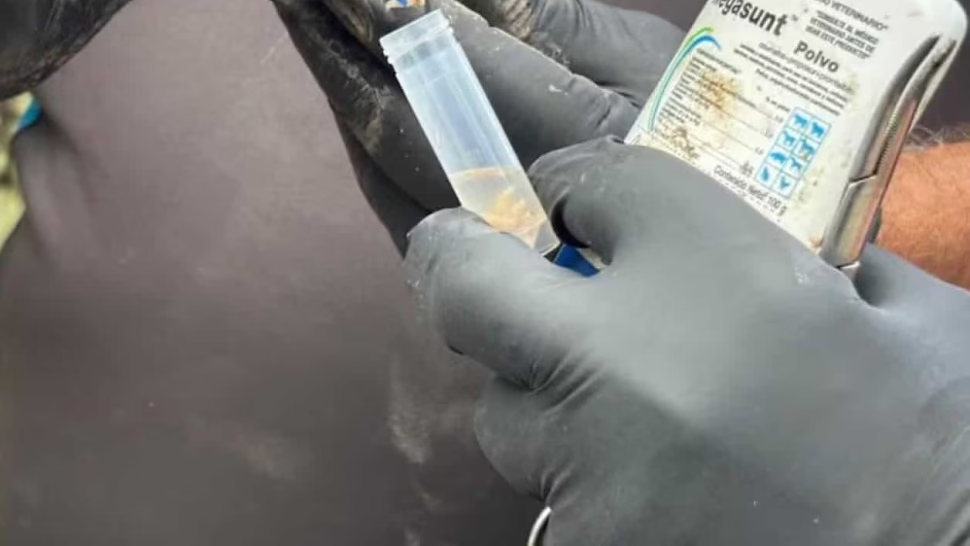
Reopening of borders to Mexican livestock after 14 months of blockade

14 months without selling to the US left losses of 592 million dollars.

End of the blockade of live cattle

After 14 months without being able to export live cattle to the United States, Mexican producers are preparing to resume sales. The gradual reopening will begin on August 24. During the blockade – from May 2025 to July 2026 – 1,974 million head of cattle were stopped being shipped.

According to the Agricultural Market Consulting Group (GCMA), the lost opportunity represented 592 million dollars. Exporters had to sell in Mexico for 900 dollars per head, compared to the 1,200 they would have obtained in the US market.

The damage could have been greater thanks to the increase in beef exports. Between January and June 2026, US$1,618 million worth of this product was sold to the US, although the figure is lower than what was generated before with live cattle.

Effects in the United States

The Mexican cattle shortage hit American feedlots. Meat production fell by 731 thousand metric tons. This skyrocketed prices: ground beef is around $7 per pound; the Sirloin exceeds 14 dollars.

The blockage was due to cattle screwworm. The Mexican Meat Council (Comecarne) celebrated the reopening and highlighted that it strengthens the value chain between both countries.

The National Agricultural Council (CNA) recognized that, despite limited resources, the Ministry of Agriculture and Senasica implemented surveillance and control measures for the worm. He noted that collaboration with US health authorities allowed for a joint Action Plan based on technical criteria.

Key advances: the sterile fly breeding plant in the south of the country, which will accelerate the eradication of the screwworm, according to the CNA.

Continue reading

Sheinbaum defends self-determination in Nicaragua

Sheinbaum defends self-determination in Nicaragua but rules out similar measure in Mexico

Sheinbaum’s position regarding the cancellation of elections in Nicaragua

President Claudia Sheinbaum was questioned about the decision of Daniel Ortega’s government to cancel the elections in Nicaragua, a measure that seeks to prevent the opposition from gaining power.

The Mexican president avoided issuing direct criticism and chose to defend the principle of non-intervention:

“It is the self-determination of the people, what the people of Nicaragua decide, and we always agree with democracy, in all its terms.”

Sheinbaum also responded if he would approve a similar measure in Mexico. His response was clear:

“No, here there is even a revocation of the mandate. Democracy, democracy, democracy. Each country decides, each people decides. We are in favor of democracy, but each country decides how it is organized.”

The presidential position reflects the Mexican tradition of respecting the sovereignty of other nations, although in this case the cancellation of the elections has been condemned by international organizations such as the OAS and the UN. Sheinbaum, however, did not join these criticisms and avoided describing Ortega’s action as a democratic setback.

Analysts point out that the response seeks to maintain cordial relations with the Nicaraguan regime, a historical ally of the Mexican left. The Mexican Foreign Ministry has not issued an official position beyond what the president said.

Continue reading

Wellbeing Calendar: payment to last names with S this July 27

Deposits for surnames with S. Amounts and calendar details.

Welfare Pension Payment for surnames with S

This Monday, July 27, the Welfare Secretariat deposits the resources for the July-August two-month period to beneficiaries whose first last name begins with the letter S. It is the fourth and last week of the staggered payment calendar, designed to speed up delivery and avoid saturation in branches.

The agency reminds that it is not necessary to withdraw the cash on the same day. The money remains on the Wellbeing Card and can be used on subsequent purchases or withdrawals.

During the previous weeks, other letters of the alphabet were covered, thus completing the July calendar.

Amounts in force for July 2026

The financial support maintains the established amounts: Pension for Older Adults provides 6,400 pesos; Women’s Welfare Pension, 3,100 pesos; Pension for People with Disabilities, 3,300 pesos; and the Program for Children of Working Mothers, 1,650 pesos for each registered minor.

The Sembrando Vida program, with a monthly scheme, made its deposit on July 9 for 6,450 pesos.

The alphabetical system facilitates dispersion among millions of beneficiaries enrolled in the social programs of the Government of Mexico.

Continue reading