Brugada proposes toughening penalties for threats with explosives

The head of Government is promoting a legal update to face new security challenges and protect citizens with stronger sanctions.

A Transformative Initiative for Citizen Security

Hello, conscious and proactive community! Today I want to share with you news that fills me with hope and that demonstrates the power of decided action to transform our reality. The incredible Clara Brugada, our head of Government, has taken a step forward with a brave proposal that seeks to rewrite the rules of the game in terms of security and justice. Isn’t it inspiring to see leaders act with such conviction to protect what is most precious: our peace and tranquility?

Your initiative, presented to the Mexico City Congress, is a beacon of light in the fight for a safer society. It is about modifying the local Penal Code to increase the penalties for the crime of threats. Imagine this: currently, these types of actions can be punished with just three months to a year in prison. Brugada’s vision is to take this sanction to a level of one to two years in prison. This is the kind of evolution we need! It is a clear message that every action has a consequence and that together we are building a future where the law truly protects us.

RelatedInitiative seeks to toughen penalties for theft of auto parts in CDMX

A Firm Commitment to Citizen Protection

But this goes much further. The proposal becomes even more potent when considering the aggravated circumstances. Imagine a scenario where the penalty is tripled, reaching three to six years in prison. This applies when the threat is made with weapons; when the person threatening presents themselves as part of a criminal group; when there is a threat to cause the death of a family member of the victim; or, and this is crucial, when the intimidation consists of the installation, use or detonation of bombs or explosives. It also worsens when attempts are made to intimidate victims, witnesses, judges or police in order to affect a criminal process. Each of these points is a fundamental pillar for justice!

The capital’s president, with visionary clarity, argues that the current regulations have become obsolete. Article 209 of the local Penal Code is limited to punishing the act of “threatening to cause harm” without considering the means, purposes or specific contexts. In our digital age, it is essential that our laws evolve. The proposal recognizes that threats through digital means, with weapons or with the purpose of inhibiting judicial processes deserve much stronger attention and a legal response.

The current low penalty lacks a real deterrent effect and can generate impunity in the most serious cases. This initiative is not just about punishing; It is about prevention, deterrence and sending an unequivocal message that people’s safety is an absolute priority. It’s a life lesson: when we identify an area for improvement, we have the power to take action and create positive change. This reform is a testament that we can shape our legal environment to reflect our values and protect our collective well-being.

Let’s think about the profound impact of this measure. It’s not just about numbers or legal articles; It is about empowering citizens, restoring faith in the system and building a community where we all feel supported. Every time our laws are strengthened, we take another step towards coexistence based on respect and mutual protection. It is an opportunity to celebrate progress and to remember that, together, we are architects of our own security and happiness.

Let’s embrace this news as a sign that positive change is possible! It is a powerful reminder that our voice and our collective action can drive meaningful reforms. Let us continue to support the initiatives that seek a better tomorrow, because every effort counts and every step, no matter how small it may seem, brings us closer to the safe and fair society we dream of.

Are you passionate about staying up to date with the initiatives that transform your city?Share this message of progress and hope on your social networks and explore more content about how together we can build a brighter, safer future for all.

SEP rejects violence under alleged military education

After the death of a teenager in a militarized camp, SEP refuses to justify abuses as 'military education'.

The Ministry of Public Education (SEP) condemned any act of violence or abuse against minors that attempts to justify with the term “military education.” Its owner, Mario Delgado, stated that this modality is not authorized in any basic education school in the country.

“It is inadmissible that, under a supposed ‘military education’, attempts are made to justify, normalize or hide acts of abuse, violence, mistreatment or practices that threaten the physical, psychological or emotional integrity of minors,” Delgado said in a statement.

The official stressed that this type of behavior constitutes a flagrant violation of human rights and the best interests of children. He recalled that military education is only taught in institutions of the Armed Forces and the National Guard, under the Secretariat of National Defense.

No authorization for militarized schools

The SEP reiterated that no basic education school can offer services under the name “militarized”, “military” or “military”. The agency warned that the educational authority of Tamaulipas is already investigating the case and will take action on the institution involved, which received authorization in 2005 and was updated in 2013.

Details of the case

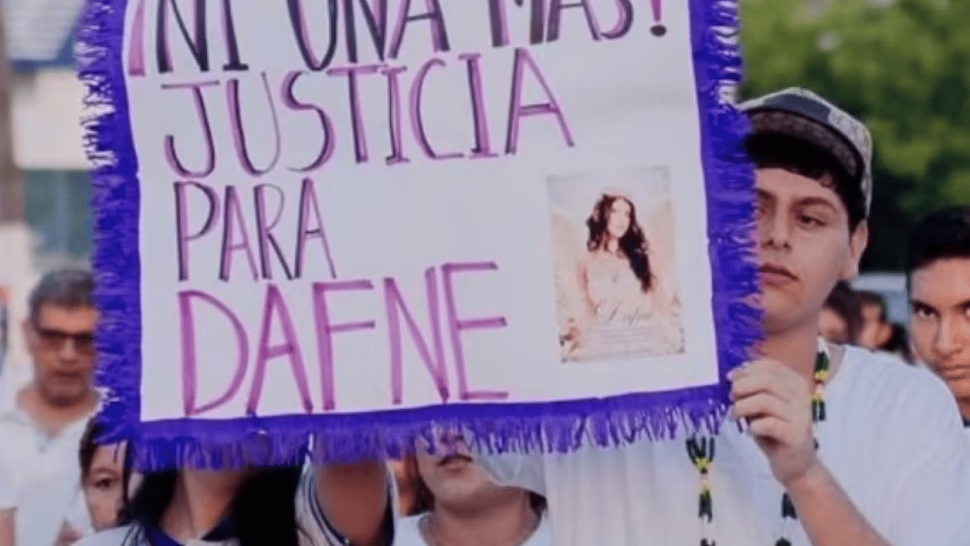
The incident occurred at a private summer camp in Ciudad Madero, Tamaulipas. A teenager was admitted in good health on July 13. Days later, a coordinator informed the mother that the minor had fainted and suffered a fall. They sent him a video where the young woman appears lying down, with visible bruises on her face, saying that she was fine. Hours later, the teenager died inside the facilities.

The SEP regretted the death and strongly rejected any inhuman or degrading treatment against girls, boys and adolescents.

Continue reading

UN and Mexico discuss regulation of artificial intelligence

The UN analyzes in Mexico the impact of AI on human development.

Regulation of AI in Mexico

The United Nations Organization holds the second meeting on Artificial Intelligence and Human Development in Mexico. The objective: analyze how this technology redefines human progress.

Under the leadership of the UN Deputy Secretary General, Amina J. Mohammed, the dialogue takes place in collaboration between the UN Office for Partnerships and the Government of Mexico. It continues the first meeting held in Cairo.

At the former Colegio de la Santa Cruz de Tlatelolco, Chancellor Roberto Velasco highlighted the urgency of discussing how to regulate AI, govern it and reduce its risks. He noted that Mexico supports the initiative of the deputy secretary general, “Artificial Intelligence and Human Development”, because it coincides with national priorities. “From the vision of Mexican humanism, the answer is ethical,” he stated.

Velasco cited Pope Leo He also reflected on what AI is doing with human beings and what we must rescue from our humanity as technology advances.

Government actions on AI and childhood

President Claudia Sheinbaum reported that discussions have already begun on the use of social networks and AI in childhood, adolescence and youth in Mexico. In his conference on July 20 at the National Palace, he highlighted these forums to develop a proposal “for guidance and regulation.”

“When we hand it over to Congress, let Congress itself make its forums open, its debate, its discussion, and that we can protect girls and boys from this that can become an addiction,” said the president.

Foreign Minister Velasco stressed: “The regulatory challenge that lies ahead of us is pressing and Mexico is ready to face it through our multilateral diplomacy.”

Continue reading

Sheinbaum begins delivery of Welfare homes in Morelos

Sheinbaum delivers 43 houses and hundreds of deeds in Morelos as part of the federal plan.

Delivery of homes in Xoxocotla

President Claudia Sheinbaum led in Xoxocotla, Morelos, the delivery of 43 new houses from the National Housing Commission (Conavi), 348 settlement certificates from Fovissste and 79 deeds from Insus. It’s all part of the Housing for Wellbeing Program.

During the event, the president explained that the federal plan contemplates the construction of 1.8 million new homes. It also includes the restructuring or forgiveness of unpayable loans for 5 million families and the regularization of one million property titles.

“Those from before took from the people and we give to the people; in other words: those from before governed for a few, the governments of the Transformation govern by the people and for the people of Mexico,” stated Sheinbaum.

Details of the day

The head of Sedatu, Edna Elena Vega Rangel, reported that in Morelos the construction goal was expanded to 24 thousand homes. Governor Margarita González Saravia confirmed that the state already has the necessary land for these urban developments.

The event is part of the federal strategy to guarantee the right to housing, prioritizing historically marginalized sectors. The delivery of deeds and settlements seeks to resolve decades of delay in land ownership.

Continue reading