Attack in Hormuz: ship attacked and tension on the rise

New attack on ship in Hormuz: crew safe, but no one claims responsibility.

Attack in the Strait of Hormuz: who is behind it?

A cargo ship was attacked by small boats near the Strait of Hormuz, that sea route through which almost a fifth of the world’s oil and gas passes. British authorities confirmed the incident, but so far no one has claimed responsibility for the attack. The crew are safe, according to the UK Maritime Trade Operations centre.

This is not an isolated case. Since the conflict between Iran and the United States began, the area has become a tinderbox. Iran has already warned that it will only allow ships not linked to the US or Israel to pass, and that on top of that you have to pay a toll. It’s as if they put a checkpoint in the middle of the global crude oil highway.

RelatedTrump launches ‘Project Freedom’ to rescue ships in Hormuz

Meanwhile, in Tehran they are evaluating Washington’s response to a proposal to end the war. But be careful: they said that for now they are not touching on the nuclear issue, although that has been the toughest nut to crack between both countries. The Iranian economy suffers: the currency is devalued and people have a hard time.

What worries me is how this affects real families, not just markets. The uncertainty in Hormuz is already shaking global fuel prices. And while the diplomats talk, the ships continue to navigate increasingly dangerous waters.
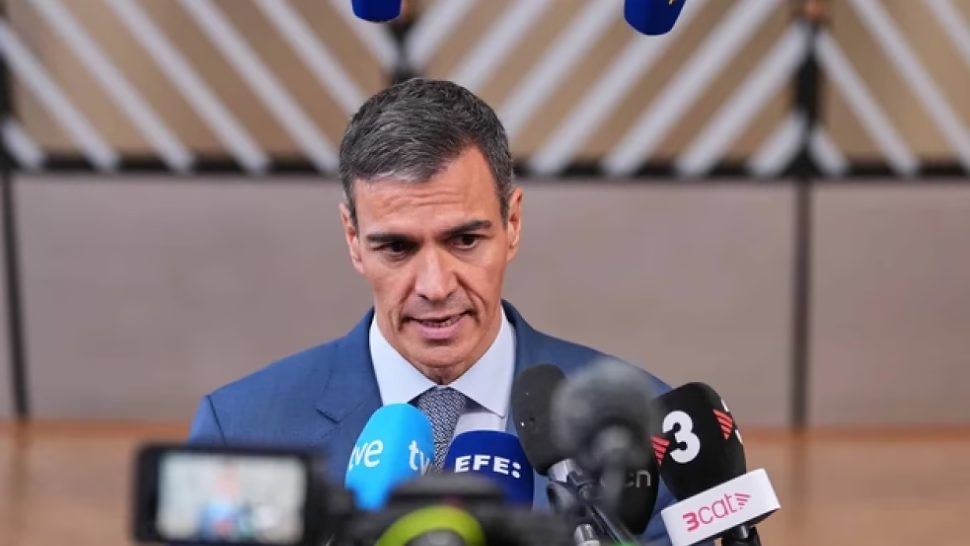

Begoña Gómez, on trial for influence peddling in Spain

The wife of the Spanish president will face trial for alleged corruption crimes.

Court order against Sánchez’s wife

An investigating judge in Madrid ordered that Begoña Gómez, wife of the president of the Spanish government, Pedro Sánchez, sit in the dock for alleged crimes of influence peddling and corruption. The resolution includes the delivery of his passport and the obligation to appear in court every two weeks.

Judge Juan Carlos Peinado argued that there is a risk of flight. A trial date has not yet been set. The court decision has intensified the political debate in Spain.

Reactions and context

The opposition has demanded a response from the socialist government. Several political leaders consider that the case affects the integrity of the executive. For now, Sánchez maintains his support for his wife and has reiterated his confidence in justice.

The process continues and it is expected that the coming weeks will define the judicial calendar.

Continue reading

Train collision in England: one dead and 9 in critical condition

Nine passengers in critical condition and the driver died after a nighttime crash.

Train collision in central England

Nine people were in critical condition Saturday following a collision between two passenger trains that occurred the night before in central England. The driver of one of the locomotives died in the incident, police reported.

More than 80 people received medical attention

The head of the British Transport Police, Lucy D’Orsi, said that more than 80 people were treated in hospitals after the crash, which occurred late on Friday. A day later, 28 of them were still hospitalized. Authorities continue to investigate the causes of the accident.

Continue reading

Colombia votes between progressive continuity and conservative turn

Colombia defines its future between two opposite poles: the continuity of Petro or a conservative turn.

Two visions, one country on the limit

Colombians go to the polls this Sunday for the closest presidential second round in years. The progressive Iván Cepeda, an ally of Gustavo Petro, faces the conservative Abelardo de la Espriella, an outsider who surprised by leading the first round with 43.73% of the votes.

“I am concerned about the extreme polarization. There are two very opposing sides and the violence worries me,” lawyer John Manrique told The Associated Press from Bogotá. “I hope we accept the result and seek a social consensus.”

The ghost of polarization

Glaeldys González, analyst at the International Crisis Group, warns that the levels of polarization are “extremely high” and that the electorate is looking for a real solution to violence, health, corruption and finance in both poles.

De la Espriella, known as “El Tigre”, promises a tough hand: mega prisons like Bukele’s and confronting illegal groups. He received the endorsement of Donald Trump. Cepeda, philosopher and former communist, promises to deepen Petro’s social reforms and maintain peace talks. This week, 100 members of armed groups demobilized thanks to this policy.

Allegations of fraud and call for calm

The second round has tense the atmosphere. Cepeda admitted that Petro did not recognize the preliminary count, although he later accepted the official count. The Ombudsman’s Office asked candidates and leaders to promote trust in institutions and avoid unsubstantiated allegations of fraud.

González pointed out that Crisis Group views possible outbreaks of post-election violence with concern, but trusts that international institutions and observers will help contain them.

Yamile Guevara, a retired teacher, criticized the historical distrust of the left: “The left has always been seen as something negative. People forget history.”

On Sunday, Colombia decides between two opposite paths, with democracy and peace as a backdrop.

Continue reading