ASEA investigates Pemex spill in Dos Bocas and closes beaches

Environmental authorities investigate the incident while coastal communities face restrictions due to the emergency.

ASEA will supervise Pemex after hydrocarbon spill in Dos Bocas

An environmental incident at the facilities of Petróleos Mexicanos (Pemex) has generated an alert at the Dos Bocas Maritime Terminal, located in Paraíso, Tabasco. The National Agency for Industrial Safety and Environmental Protection (ASEA) announced that it will carry out exhaustive supervision of the state company to determine the causes of the spill, quantify the volume of crude oil released and evaluate the remediation measures implemented.

Environmental impact and immediate actions

The spill, whose magnitude has not yet been specified by Pemex, caused the preventive closure of the surrounding beaches due to the presence of chapopote (mixture of hydrocarbons and sediments). The municipal authorities displayed black flags, a sign prohibiting access to the sea, while cleaning teams work in coordination with the parastatal. The ASEA, a body linked to Semarnat, emphasized its commitment to ecological preservation and promised to update information on progress.

RelatedASEA launches environmental regularization program for fuel stations

“We are in coordinated action with Pemex to remove the oil that affects our coasts”, declared the Paraíso city council. The measure directly affects local fishermen, who suspended economic activities indefinitely.

Lack of transparency and background

As of the closing of this note, Pemex has not issued an official statement detailing the causes of the incident or the activated protocols. This event adds to a series of operational incidents recorded at company facilities, which has generated criticism from environmental organizations and affected communities.

Experts in industrial safety emphasize that recurring spills show failures in infrastructure maintenance and contingency plans. The ASEA, for its part, could impose economic or administrative sanctions if it identifies negligence.

Why is it relevant? Dos Bocas is home to the Olmeca Refinery Project, emblematic for national energy policy. Incidents like this could impact its operations and increase regulatory pressures.

Call to action

Share this information to keep your network informed about environmental risks and corporate responsibilities. Explore more content on sustainable energy and industrial regulation on our site.

Are you interested in going deeper? Follow us to receive exclusive analysis on how these events affect the local economy and ecosystems.
Massive security reinforcement and alcohol ban at the Azteca

56,000 police officers and alcohol restriction for the game at the Azteca.

Measures for the Mexico-Czech Republic match

The government of Mexico City announced an unprecedented security operation for this Wednesday’s game at the Azteca stadium. 56,000 personnel will be deployed, five times more than the 11,219 employed last week.

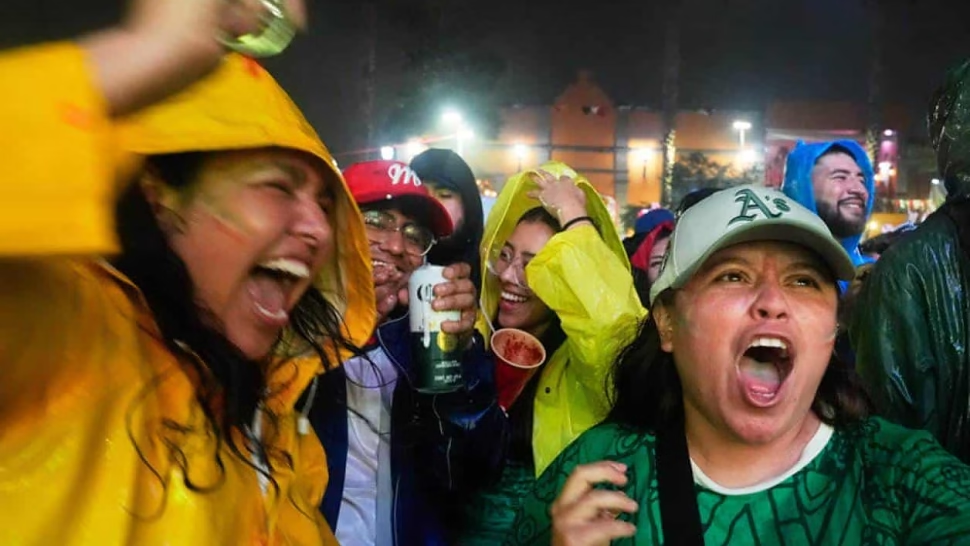
The decision responds to the celebrations of the previous Thursday, when some 700,000 people gathered in the capital after Mexico’s victory over South Korea. Although there were no injuries, nearly 40 tons of garbage were collected in the Ángel de la Independencia and the Zócalo.

The Secretary of Security, Pablo Vázquez, detailed that 7,500 police officers will guard the Azteca stadium. Another 3,275 will be in the Zócalo and 4,200 on Reforma Avenue. The objective is to protect players, referees, authorities and fans.

In addition, the Secretary of Government, César Cravioto, reported that starting at 3 p.m. on June 24, a ban on the sale of alcohol will take effect for sixteen hours. Applies to the Historic Center and five neighborhoods of Cuauhtémoc.

Sales will only be allowed in restaurants, hotels and private clubs, accompanied by food. Convenience stores and supermarkets are excluded. The fines for non-compliance amount to up to 293,275 pesos (about $17,251).

The Mexican Alliance of Transporters Organization (AMOTAC) called for mobilizations on highways in the 32 states and blockades in the capital to protest against the violence. The operation also considers these protests.

Continue reading

UNAM, new WHO collaborating center in oral health

The WHO recognizes UNAM as a reference in oral health and aging.

International recognition for UNAM

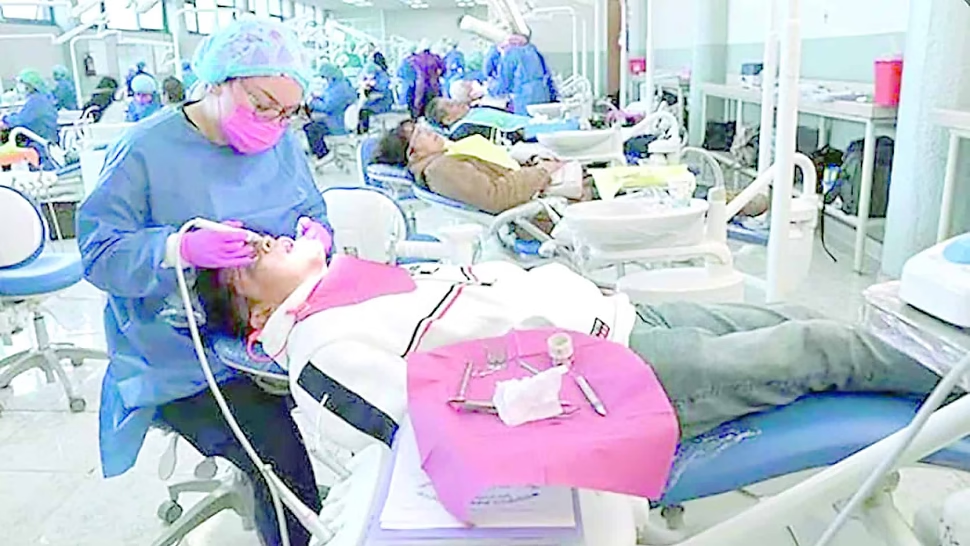
The World Health Organization (WHO) designated the Department of Oral Public Health of the UNAM Faculty of Dentistry as a Collaborating Center in Oral Health and Aging. The distinction is valid for four years.

With this appointment, the highest educational institution consolidates itself as a regional reference in the comprehensive care of older adults.

Implications of the appointment

The recognition will allow university specialists to participate in the development of public policies focused on improving the quality of life of the elderly.

In addition, they will promote strategies to promote among older adults and caregivers the importance of maintaining adequate oral health as an essential part of general well-being.

The designation places UNAM on a level of technical cooperation with the WHO, which opens opportunities to influence global guidelines on aging and oral health.

Continue reading

Digital sexual exploitation affects 1.6 million adolescents in Mexico

1.6 million adolescents in Mexico suffer online sexual exploitation every year.

The report reveals alarming figures

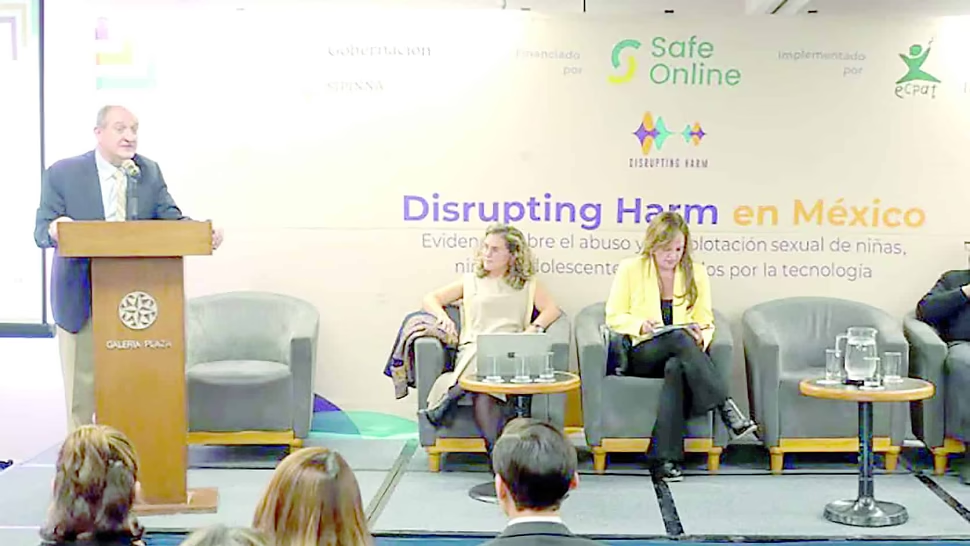
Unicef, ECPAT International and Interpol published the study “Disrupting Harm México”, which indicates that one in eight adolescent Internet users in the country – around 1.6 million – experienced sexual exploitation facilitated by digital technologies for a year.

67% of cases occurred online only, mainly on social networks and platforms. However, violence is not limited to the virtual sphere: in almost two out of every three situations, the victims knew their attackers, who were usually friends, partners or family members.

The report documents serious under-reporting. 32% of victims did not tell anyone what happened out of shame or fear, and less than 1% filed a formal complaint. This reflects normalization and silence around these attacks.

Consequences and call to action

In mental health, the consequences are profound. Those who suffered this type of violence are 15 times more likely to self-harm and 12 times more likely to have thoughts about their own death, compared to those who did not have that experience.

Fernando Carrera, Unicef ​​representative in Mexico, asked to reinforce prevention and responsibility of digital platforms. Lorena Villavicencio Ayala, from SIPINNA, stated that the State must guarantee the safety of girls, boys and adolescents in digital environments.

Continue reading