Mayor of Celaya denounces intimidation with bullets at his home

The mayor and his team face direct intimidation with projectiles, revealing the complex network of pressures and interests in the region.

A pattern of intimidation against the municipal government of Celaya

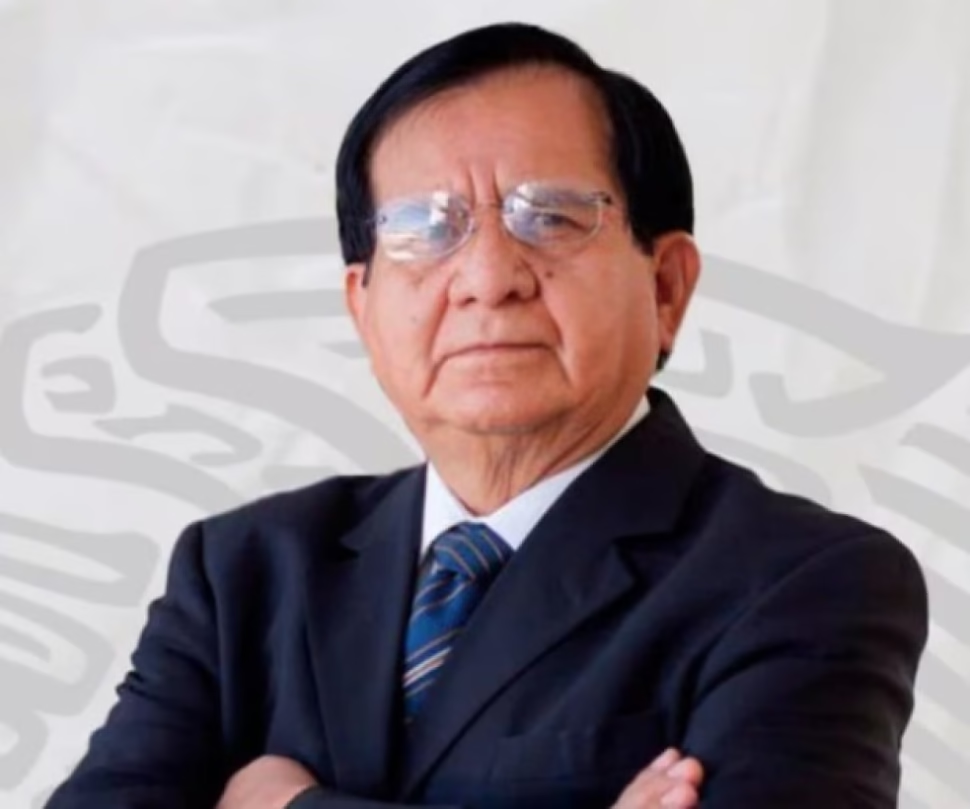
The municipal president of Celaya, Juan Miguel Ramírez Sánchez, affiliated with the Morena party, has made public some serious accusations concerning his personal safety and that of his team of collaborators. According to their statements, collected in a collective interview, approximately two months ago an act of direct intimidation was perpetrated by leaving ballistic projectiles at their residence. This incident is not isolated, but is part of a series of systematic pressures and threats that he has experienced throughout his almost eleven months at the head of the local administration.

The phenomenon of intimidation extends beyond the figure of the mayor. Ramírez Sánchez explained that key members of his cabinet have also been subject to similar actions, finding ammunition in their official vehicles. Specifically, he mentioned the Director of Inspection, Eduardo Griss Kauffman, and the Director of Urban Development, Luis Martín González Guzmán, as some of the officials who have received this macabre message. This method of coercion, using bullets as a symbol of threat, is a documented tactic used by criminal groups to instill fear and demand concessions without the need for direct confrontation.

RelatedJeff Bezos and Lauren Sánchez seal their love in a dream wedding in Venice

Background and context of the threats

The security situation for public servants in Celaya is not a new issue. The councilor recalled that, from the moment he made the decision to run for office, he was aware that he would face numerous challenges and problems of great magnitude. However, the persistence and audacious nature of the threats underscore the complexity of the security environment in the region. A crucial precedent occurred on November 22, 2024, when the mayor reported having received explicit threats from organized crime structures. The central demand of these groups, according to their testimony, was the control of various strategic directions within the municipal Public Security area, which would show an attempt to take over institutions and co-opt the functions of the State.

An aspect that raises deep questions is the decision not to present a formal complaint to the Attorney General’s Office of the State of Guanajuato. When questioned about this, Ramírez Sánchez raised a pragmatic doubt: “I can file it (the complaint), but who do we accuse of putting the bullets on us?” This reflection highlights one of the biggest obstacles in the fight against organized crime: the difficulty in identifying and prosecuting the intellectual authors of these actions, who usually operate from the shadows. Instead of the ordinary judicial route, the municipal administration chose to request direct support from the Secretariat of National Defense (Sedena), which responded by reinforcing the security device with elements of the National Guard, increasing the number of troops after the June incident.

Interests at stake and the administration’s position

The mayor was cautious when it came to pointing out a single person responsible for the threats. He suggested that these could be attributed to criminal groups operating in the territory, but also hinted at the possibility that other actors with “many interests” could be involved. This calculated ambiguity reflects the intricate web of power in which local politics unfolds, where economic, legal and illegal interests often intertwine. As an example of the actions that could have triggered these reactions, he cited the recent operation to dismantle semi-fixed posts established irregularly on the sidewalk of Antonio Plaza Street, in the vicinity of the city’s Bus Station. These interventions, although they seek order and legality, usually affect money flows and territorial control dynamics.

Faced with this panorama of pressure, the official position of the municipal president is one of unbreakable resistance. He assured that he was determined to face the problems and continue implementing what he considers “positive actions for the development of Celaya.” He affirmed that his government will always be willing to agree with whoever is right within the framework of the law and dialogue, but made it clear that he will not give in or accept pressure of any kind that compromises the autonomy of his administration or the security of citizens. This firmness, although it exposes it to greater risk, seeks to establish a precedent of authority and institutional resilience in a context marked by violence.

Did you find this analysis of the security challenges faced by local governments relevant? Share this content on your social networks to expand the conversation and make this problem visible. Explore more articles in our security and national politics section to stay informed.

Sheinbaum announces 42 CT scanners and telemedicine to strengthen health

The president detailed investments in medical equipment, telemedicine and improvement of clinics.

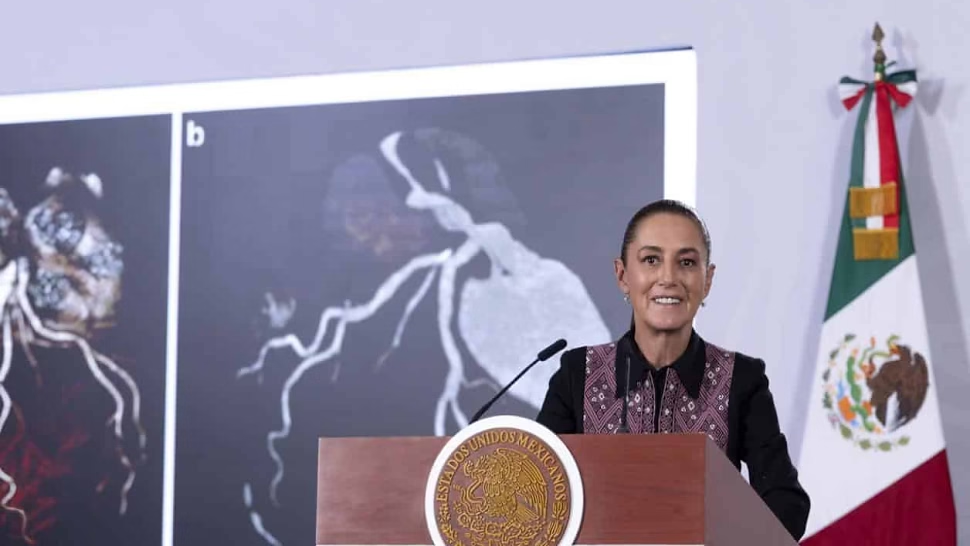
President Claudia Sheinbaum reported on advances in the public health system, with investments in equipment, telemedicine and improvement of clinics. He affirmed that the State must guarantee access to health from prevention to care for complex diseases.

“We are compensating for the profound damage that neoliberalism caused in the health system,” he said at the morning conference.

Equipment and telemedicine

The IMSS installed 42 state-of-the-art CT scanners in 40 hospitals in 19 states. Of these, 41 are from 256 cuts. They allow early detection of tumors and bleeding, perform up to 50 studies per day and reduce waiting times. They were acquired for 29 million pesos each, below the 40 million in the past.

The ISSSTE expanded telemedicine from 239 to 859 units. It offers consultations in 15 specialties, such as cardiology and dermatology, from 118 second and third level units to 741 first level.

The Clinic is Ours

The La Clínica es Nuestra program delivered 4,608 million pesos in 2025 to 8,483 medical units, with the participation of 67,864 people. 42 thousand improvement actions were carried out in infrastructure and equipment. The 2026 call will begin in July, including for the first time 153 units from Yucatán with 80 million pesos.

Sheinbaum added that progress is being made in the House to House Health program, with more than 20 million consultations with older adults and people with disabilities. Starting in August-September, you will be able to collect medications at Farmacias del Bienestar, health centers and a network of pharmacies. Next year the Universal Health Service will begin with a single credential.

Continue reading

Massive security reinforcement and alcohol ban at the Azteca

56,000 police officers and alcohol restriction for the game at the Azteca.

Measures for the Mexico-Czech Republic match

The government of Mexico City announced an unprecedented security operation for this Wednesday’s game at the Azteca stadium. 56,000 personnel will be deployed, five times more than the 11,219 employed last week.

The decision responds to the celebrations of the previous Thursday, when some 700,000 people gathered in the capital after Mexico’s victory over South Korea. Although there were no injuries, nearly 40 tons of garbage were collected in the Ángel de la Independencia and the Zócalo.

The Secretary of Security, Pablo Vázquez, detailed that 7,500 police officers will guard the Azteca stadium. Another 3,275 will be in the Zócalo and 4,200 on Reforma Avenue. The objective is to protect players, referees, authorities and fans.

In addition, the Secretary of Government, César Cravioto, reported that starting at 3 p.m. on June 24, a ban on the sale of alcohol will take effect for sixteen hours. Applies to the Historic Center and five neighborhoods of Cuauhtémoc.

Sales will only be allowed in restaurants, hotels and private clubs, accompanied by food. Convenience stores and supermarkets are excluded. The fines for non-compliance amount to up to 293,275 pesos (about $17,251).

The Mexican Alliance of Transporters Organization (AMOTAC) called for mobilizations on highways in the 32 states and blockades in the capital to protest against the violence. The operation also considers these protests.

Continue reading

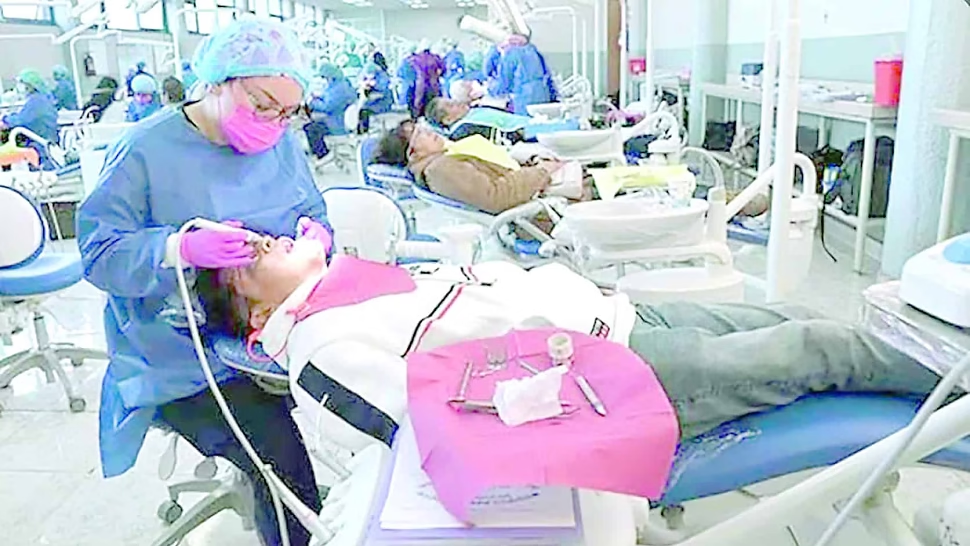
UNAM, new WHO collaborating center in oral health

The WHO recognizes UNAM as a reference in oral health and aging.

International recognition for UNAM

The World Health Organization (WHO) designated the Department of Oral Public Health of the UNAM Faculty of Dentistry as a Collaborating Center in Oral Health and Aging. The distinction is valid for four years.

With this appointment, the highest educational institution consolidates itself as a regional reference in the comprehensive care of older adults.

Implications of the appointment

The recognition will allow university specialists to participate in the development of public policies focused on improving the quality of life of the elderly.

In addition, they will promote strategies to promote among older adults and caregivers the importance of maintaining adequate oral health as an essential part of general well-being.

The designation places UNAM on a level of technical cooperation with the WHO, which opens opportunities to influence global guidelines on aging and oral health.

Continue reading