At least 31 Palestinians die in incident during aid distribution in Gaza

A new aid distribution strategy in Gaza ends in tragedy, leaving dozens dead and injured.

A new aid system marked by chaos and violence

At least 31 Palestinians were killed and more than 170 injured during an incident that occurred early Sunday morning in the city of Rafah, southern Gaza Strip. According to testimonies collected by health officials and eyewitnesses, the victims were heading to a food distribution center run by an Israeli-backed foundation when military forces opened fire on the crowd. The Israeli Army denied having fired on civilians in the vicinity of the site, arguing that its troops only fired warning shots against suspicious individuals who advanced towards them during the night.

Contradictions in versions and lack of independent access

The Israeli military released drone footage that it said showed gunmen shooting at civilians in Khan Younis. However, The Associated Press could not verify the authenticity of the material, nor determine the exact context of the events. For its part, the humanitarian foundation involved assured that the distribution of aid was carried out “without incident” and denied previous reports about chaos in the area, although independent media do not have access to these compounds, located in restricted military areas.

RelatedGaza experiences a crucial truce with hopes for peace and aid

The International Committee of the Red Cross (ICRC) reported that its field hospital in Rafah treated 179 wounded, 21 of whom died on arrival, most with projectile injuries. “All patients stated that they were trying to access a help point,” the agency declared, describing the event as the worst since the center opened more than a year ago. Philippe Lazzarini, director of the UN agency for Palestinian refugees, denounced that “the distribution of aid has become a death trap.”

International repercussions and failure of the aid system

Humanitarian organizations, including UN agencies, have refused to collaborate with the new distribution system, arguing that it violates basic principles of neutrality and equitable access. Jonathan Whittall, representative of the UN humanitarian office in Gaza, described it as “an engineered shortage”, referring to Israeli restrictions that make it difficult to deliver aid to 2 million Palestinians at risk of famine.

Context of the conflict and devastating figures

The war in Gaza, unleashed after the Hamas attack on October 7, 2023, has left more than 54,000 dead, according to the local Ministry of Health, although it does not distinguish between civilians and combatants. The Israeli offensive has destroyed critical infrastructure and displaced 90% of the population, worsening dependence on international aid. Meanwhile, ceasefire negotiations face obstacles, with Hamas requesting amendments to a US-backed proposal.

Are you outraged by this situation? Share this information to make the humanitarian crisis in Gaza visible and explore more content about global rights on our social networks.
Díaz-Canel rejects that economic measures are capitalist

The Cuban president defends the 176 measures as strengthening socialism.

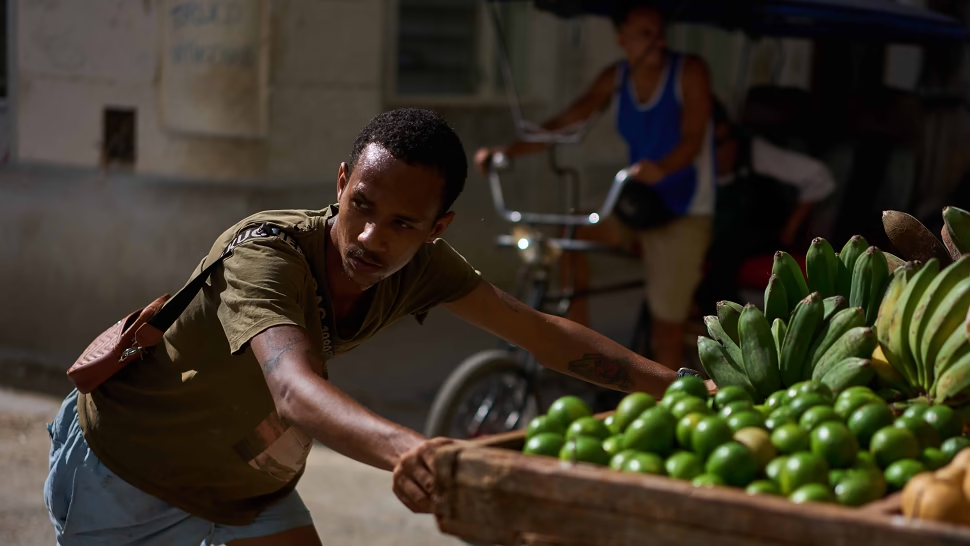
The president of Cuba, Miguel Díaz-Canel, denied that the package of 176 economic measures approved by the Communist Party and the National Assembly represents a retreat towards capitalism. In an interview with Puerto Rican journalists broadcast by official media, he assured that the actions are sovereign and seek to strengthen the socialist model in the face of the complex crisis facing the island.

Measures in context

Díaz-Canel acknowledged that the initiatives have received criticism from both right-wing sectors and left-wing groups. However, he emphasized that this is an adaptation to current circumstances, not an abandonment of the country’s historical principles. The president insisted that a capitalist restoration is not promoted, but rather that he seeks to sustain the socialist system in an adverse environment.

The statements have generated a wide debate inside and outside Cuba. International analysts are closely observing whether these measures imply profound changes in the economic structure of the Caribbean nation. For now, the government maintains its official line: necessary adjustments, without ideological concessions.

Continue reading

Trump deviates from script on children’s podcast to talk about former presidents

Trump read a children's story and diverted the text to criticize Obama and joke about other former presidents.

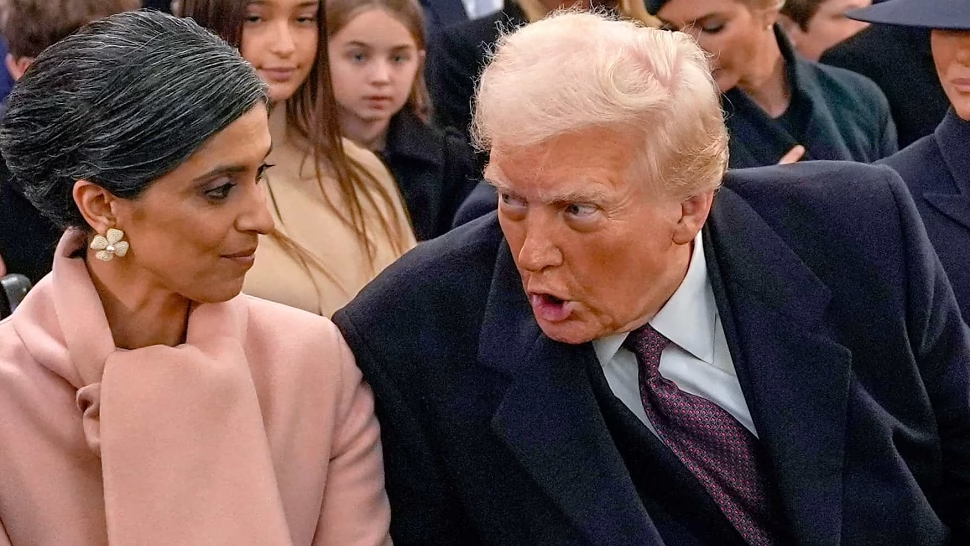
US President Donald Trump participated as a guest on the children’s podcast “Storytime with the Second Lady”, hosted by the second lady, Usha Vance. During the reading of the illustrated book Presidents Play!, the president took the opportunity to make comments about former presidents, his life in the White House and personal anecdotes, moving away from the original text.

Comments on his predecessors

Trump praised Ronald Reagan and described Lyndon Johnson as “a strong man.” He also made jokes about Richard Nixon and Herbert Hoover. However, he again criticized former President Barack Obama, questioning his sporting abilities and his love of golf. These statements have generated divided reactions among the audience.

Reading details

Seeing the illustrations, Trump paused to talk about himself. He commented that he would like to ride a horse, but that he would prefer a “very slow” one. He confessed that he had not worn a swimsuit in years and joked that he did not exceed the weight of former President William Howard Taft, considered the largest president in US history.

Reactions and context

Trump’s participation in this space aimed at children has been highlighted by the contrast between the tone of the podcast and the president’s political comments. Although the program seeks a friendly environment for the little ones, Trump chose to intersperse criticism and personal anecdotes that diverted attention from the book.

Continue reading

La Guaira: more than 2 thousand deaths and the drama of identifications

Tragedy in La Guaira: more than 2 thousand dead and thousands missing after earthquakes.

The seismic tragedy in La Guaira

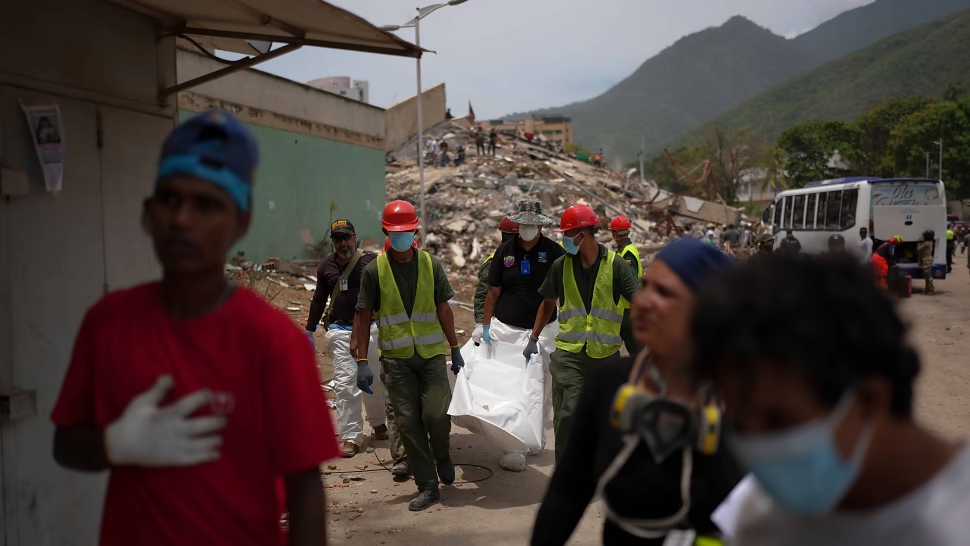
The earthquakes of June 24 in the Venezuelan state of La Guaira left at least 2,295 people dead and thousands remain missing. Hundreds of families seek to identify their loved ones among the bodies recovered from the rubble, before they are sent to mass graves.

Rosa López recounted how she found the body of her son-in-law, José Antonio Toledo, a security guard who died when the building where he worked collapsed. After visiting hospitals and a makeshift morgue, the family managed to identify him, but did not have the resources for a funeral service. The mayor’s office gave them a free space to bury him.

The authorities and forensic teams work tirelessly. Specialists estimate that between 60 and 70% of the victims are recognized by family members or neighbors, although the advanced state of decomposition makes the work difficult. Refrigerated containers have been installed due to the increase in bodies, and the opening of mass graves has not been ruled out.

The wait of families

Around the port of La Guaira and the temporary morgues, dozens of families line up for hours in the hope of identifying their relatives. They use tattoos, scars, clothing or shoes to confirm identity. Pain is mixed with uncertainty about the missing.

Rescuers estimate that recovery efforts could last at least three months due to the number of collapsed buildings. Thousands of volunteers have joined the search, in an effort to give families the chance to say goodbye and give them a last rest.

Continue reading