Aid cuts kill children in South Sudan as cholera spreads

Reduced humanitarian funding claims lives in South Sudan as clinics close and cholera rages.

The irony of dying to save

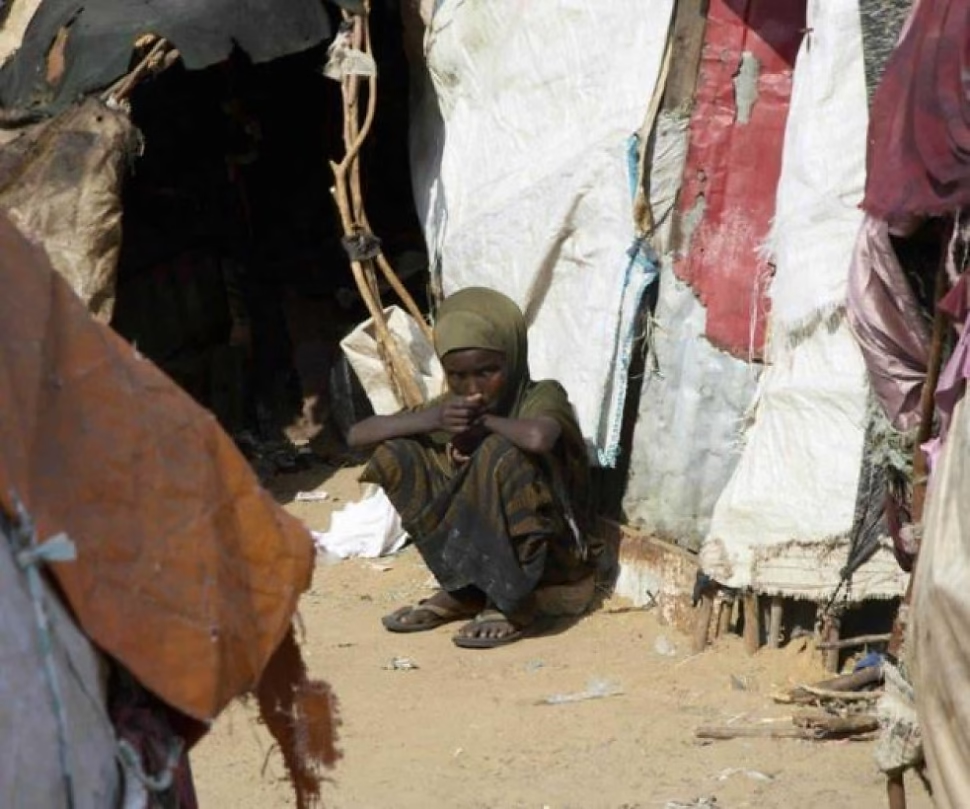
NAIROBI, Kenya — Because nothing says “budget efficiency” like letting five children die of cholera in South Sudan after aid cuts turned a simple doctor’s visit into an epic Lord of the Rings-style hike. Of course, without the fun part of the hobbits. The organization Save the Children reported on Wednesday that, in the state of Jonglei—a place so flood-prone that even fish call for help—seven health centers were closed. The remaining 20 are in the hands of heroic volunteers, but without resources to transport patients. Priorities? What is that?

When humanitarian aid becomes a survival game

This is the latest jewel in the crown of USAID, which decided that programs in countries plagued by conflict and drought were a dispensable expense. Chris Nyamandi, director of Save the Children in the region, summed it up elegantly: “There should be global outrage that decisions made in air-conditioned offices kill children within weeks.” But then again, who has time to be outraged when there are important meetings about…uh…cutting more funding?

RelatedChild marriage steals the childhood of more than 313 thousand minors

Meanwhile, at Akobo hospital – the only one still half-functioning – the medical director described the situation as “catastrophic.” And he hasn’t seen the electricity bill. The figures from the Ministry of Health are worthy of a horror movie: 46,716 cases of cholera and 871 deaths since October. But don’t worry, the World Food Program (WFP) has a solution: cut more. 7.7 million people on the verge of famine? What better time to adjust the budget!

As if that were not enough, the UN warned that South Sudan is one step away from another civil war. An armed group attacked a UN helicopter, the government responded with bombings, and the vice president is under house arrest. Come on, a normal Tuesday.

And don’t think that Somalia is saved. There, six million people face food insecurity, and the WFP reduced its assistance from 2.2 million people in 2024 to… 820,000. Progress! Of course, the US State Department admitted that some cuts were “by mistake.” Oops! Did anyone apologize? No, but there was surely a meeting to discuss it.

What can you do? Share this note and remind the world that humanitarian aid is not a luxury, it is a necessity. Or, if you prefer, keep scrolling through memes while millions suffer. You decide.
Lindsey Graham, Trump ally, dies at 71

Senator Lindsey Graham died at age 71 from an aortic dissection. Trump expressed his regret.

A loss in Congress

Republican Senator Lindsey Graham, a close ally of President Donald Trump, died Saturday night after a brief and sudden illness. He was 71 years old. His office confirmed the news in a statement posted on social media.

“The family appreciates the prayers and asks for privacy at this difficult time,” the text stated. No further details were immediately given.

Hours later, a second statement revealed the preliminary cause: an aortic dissection resulting from arteriosclerotic cardiovascular disease, according to the District of Columbia Medical Examiner. This is a rupture of the aorta due to hardening of the arteries.

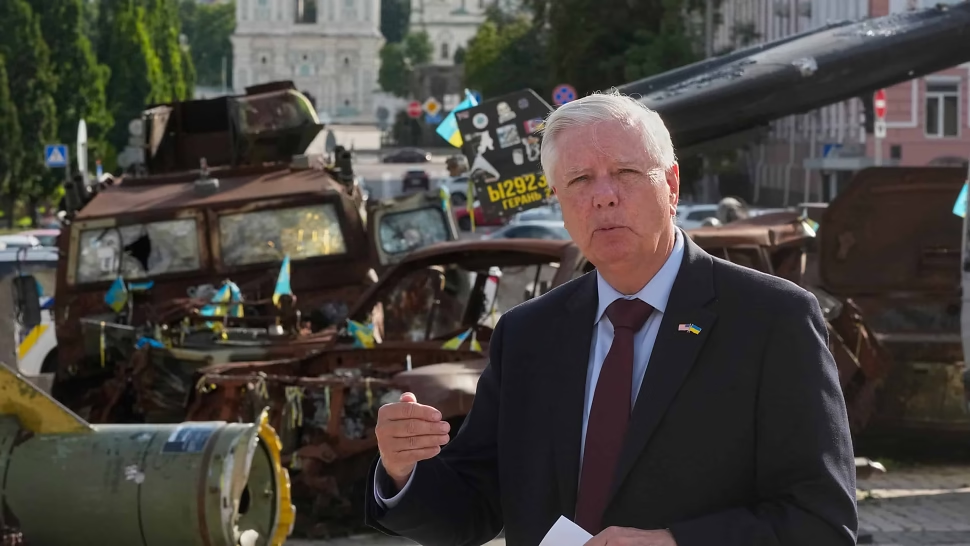
Trump, who spoke frequently with Graham, told NBC’s “Meet the Press” that the senator called him on Saturday after returning from a trip to Ukraine. “It sounded a little tired, but perfect,” he said. The president ordered flags to fly at half-mast until next Saturday.

Graham, a former Air Force attorney, served three decades in Congress. He was a foreign policy hawk and advised Trump on issues such as Iran and Russia. On Friday he had announced an agreement to advance sanctions against Russia. As chairman of the Senate Budget Committee, he was key in Trump’s second term, when Republicans pushed laws with a slim 53-47 majority in the House.

Continue reading

US bombs Iran in response to attack in Strait of Hormuz

Air retaliation after Iranian attack on a ship in the Strait of Hormuz.

New escalation in the Strait of Hormuz

The United States launched multiple airstrikes against Iran on Sunday, in response to an Iranian action against a container ship in the Strait of Hormuz. The initial attack set the boat on fire and left one crew member missing.

Tehran responded with offensives against Bahrain, Kuwait, Qatar, Jordan and Oman. The latter nation, located on the other side of the strait, faces Iranian pressure to cooperate in managing maritime traffic.

The US military said it seeks to “degrade” Iran’s ability to attack commercial ships that transit freely through the waterway. The statement came after a third round of attacks, which lasted until early Monday morning.

Iranian state media confirmed explosions at several points. The first American wave, on Sunday morning, was a direct retaliation for the Iranian attack on the container ship the day before. In response, Iran attacked Gulf Arab countries, intensifying a cycle of violence that jeopardizes negotiations between Tehran and Washington to end the conflict.

Military objectives and reactions

Hours later, the United States attacked again. The governor of the island of Qeshm, near the strait, reported fewer than a dozen shells fired at military targets, with no casualties, according to the state agency IRNA. Explosions were also heard in Bandar Abbas and Hajiabad.

A U.S. official, speaking on condition of anonymity, said some attacks targeted missile systems, air defense and vessels of the paramilitary Revolutionary Guard.

US Central Command said it hit about 140 targets, including missile and drone launch sites, ammunition depots and communications equipment.

Negotiations on the brink of collapse

Iran and the United States are almost halfway through the 60-day period of their interim agreement, designed to reach a definitive cessation of hostilities. The strait, a key route for global oil and gas supplies, has become a point of friction that threatens to break down talks.

“A return to large-scale hostilities would have catastrophic consequences,” said UN Secretary-General António Guterres, according to a statement.

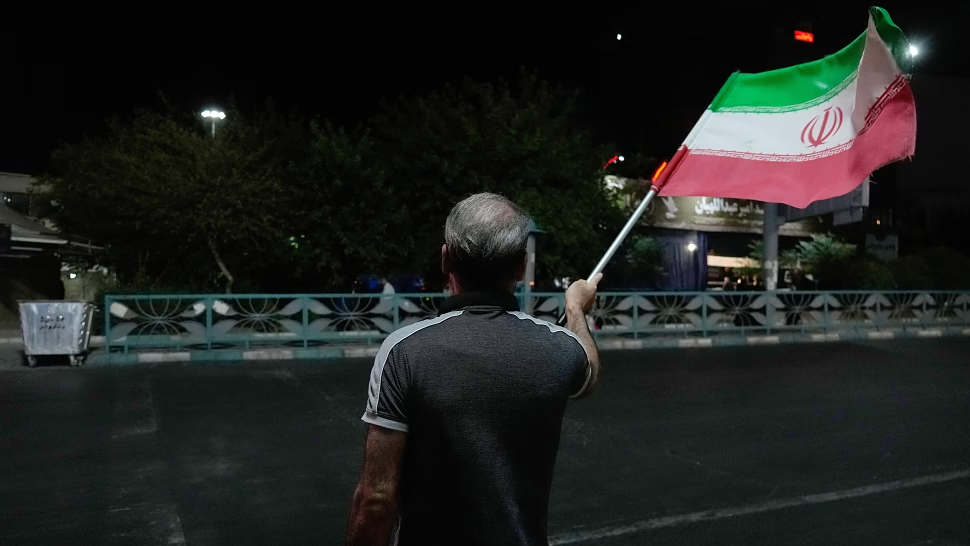
Iran maintains that the strait is closed; The United States denies it. The tension continues to increase.

Continue reading

Leo XIV warns about wars and calls for dialogue in his summer Angelus

Pope Leo XIV presided over his first summer Angelus and warned about conflicts in the Middle East and Ukraine.

Pope Leo XIV and his call for peace from Castel Gandolfo

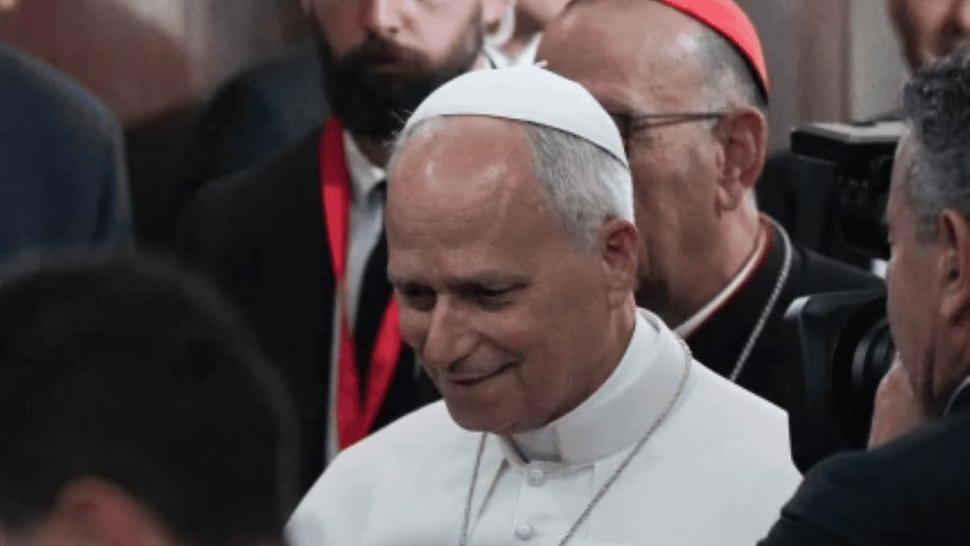
Pope Leo XIV presided this Sunday over his first summer Angelus from the Castel Gandolfo residence. Unlike the traditional popemobile, the pontiff toured the streets in a golf cart to greet the faithful and highlighted the place as a place to rest.

However, the summer season did not diminish his concern about global conflicts. During his reflection, the Pope expressed concern about the wars that affect various regions.

“Unfortunately, the winds of war are blowing again in the Middle East, in Ukraine and in many other parts of the world, sowing violence, terror and death, and once again hitting so many innocent people. Let us not allow these winds to extinguish the small flame of hope and peace,” he stated.

The Pontiff insisted that dialogue is the only way to a lasting solution.

“I renew my desire to persevere on the path of dialogue, encounter and diplomacy, the only path capable of leading to a just and lasting peace,” he said.

International peace summit in Castel Gandolfo

As part of Sea Sunday, Leo XIV also sent a message to maritime workers, affected by the remoteness and fear of conflicts on routes such as the Strait of Hormuz.

The promotion of peace will be the focus of a high-level summit to be held this week at the Borgo Laudato Si’. For three days, some 30 Nobel laureates, former heads of state and representatives from more than 30 universities will debate international security, governance of artificial intelligence, disarmament and economics for peace. Among the attendees are leaders from OpenAI, Google DeepMind, Aaru and Anthropic.

The opening of the meeting will be on Tuesday, July 14, with the participation of Cardinals Fabio Baggio, Silvano Maria Tomasi and Ángel Fernández Artime, as well as Nobel Prize winners Muhammad Yunus, Juan Manuel Santos and James Muller.

Although an intervention by the Pope has not been confirmed, the fact that the summit will be held in Castel Gandolfo and that the encyclical Magnifica Humanitas is the central theme generates expectations. Sources indicate that a possible announcement regarding his presence could be made this Monday.

Continue reading