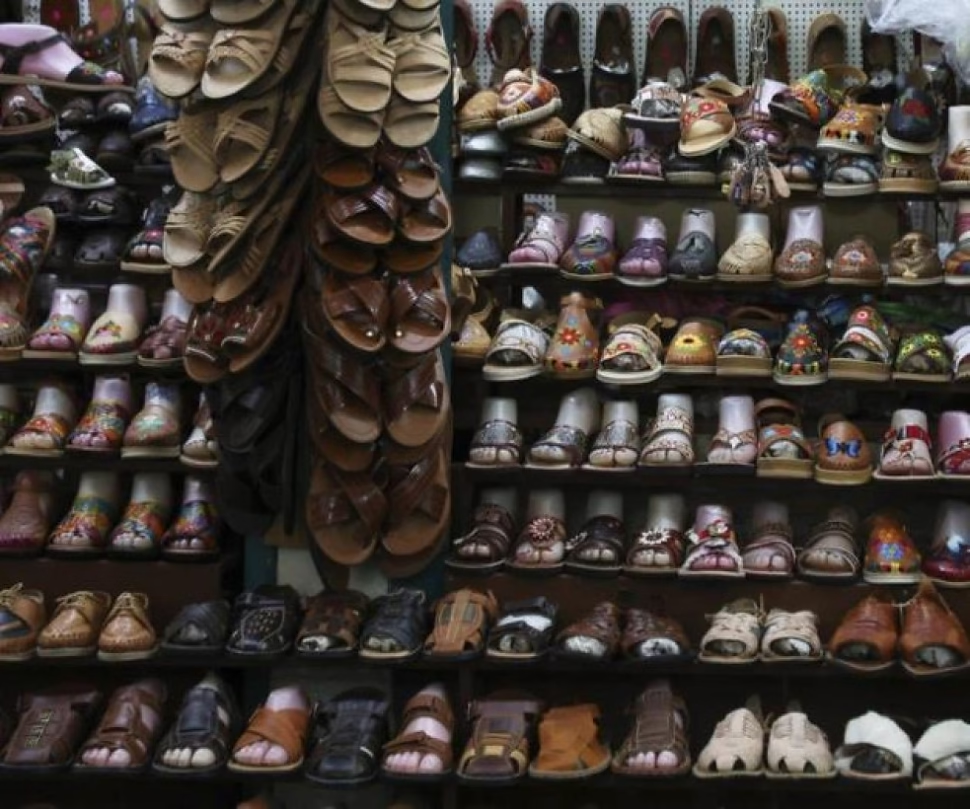
Adidas apologizes for controversy with Oaxacan huaraches

The sports brand faces criticism for cultural appropriation after launching a model inspired by traditional Zapotec footwear.

The controversy and its context

On Monday, August 11, 2025, Adidas issued a public statement addressed to Mexican and international opinion, acknowledging its mistake in using as inspiration the handmade huaraches of the Zapotec community of Villa Hidalgo de Yalálag, in Oaxaca, for its “Oaxaca Slip-On” model. This footwear, developed in collaboration with designer Willy Chavarría, combined traditional elements—such as leather braiding—with a sporty sole, generating accusations of cultural appropriation and lack of prior consultation with the original artisans.

Technical details and institutional reactions

The Oaxacan huaraches are pieces of intangible heritage, manufactured manually with techniques passed down for generations. According to intellectual property experts consulted, the case shows legal gaps: Mexico lacks robust mechanisms to protect ancestral designs against transnational companies. The Secretary of Culture of Oaxaca, Flavio Sosa, confirmed that three axes of reparation will be analyzed: economic compensation, guarantees of non-repetition and direct dialogue with the affected community.

RelatedControversy over Oaxacan huaraches in collaboration with Adidas

In parallel, the federal government announced a certification program for crafts, which includes training in copyright and fair marketing. This measure comes after a series of similar incidents, such as the cases of Carolina Herrera (2019) and Zara (2021), where international brands replicated indigenous textile patterns without authorization.

Global implications and lessons

The controversy transcends the commercial: it reflects tensions between globalization and cultural preservation. Analysts point out that, although Adidas acted under current legal parameters, its strategy ignored the symbolic value of footwear for the Zapotecs. The company, for its part, committed to reviewing its collaboration protocols with indigenous communities, a constant demand from organizations such as UNESCO and WIPO.

This case could set precedents in terms of collective rights, especially after the reform of article 232 of the Federal Copyright Law, which seeks to penalize plagiarism of traditional designs. Experts recommend corporations implement prior intercultural consultations and profit-sharing schemes.

Call to action

Are you interested in learning more about the protection of popular art? Share this analysis and explore our section dedicated to indigenous culture and rights. Together we can make these crucial debates visible for the future of creative diversity.
Sheinbaum receives the president of Switzerland and businessmen

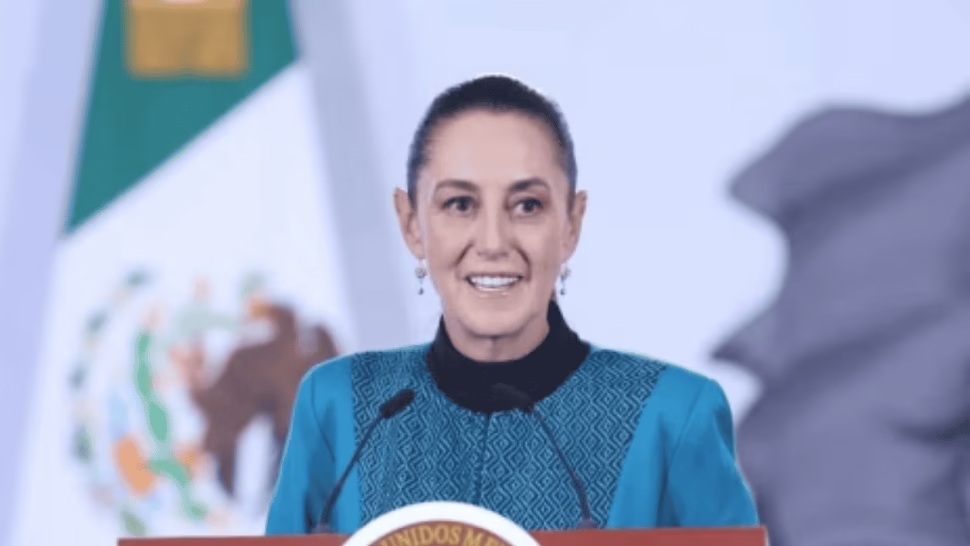
Sheinbaum will receive the Swiss president and businessmen this Wednesday at the National Palace.

Official visit of the Swiss president

President Claudia Sheinbaum reported that this Wednesday, July 8, she will receive the president of the Swiss Confederation, Guy Parmelin, at the National Palace, along with a delegation of businessmen. The objective: discuss and strengthen commercial ties between both countries.

“Tomorrow the president of Switzerland is coming, we are going to be here, we are going to receive him. And he comes later with a group of businessmen who we are also going to receive,” he explained during the morning conference on Tuesday, July 7.

A day before, Roberto Velasco, head of the Ministry of Foreign Affairs (SRE), received Parmelin and his wife, Caroline Merotto. Wednesday’s official agenda will be headed by Sheinbaum, who will also speak with the Swiss Minister of Economy.

This meeting is part of the Mexican government’s strategy to diversify its trade partners beyond North America. Switzerland is a relevant player in investment and technology, with companies such as Nestlé, Novartis and ABB with a presence in the country. The specific agreements that could be announced have not yet been detailed.

Continue reading

Sheinbaum requests investigation for air transfer to the United States

President Sheinbaum asks to investigate possible US deception in the transfer of alleged criminals.

Investigation for air transfer to the US

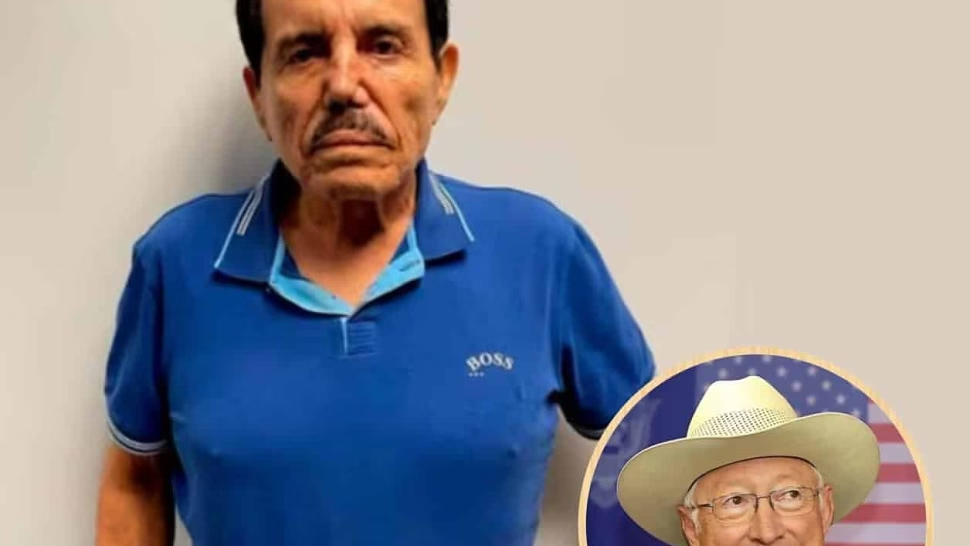
President Claudia Sheinbaum reported that she formally asked the Attorney General’s Office (FGR) to open a file to determine possible crimes in the air operation that took two alleged members of organized crime from Mexico to the United States on July 25, 2024.

The controversy resurfaced after the Federal Bureau of Investigation (FBI) publicly displayed the aircraft used, contradicting previous official versions.

Sheinbaum recalled that former President Andrés Manuel López Obrador repeatedly asked the US government to clarify whether its agencies participated in that arrest. The then ambassador Ken Salazar publicly denied it.

Doubts about the American version

Given the new evidence, the president questioned the veracity of United States diplomacy. He pointed out that everything indicates that the Mexican government was deliberately lied to, which would represent a violation of international treaties, the Constitution and an interference in national sovereignty.

It also left open the doubt about possible bilateral pacts outside of Mexican institutions, after the arrival in the United States of relatives of a member of the Sinaloa Cartel.

He emphasized that his administration does not and will not make agreements with organized crime. The Ministry of Foreign Affairs (SRE) will request direct reports from the FBI, while the FGR will announce the progress of the files initiated under the management of prosecutor Alejandro Gertz Manero.

Sheinbaum clarified that the government welcomes the arrest of criminals, but insisted that respect for sovereignty, mutual trust and cooperation without subordination must govern the bilateral relationship.

He assured that they will seek a coordinated dialogue for the well-being of both peoples, although this does not mean that Mexico will lower its head or accept falsehoods from a trading partner.

Continue reading

Sheinbaum: Toyota transfer does not respond to T-MEC

Toyota will move production from Tacoma to Texas gradually through 2030; Guanajuato plant continues operating.

President Claudia Sheinbaum responded this Tuesday to the President of the United States, Donald Trump, who attributed the transfer of a Toyota plant from Tijuana to Texas to his tariff policy. Sheinbaum read a statement from the Ministry of Economy and assured that the decision does not derive from the annual reviews of the T-MEC.

“It is not one of the annual reviews, President Trump himself attributes this decision to the tariffs or tariffs that he imposed on Mexico and other countries related to the automotive industry. What Toyota tells us is that it is part of its global review and we, therefore, guarantee employment and continue with investments,” he explained during the morning conference.

The president indicated that the federal government is holding talks with Toyota about the details of the transfer, seeking to protect the working conditions of Mexican workers. According to the report from the Ministry of Economy, the movement of production of the Tacoma truck from Baja California to the United States will not be immediate. It will begin a gradual process that will conclude in 2030.

Sheinbaum highlighted that Toyota will maintain the operation of its plant in Guanajuato, which generates 2,800 direct jobs and thousands indirect jobs. In addition, he announced that in the coming days a new automotive investment from another global firm will be announced, exceeding $500 million, as a result of efforts by his administration.

Continue reading