CJNG financial operator linked to process

The bank accounts of a CJNG boss did not go unnoticed by the UIF, which triggered his arrest and a federal judicial process.

Not All That Glitters is Gold: CJNG ‘Accountant’ Arrested

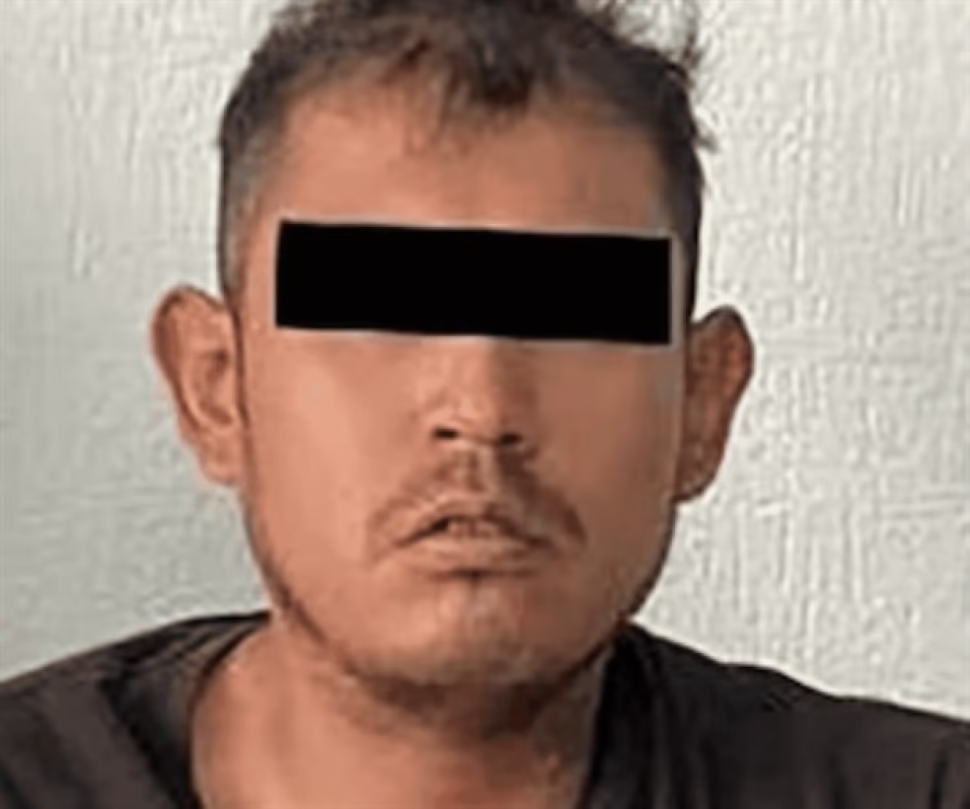
It seems that arrest season for drug lords is hotter than a trending topic on Twitter. The Attorney General’s Office (FGR), in a move that reminds us that the mathematics of crime never works out, has just scored something important. Óscar Antonio Álvarez González, alleged financial operator of the Jalisco Nueva Generación Cartel (CJNG), was linked to the process. Basically, they said “hold my beer” to his attempts to launder money and now he faces charges for organized crime and operations with resources of illicit origin. Their financing master plan fell apart faster than a house of cards on a windy day.

The story is so cinematic that it even has its own climax in an airport. A few days ago, the federal authorities, with an arrest warrant in hand and probably with the determination of an action hero, detained him upon arriving at the Mexico City International Airport (AICM). We do not know if he came on vacation or a “business meeting,” but his trip ended with a very different destination than what he had planned: jail. An unexpected twist that not even the best Netflix scriptwriter could have imagined.

RelatedJulión Álvarez conquers Reynosa with a historic concert

Dirty Money Does Not Go Unnoticed

All this drama began to simmer in August 2024. The Treasury’s Financial Intelligence Unit (UIF), those anonymous heroes who review account statements instead of memes, filed a complaint. The reason? They detected some unusual financial operations and a parade of companies linked to Álvarez González that smelled worse than a rotten fish. The suspicious transactions were the stitch that unraveled the entire skein, connecting him directly to a criminal organization. Because, let’s be honest, when millions are moving, it’s hard to go unnoticed, even if you think you’re the Walter White of finance.

The Public Ministry of the Federation (MPF) did not rest on its laurels. He gathered all the necessary evidence – the digital receipts of his misdeeds – and appeared before a Control Judge. The result was as forceful as a passive-aggressive comment at a family meeting: they linked the accused to the trial, they decreed his unofficial preventive detention (that is, without the right to bail, because the risk of escape was higher than the price of avocado) and gave the investigation four months to continue connecting the dots. A period that, surely, the prosecution will use to uncover more financial sewers.

This case is a reminder that the long arm of the law also knows numbers. While the cartels become more sophisticated, the financial and judicial authorities modernize at the same time. The fight against money laundering and organized crime is a daily battle that is fought both on the streets and in bank statements. The arrest of a drug trafficking treasurer like Álvarez González not only dismantles a key piece in the CJNG financing machinery, but also sends a clear message: no matter how much they try to hide it, illegal money always leaves a digital trail that is impossible to completely erase.

Do you think these actions really impact large criminal organizations? Share this note and tell us your opinion on your social networks. And if you are interested in the topic, explore more content on financial operations against drug trafficking on our site.
Sheinbaum calls for unity in the face of violations of the rights of Mexicans in the US.

President calls on parties and society to reject violations of the rights of fellow citizens.

Sheinbaum calls for national unity

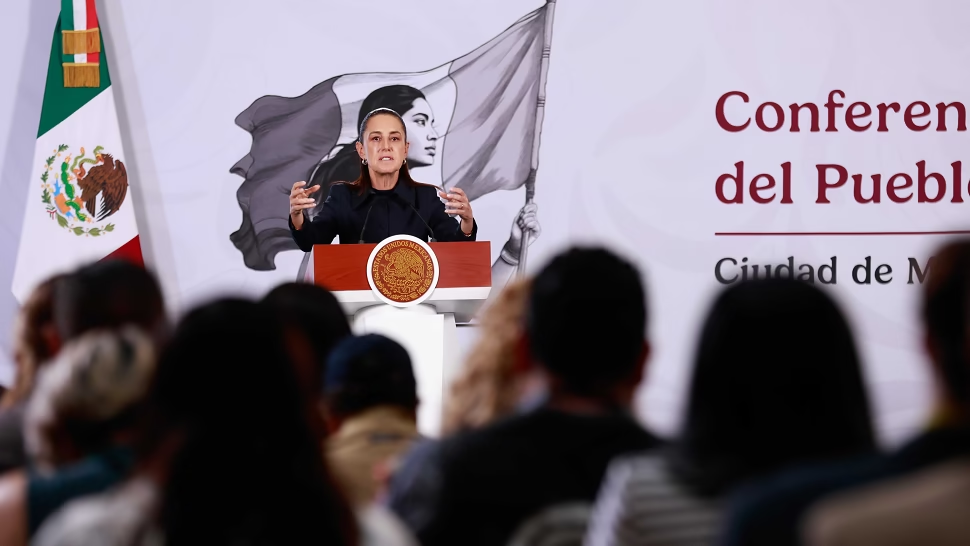
President Claudia Sheinbaum asked all political parties, Congress and Mexican society to join in rejecting the violations of the human rights of fellow citizens in the United States. He reported that this Monday the Ministry of Foreign Affairs (SRE) will present formal complaints for the death of 17 Mexicans linked to actions of the Immigration and Customs Enforcement Service (ICE).

“This is an issue not only for the Government of Mexico… I call on all political parties, everyone, the entire society… to be in solidarity with our fellow citizens in the United States. I don’t think anyone would like this situation,” he declared at the morning conference.

The president also reported contact with the US ambassador Ronald D. Johnson, who was receptive to the Mexican position. Foreign Minister Roberto Velasco Álvarez communicated the legal actions to be taken and Johnson perceived the concern of the Government of Mexico.

Sheinbaum clarified that a bilateral conflict is not sought, but maintained that it is necessary to raise our voice in the face of human rights violations. He called on the Permanent Commission of the Congress of the Union so that all parties, without exception, present requests for information and show their rejection.

Continue reading

Historic investment of 59 thousand million pesos in schools by 2026

The federal government will invest 59 thousand million pesos in schools, benefiting 71 thousand schools.

President Claudia Sheinbaum announced a historic investment of nearly 59 billion pesos for educational infrastructure in 2026. The resources will be channeled through the School is Ours (LEEN) program and the Multiple Contributions Fund (FAM).

“Historical investment of 59 billion pesos for schools in the country, without considering what the federal entities invest directly,” he pointed out in the morning conference.

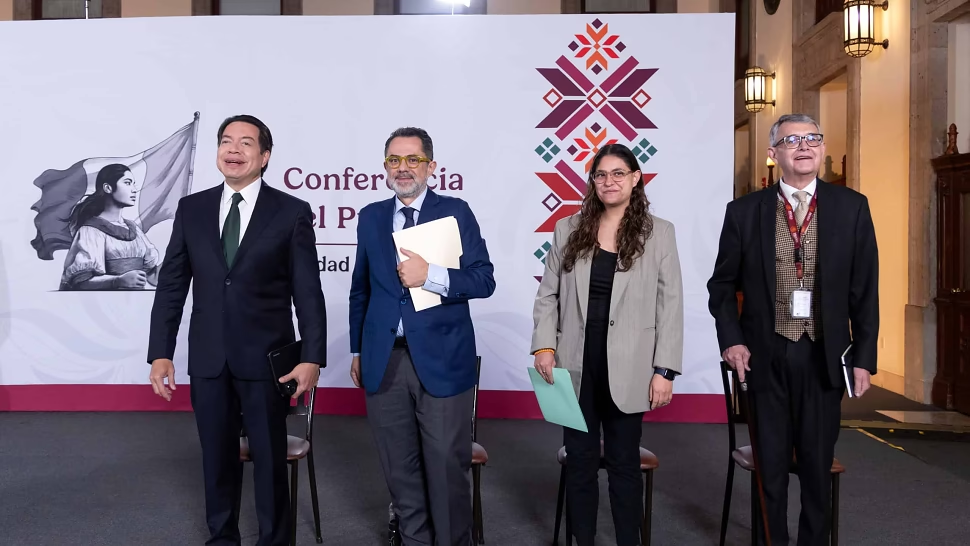
The Secretary of Education, Mario Delgado, detailed the distribution: 37,715 million pesos for basic education (15,021 million pesos direct and 22,694 million pesos from LEEN); 10,916.4 million pesos for upper secondary education, which includes the creation of 156,240 new places through new National Baccalaureates; and 9,783.9 million pesos for higher education in schools such as the Rosario Castellanos University and TecNM.

In addition, the year closes with 22 million scholarship recipients at all educational levels, according to the official.

The School is Ours reaches more than 71 thousand schools

The general director of LEEN, Pamela López, reported that this year 71,482 schools were served with a social investment of 22,694 million pesos. Resources are allocated according to vulnerability, marginalization and social backwardness. The program covers from Multiple Care Centers to high schools, with full coverage in middle and high schools.

“All these achievements have been possible thanks to the participation of mothers, fathers, teachers, who make up the school communities,” said López.

Continue reading

Mexico sends 388 tons of aid to Venezuela after earthquakes

Semar vessels complete eight-day journey with supplies and water treatment plants.

Humanitarian aid from Mexico to Venezuela

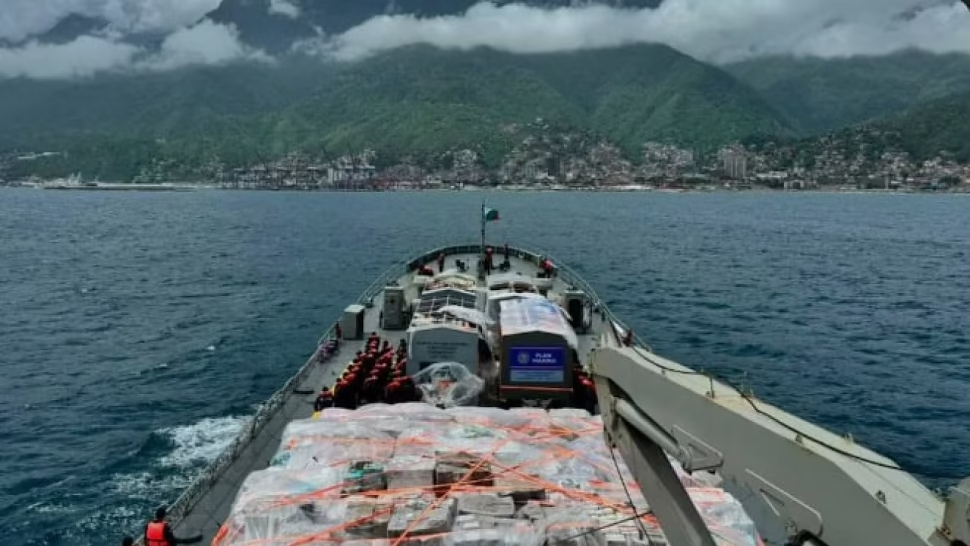
The logistical support vessels ARM Isla Holbox and ARM Huasteco docked at the port of La Guaira, Venezuela. They carry assistance sent by the Mexican government for the victims of the June 24 earthquakes. The phenomenon left thousands of people dead and injured.

The Secretary of the Navy (Semar) reported that the mission was ordered by President Claudia Sheinbaum. It is part of Mexico’s commitment to international cooperation in the face of natural disasters.

What does the cargo include?

The boats sailed eight days through the Caribbean. They transported 388.4 tons of aid: food, bottled water, medicines, personal hygiene items and medical supplies. They also have four water treatment plants, each capable of generating a thousand liters of purified water per hour. The journey covered 1,969 nautical miles, equivalent to more than 3,600 kilometers.

Naval participation

One hundred elements of the Navy Emergency Response Brigades will participate in the disembarkation, installation and operation of the water treatment plants. They will also collaborate in the distribution of support together with local authorities.

Semar highlighted that the immediate emergency has already been overcome, but recovery actions continue to restore essential services in the affected communities. The operation was possible thanks to the coordination between the government, companies, foundations and civil organizations. Mexico thus reaffirms its policy of international solidarity in the face of disasters.

Continue reading