Artificial intelligence, virtual reality and other emerging technologies are gaining ground in UNAM classrooms. Teachers from various faculties and institutes incorporate these digital tools to support teaching-learning processes and respond to new forms of student interaction.
Emerging technologies in university education
Gustavo de la Cruz Martínez, professor at the Faculty of Sciences and the Master’s Degree in Computer Science and Engineering, considers that these technologies represent an opportunity to rethink teaching practice. Also an academic technician at the Institute of Applied Sciences and Technology (ICAT), he uses virtual reality, augmented reality and generative artificial intelligence in his classes to create immersive experiences.
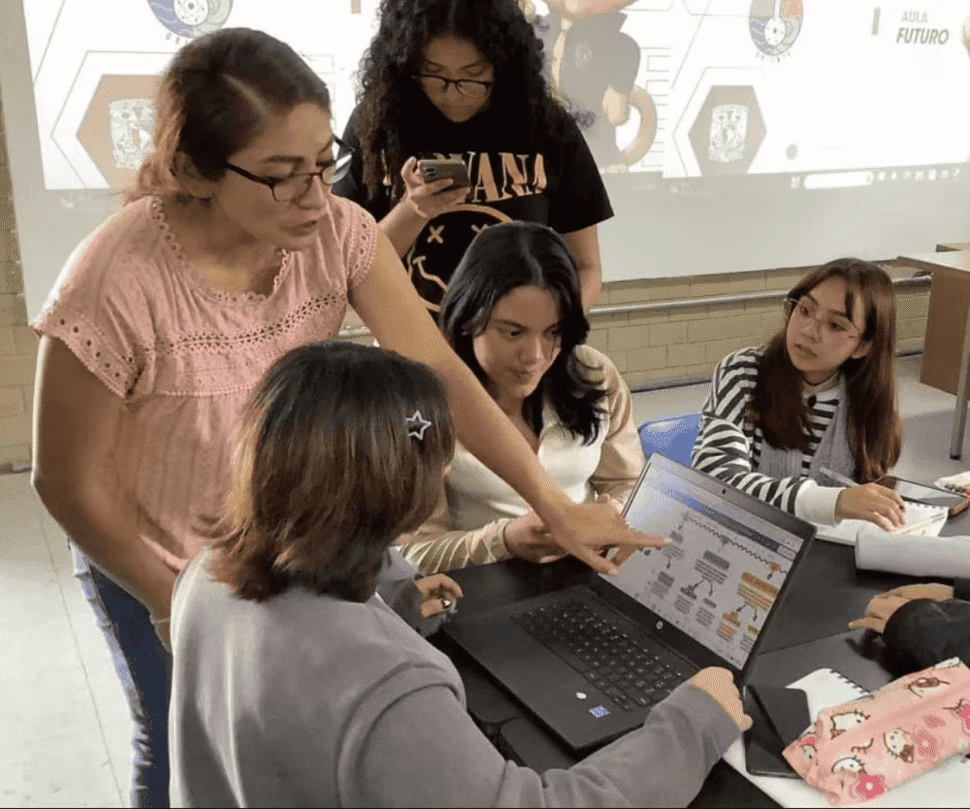
De la Cruz is part of the Classroom of the Future project, developed by ICAT. It is currently installed in eight high school campuses, five faculties, three institutes and a UNAM library. The initiative transforms traditional educational spaces into flexible environments that encourage interaction and collaboration.
“The objective is not for technology to be the center of the educational process, but rather a tool to generate teaching-learning situations oriented by clear pedagogical goals,” explained the specialist, who stressed the ethical, critical and reflective use of these resources.
The academic pointed out that, while students move away from pencil and paper and show greater familiarity with mobile devices, some teachers still resist incorporating artificial intelligence into their activities.
Sinuhé Jurado Pulido, professor at the Faculty of Dentistry, has specialized for more than a decade in technologies applied to teaching. It states that AI allows us to design teaching sequences, streamline information searches and optimize preparation times. However, he warns that these tools should support learning, not replace the creative and training process.
In Dentistry, practical evaluations are already applied with simulators that allow students to solve clinical problems similar to those in their professional practice.
Ana Eloísa Heredia García, professor at the Faculty of Law, maintains that to connect with the new generations it is essential that teachers know and use information technologies, legal databases and artificial intelligence. It proposes guiding students on its responsible use and teaching them to verify information with original sources.
Heredia García suggests expanding teacher training in resources such as videos, virtual reality glasses and digital platforms, to strengthen teaching and make academic activities more attractive.
Specialists agree that the incorporation of emerging technologies must be accompanied by clear pedagogical criteria and continuous training of teachers.