UN speaks out after the wave of violence due to the death of ‘El Mencho’

The UN expresses solidarity with Mexico after a violent day of blockades and clashes that left dozens dead.

The UN extends its hand to Mexico in the midst of chaos

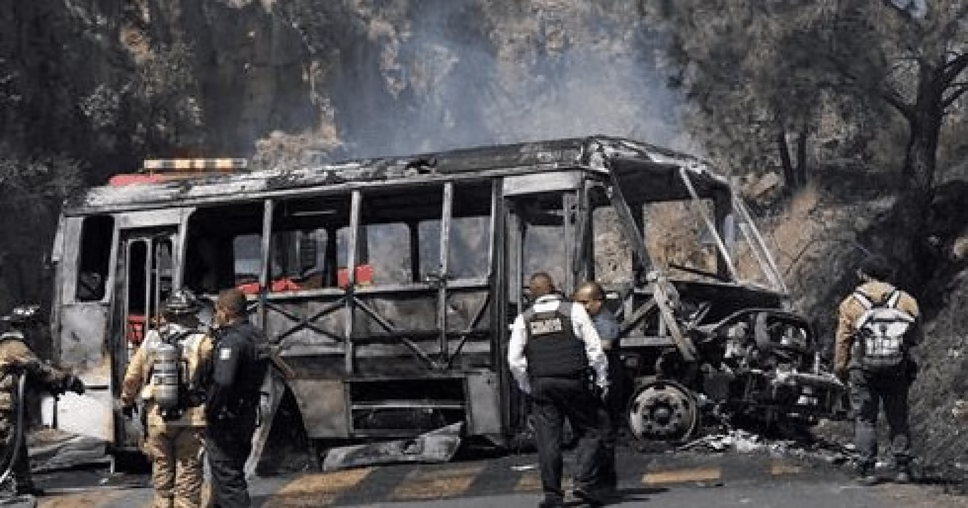
The United Nations Organization has just broken its silence. After the complex and bloody day on Sunday, unleashed by the death of the criminal leader Nemesio Oseguera Cervantes, ‘El Mencho’, the UN in Mexico expressed its solidarity.

They are not empty words. The international organization expressed its condolences for the lives lost, both civilians and agents who fell “in the line of duty.” It is a direct recognition of the human cost of this war.

“We reiterate our willingness to continue accompanying the Government of Mexico in its efforts to strengthen security and confront organized crime in accordance with the rule of law,”

the statement added. It is an offer of support, but also a subtle reminder: the answer must be within the legal framework.

RelatedMexican Foreign Minister represents Mexico in the UN General Assembly

The figures behind the drama

And how big was the explosion? The authorities have the numbers. The Security Cabinet reported 252 blockades in 20 states. A coordinated and terrifying show of force.

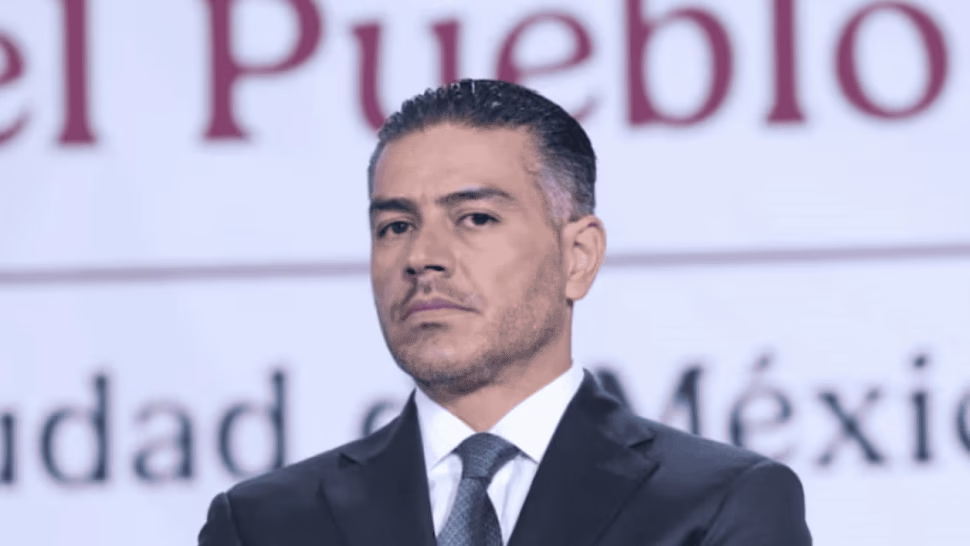
But the real drama is in the final balance. Secretary Omar García Harfuch detailed it: 62 deaths in total after the attacks ordered by the cartel.

In Jalisco alone, the epicenter, there were six attacks. 25 members of the National Guard, a guard, a prosecutor and an innocent woman fell there. 30 suspected criminals also died. In Michoacán, the balance was four criminals killed and 15 officers injured.

These are numbers that paint a war movie scenario, but they occurred on our roads and cities. Each figure is a destroyed family, a hole that is not filled with speeches.

The UN puts an international focus on this. It is no longer just an internal problem; It is an issue that draws the world’s attention. The question now is what comes next after the official report and condolences.
Sinaloa: 2,540 detainees and record of drug seizures

2,540 detainees and 94 tons of drugs seized in Sinaloa since October.

Operation in Sinaloa: figures and results

The Secretary of Security, Omar García Harfuch, reported that since October 2024, 2,540 people have been arrested for high-impact crimes in Sinaloa. 94,526 kilograms of drugs were also seized. There are 16,440 federal elements deployed in the entity.

The report was presented after the capture of Ismael “El Mayo” Zambada, which unleashed violence between organized crime factions. García Harfuch pointed out that the priority is “to protect the population and combat impunity.”

He highlighted that in three actions, 90 criminals who operated from prisons surrendered. Operations were intensified to dismantle criminal cells and secure weapons and clandestine laboratories.

Increase and reduction in homicides

After the arrest of “El Mayo”, intentional homicides increased 232% in September 2024. In December the Sinaloa Plan was implemented, and by June 2025 the average daily number of victims decreased 44%.

Among the relevant detainees are Juan Carlos “N”, financial operator; José Manuel “N”, linked to homicides and drug trafficking; and Daniel Alfredo “N”, wanted by the US. Iván “N”, head of a faction linked to the Beltrán Leyva, with seven accomplices, fell in Badiraguato.

More than 94 tons of drugs were seized, including 2 million fentanyl pills, 5,900 firearms and one million cartridges. In addition, 2,412 methamphetamine laboratories were dismantled.

Last Saturday, naval elements were attacked with improvised explosive devices. One deceased and three injured. In response, 10 attackers died and two were arrested, one of them Colombian.

García Harfuch assured that the security cabinet will maintain the deployment to reduce violence and combat impunity.

Continue reading

Death of woman in Saltillo investigated as feminicide

41-year-old woman deprived of life; Your partner is accused of being responsible.

Femicide in Saltillo: couple as main suspect

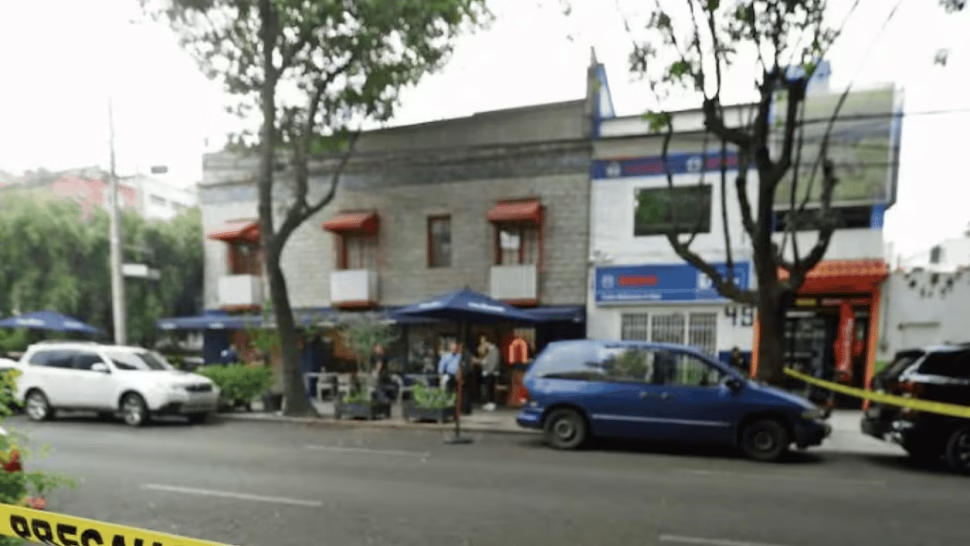
A 41-year-old woman was deprived of her life inside her home in the Santa Bárbara neighborhood, Saltillo. The Coahuila Prosecutor’s Office is investigating the case as a possible femicide. According to the information card, the main line of investigation points to his romantic partner, who is a fugitive and would be from another state.

Elements of the Criminal Investigation Agency (AIC) became aware of the incident on Monday afternoon. The body was found by the victim’s son. Red Cross paramedics came, but he no longer showed signs of life. Injuries consistent with asphyxiation were reported.

The Prosecutor’s Office deployed an operation to locate the probable person responsible. The authorities reiterated their commitment to zero tolerance for gender violence. The case has generated concern in the community of Saltillo, where preventive actions have been reinforced.

The investigation continues to clarify the facts and guarantee justice.

Continue reading

El Mayo Zambada asks for mercy for his health and cooperation

The former leader of the Sinaloa Cartel faces 17 charges and requests a federal medical center.

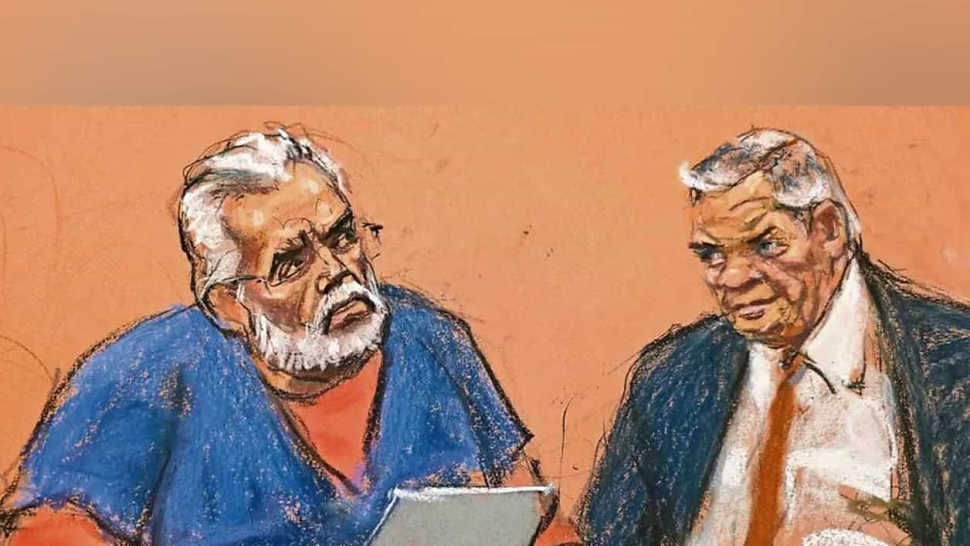
Ismael El Mayo Zambada, former leader of the Sinaloa Cartel, asked Judge Brian M. Cogan to consider his delicate state of health and his full cooperation when handing down his sentence on July 20.

His lawyer, Frank Pérez, filed a document in the court of the Eastern District of New York. He stressed that Zambada accepted his responsibility since his arrival in the United States two years ago, after being kidnapped.

Advanced age and medical problems

At 76 years old, the defendant suffers from complex and progressive medical conditions. He knows that the seriousness of the 17 charges—drug trafficking and homicide—will prevent him from walking free. That is why he requested to be confined in a Federal Bureau of Prisons Medical Center, such as Butner, Rochester or Springfield, suitable for his needs.

The defense noted that by pleading guilty and avoiding a trial, Zambada saved judicial resources and avoided security risks. The document also included details of his history: the death of his father cut short his studies and he began dealing marijuana at the age of 19 in his hometown.

Continue reading