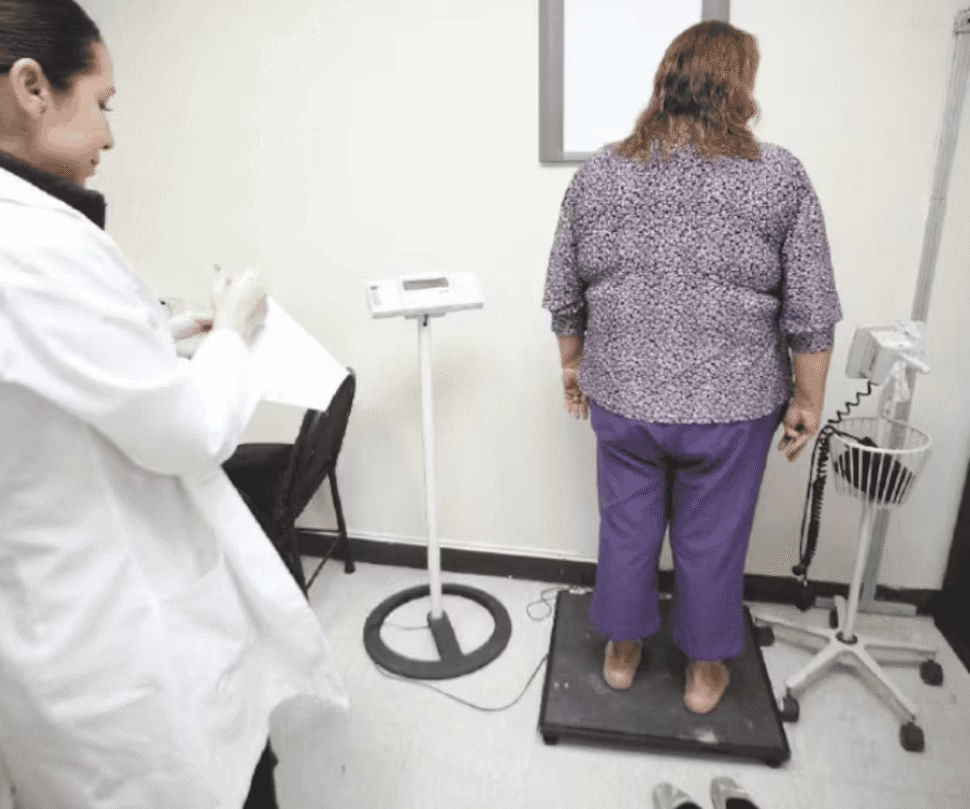
Ultra-processed foods: risk for the brain and health

UV study links industrialized diet, obesity and stress with increased risk of cancer and dementia.

A set of scientific research developed for more than a decade by the Universidad Veracruzana (UV) has revealed that the consumption of ultra-processed foods, obesity and stress act together, profoundly altering the balance of the body and increasing the risk of diseases such as cancer and dementia.

In Mexico, around 195,000 new cancer diagnoses are registered each year, while dementia affects approximately 14.2 percent of older adults.

RelatedBruce Willis maintains good physical health despite his dementia

Research findings

Researcher Deissy Herrera Covarrubias, from the UV Brain Research Institute, has led nine studies that explore the relationship between diet, stress, sexual behavior and prostate and cognitive health.

“We seek to understand what happens in the body when a person maintains a diet high in sugars and fats for years; how this type of diet modifies brain function, alters hormones, changes eating behavior, motivation and sexual behavior,” he explained.

The work began in 2015 with the research “Obesity as a risk factor in the development of cancer.” Since then, they found that body fat not only stores energy, but produces hormones and chemicals that influence the immune system and inflammation.

Eating fried foods, pastries, soft drinks, fast food, sausages and industrialized snacks not only affects weight, but also brain function. Evidence suggests that these diets increase vulnerability to neurodegenerative diseases such as Alzheimer’s.

“Science does not work as a single experiment. Each finding generates many more questions than answers,” said Herrera, a member of the National System of Researchers.

One of the most recent studies, “Ultra-processed diet and risk of cognitive decline” (2026), warns that the effects go beyond cardiovascular risk. Another work, “Stress, diet and sexual behavior” (2025), found that intense stress in early stages can leave lasting effects and increase vulnerability to cancer.

The specialist emphasized that basic research requires time to understand complex processes. These findings could contribute to developing preventive strategies based on nutrition and stress regulation.

“The human body is extraordinarily complex; we try to understand why something happens and what the long-term consequences are,” he concluded.


Immigration litigation strains Mexico-US relationship

Specialists warn that complaints against detention centers could generate consequences for fellow citizens.

Implications of immigration litigation

The initiation of legal and civil actions against migrant detention centers in the United States could strain the bilateral relationship. Specialists warn that these complaints have little chance of success and could trigger adverse measures against fellow citizens.

Internationalist Arlene Ramírez Uresti pointed out that turning to the Department of Justice or filing civil complaints faces an unfavorable political and legal scenario. As an alternative, he proposed going to the Inter-American Court of Human Rights. However, he acknowledged that Mexico has pending issues in caring for migrants and complying with international commitments.

Promoting litigation in a restrictive political context towards migration could be counterproductive. Ramírez Uresti affirmed that confrontation with the US government would limit the ability to negotiate and would cause consequences for Mexicans in that country.

UNAM political scientist Sebastián Godínez Rivera agreed that the legal strategy lacks solid technical elements. He warned that, faced with a government like that of Donald Trump, these actions could strengthen arguments to adopt measures against Mexico.

Both experts agree that the current legal path offers few guarantees. The bilateral relationship thus faces a new front of tension in immigration matters.

Continue reading

Rocha Moya assures that she remains at her home in Culiacán

Governor on leave affirms that he has been at home for 69 days since he was designated by the US.

The licensed governor of Sinaloa, Rubén Rocha Moya, stated that since May 1 he has remained at his home in Culiacán. This occurs after the United States filed accusations against him for drug trafficking.

Through her X account, Rocha Moya indicated that this Thursday, July 9, marks 69 days since she requested leave to leave office. “I did it from my conviction as a Mexican who trusts in the institutions and laws of our country,” he wrote.

“With the aim that, without the protection of the constitutional jurisdiction inherent to my position, I be investigated fully and without any restrictions by the competent authorities,” he added.

The former state president seeks for the investigations to advance without legal obstacles. Until now, there is no information about the status of the investigations against him.

Continue reading

Four National Guard agents are linked to trial for express kidnapping

Four National Guard agents were linked to proceedings for express kidnapping at the Ciudad Juárez airport.

Four elements of the National Guard were linked to proceedings for the crime of express kidnapping, after being detained at the Abraham González airport in Ciudad Juárez, Chihuahua.

The facts

The agents identified asFernando P.R., Horacio De la C.S., Alfredo G.C. and Jesús Gerardo R.A.face charges for having demanded money from at least five people. According to the bonding hearing, the victims presented evidence that the defendants were holding them to deposit resources in the bank accounts of the elements themselves.

Judge Haydee of Santiago Wong Edges determined that the defendants remain in preventive detention for an investigation period of three months.

Reaction of the governor

The governor of Chihuahua, María Eugenia Campos Galván, celebrated the judicial resolution and the action of the corporation itself in filing the complaint.

“I am very pleased that there has been a complaint by the National Guard. It would be important that at all levels and levels of government our security forces behave in accordance with the law and do the job of serving the population,” declared Campos Galván.

The case highlights the internal purge efforts in the federal forces, although doubts persist about the magnitude of irregular conduct within the corporation.

Continue reading