From an attempt to enforce the law to absolute chaos: the Trump version of the government shutdown
WASHINGTON.- The partial shutdown of the federal administration, which is already the second longest in history and has no immediate solution in sight, has quickly metamorphosed into President Donald Trump’s new favorite toy to exert unprecedented control over the state apparatus. Basically, it’s like you were given a country remote control and decided to press all the buttons at once, just to see what happens. And believe me, everything is happening.
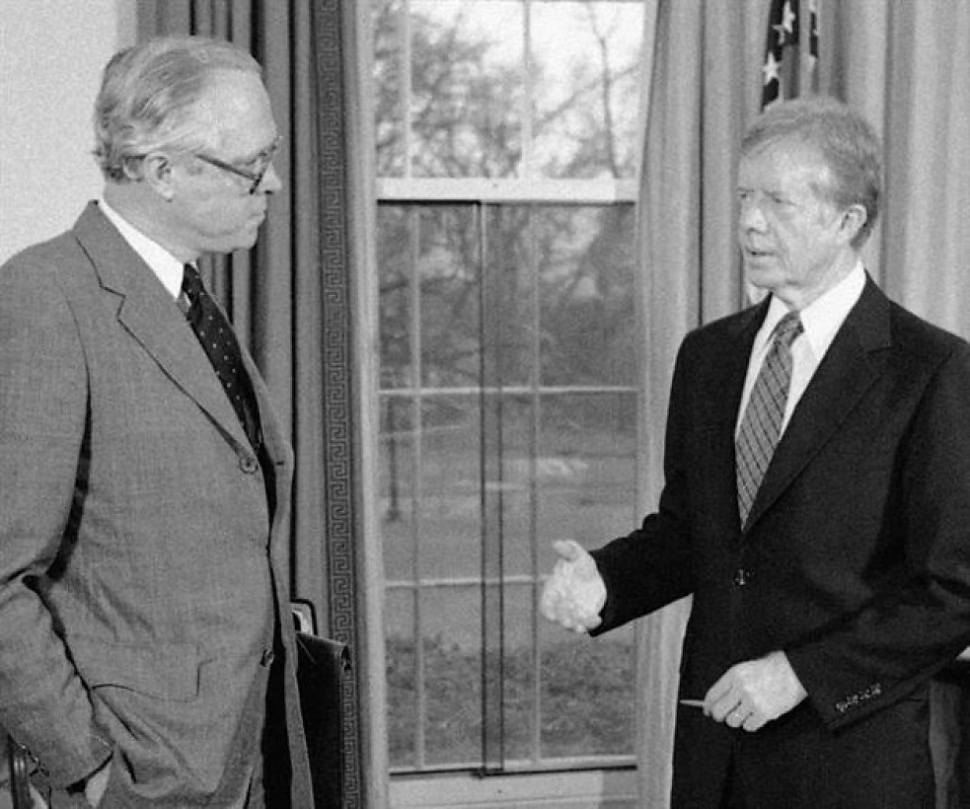
But it wasn’t always this political reality show. In an ironic twist worthy of a flashback in a series, this all began in 1980 with a well-intentioned (how naive) attempt to strengthen compliance with federal legislation. The modern phenomenon of government shutdown was born from a series of legal opinions by Attorney General Benjamin Civiletti, who served under former Democratic President Jimmy Carter. Civiletti, in an “I’m just doing my job” moment, rescued the Antideficiency Act of 1870 to argue that the regulation was “clear and unambiguous” in restricting public spending once congressional authorization expired. Without knowing it, this man was creating the monster that today delights and terrifies us in equal measure.
However, in the current shutdown, the Republican president has used the lack of funds as a weapon to punish Democrats, has attempted to fire thousands of federal employees, and has taken advantage of the power vacuum left by Congress to reconfigure the federal budget at will, as if it were his personal Spotify playlist. “I can’t believe the radical left Democrats gave me this unprecedented opportunity,” Trump posted on his social media platform at the start of the strike, with the euphoria of someone who has just found a cheat code in a video game. Democrats, for their part, have clung to their positions with the stubbornness of someone who refuses to update their operating system. This whole circus makes this fight much more difficult to resolve and could forever redefine the way Washington handles these funding interruptions.
Why do closures exist? A story that nobody asked for
In the years after the Watergate scandal, Civiletti’s tenure at the Justice Department was defined by an effort to restore public trust in Washington, sometimes with narrow interpretations of federal law. Spoiler alert: it didn’t turn out as expected. When a conflict between Congress and the Federal Trade Commission led to a delay in funding legislation for the agency, Civiletti issued his opinion, later followed by another allowing the government to perform essential services. The official was unaware that this would lay the groundwork for some of the most defining political battles to come. “I never could have imagined that these closures would last so long and that they would be used as a political tactic,” he confessed to the Washington Post six years ago. Civiletti passed away in 2022, perhaps fortunately not to see what his legacy became.
The evolution of closures: from Gingrich to our current drama
For the next 15 years, there were no prolonged government shutdowns. But in 1994, Republicans retook Congress, led by House Speaker Newt Gingrich, and promised to reform Washington. His most notable clashes with Democratic President Bill Clinton revolved around government shutdowns. Most historians agree that the shutdowns did not work, and Clinton was able to win re-election in part by showing that she stood up to Gingrich. “Republicans in the Gingrich era have some limited political victories, but for them overall it’s really a failure,” said Mike Davis, associate professor of history at Lees-McRae College. Basically, they learned their lesson… or so we thought.
There was one more significant shutdown in 2013, when Tea Party Republicans clashed with Democratic President Barack Obama. But it wasn’t until Trump’s first term that Democrats adopted the tactic of prolonged government shutdowns. And here we are, in the most dramatic season of this franchise, where the rules seem to have been thrown out the window.
How is this closure different? Spoiler: in everything
During previous funding disruptions, presidential administrations applied the rules governing shutdowns equally among affected agencies. “A shutdown was supposed to shut down the same things under Reagan as it did under Clinton,” explained Charles Tiefer, former acting general counsel of the House of Representatives and professor emeritus at the University of Baltimore School of Law. He stated that, in this shutdown, the Trump administration has used “a kind of unbridled presidential appropriation power, which is contrary to the entire system, the original Constitution and the Anti-Deficiency Act.” In other words, he skipped the instruction manual and is improvising.
The administration has incorporated a clearly political approach into the fight over funding, where agencies have updated their websites to include statements blaming Democrats for the shutdown, as if it were an Instagram story war. The Department of Defense tapped into research and development funds to pay active-duty service members. Trump has attempted to initiate layoffs for more than 4,000 federal employees who mostly work in areas perceived as Democratic priorities. This week, during a White House lunch with Republican senators, Trump introduced his budget director Russ Vought as “Darth Vader” and boasted about how he is “cutting Democratic priorities that they’re never going to get back.” Because, clearly, what this situation was missing was a touch of Star Wars.
Democrats have been emboldened by the strategy and have repeatedly voted against a Republican-backed bill to reopen the government. They argue that voters will ultimately hold Republicans responsible for the pain of the shutdown because their party has power in Washington. Virginia Democratic Senator Tim Kaine acknowledged that his state has more to lose perhaps than any other due to the large number of federal employees and activities based in that state. But he argued that his constituents are fed up with an “endless parade of punishments” by Trump, which has included firings, defunding economic development projects, lobbying campaigns against universities and the firing of Virginia’s U.S. attorney. “This makes people react,” Kaine said. And no, not in a good way.
Democratic resolve will be tested next week. Federal employees, including lawmakers’ own staff, have already gone nearly an entire month without full paychecks. The Supplemental Nutrition Assistance Program (SNAP), which helps about one in eight Americans afford food, faces a potential funding cliff on November 1. Delays in air travel