Trump calls damage to Iranian nuclear facilities monumental

The former US president assures that the attacks caused irreparable havoc, while experts warn of radioactive risks.

Impact of the bombings on Iranian nuclear facilities

The former president of the United States, Donald Trump, declared this Sunday that the air strikes carried out by US forces against nuclear complexes in Iran caused “monumental” damage. This statement contrasts with the warnings of his own advisors, who pointed out that it is premature to quantify the real impact.

Through a message on his Truth Social platform, Trump praised the precision of the military operations: “The impacts were hard and exact. Our military demonstrated great skill.” In addition, he used the slogan “MIGA” (Make Iran Great Again), hinting at his support for a change of government in Tehran.

RelatedIAEA loses verification of Iranian uranium after attacks

Contradictory assessments and global risks

While the Secretary of Defense, Pete Hegseth, stated that the Iranian nuclear program was “devastated”, General Dan Caine, chairman of the Joint Chiefs of Staff, clarified that the definitive analysis will require more time. According to preliminary reports, three strategic locations suffered severe destruction.

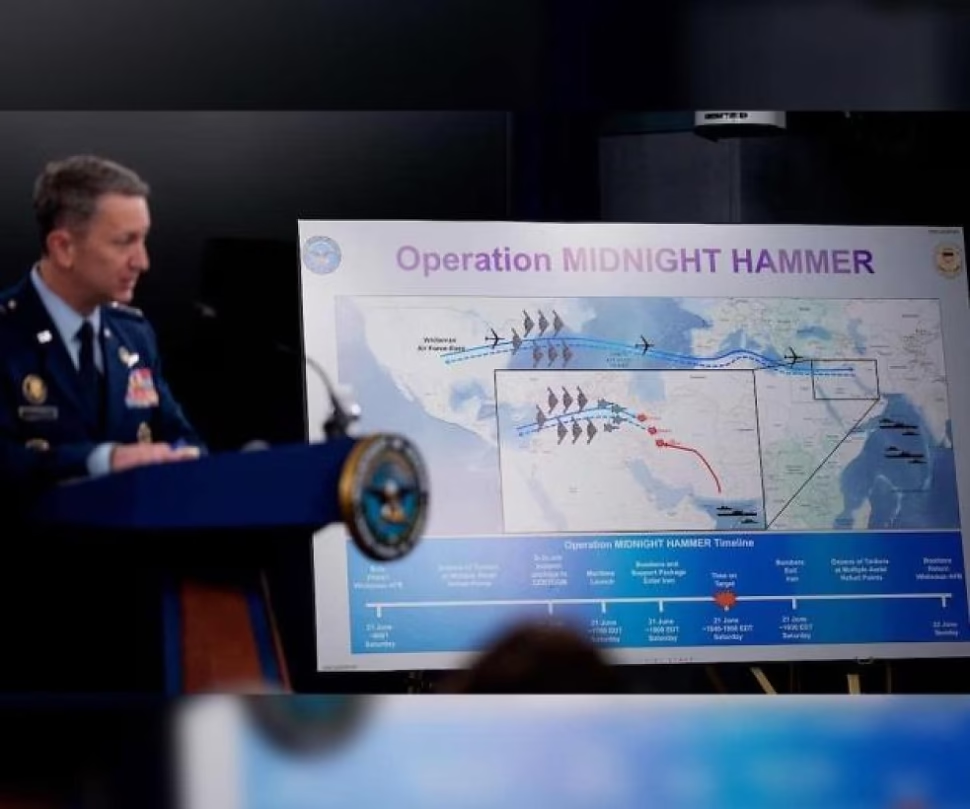
Operation “Midnight Hammer” involved seven B-2 stealth bombers, which completed an 18-hour mission without being detected by Iranian defense systems. This technical detail underlines the sophistication of the attack.

In parallel, the director general of the International Atomic Energy Agency (IAEA), Rafael Grossi, warned the UN Security Council about the impossibility of verifying damage to underground facilities such as Fordow, key to uranium enrichment. Grossi emphasized: “Attacks on nuclear sites can trigger radioactive leaks with catastrophic consequences.”.

Geopolitical implications and reactions

The conflict escalated after Iran’s request for an urgent meeting at the UN, where it accused the US of violating international law. Global security experts warn that these events could reconfigure the balance of power in the Middle East and affect negotiations on arms control.

Analysts agree that, beyond the rhetoric, the inability to assess damage to nuclear reactors represents an unprecedented environmental risk. The scientific community urges an independent inspection to rule out radiological contamination.

Are you interested in geopolitics and its technological effects? Share this analysis on your social networks and discover more content on international security in our specialized section.
Colombia votes between progressive continuity and conservative turn

Colombia defines its future between two opposite poles: the continuity of Petro or a conservative turn.

Two visions, one country on the limit

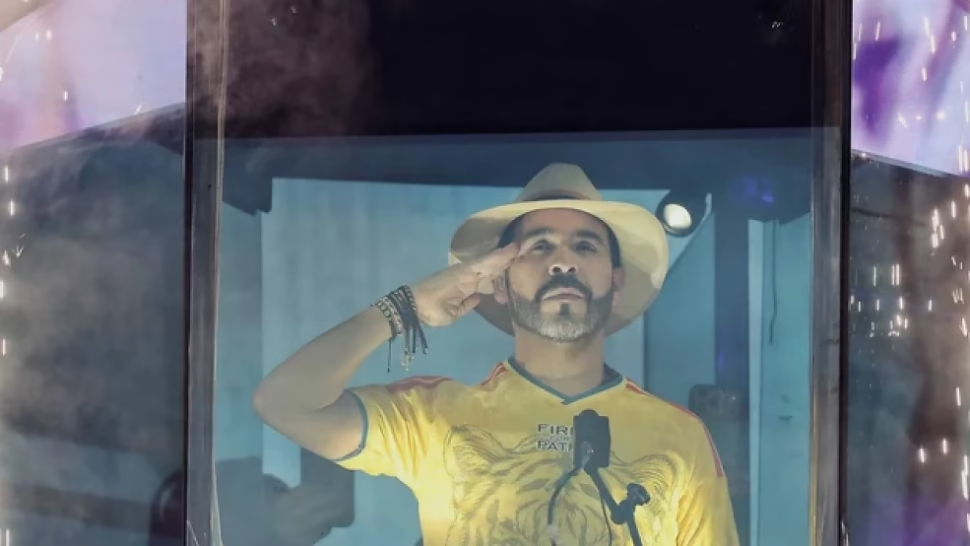
Colombians go to the polls this Sunday for the closest presidential second round in years. The progressive Iván Cepeda, an ally of Gustavo Petro, faces the conservative Abelardo de la Espriella, an outsider who surprised by leading the first round with 43.73% of the votes.

“I am concerned about the extreme polarization. There are two very opposing sides and the violence worries me,” lawyer John Manrique told The Associated Press from Bogotá. “I hope we accept the result and seek a social consensus.”

The ghost of polarization

Glaeldys González, analyst at the International Crisis Group, warns that the levels of polarization are “extremely high” and that the electorate is looking for a real solution to violence, health, corruption and finance in both poles.

De la Espriella, known as “El Tigre”, promises a tough hand: mega prisons like Bukele’s and confronting illegal groups. He received the endorsement of Donald Trump. Cepeda, philosopher and former communist, promises to deepen Petro’s social reforms and maintain peace talks. This week, 100 members of armed groups demobilized thanks to this policy.

Allegations of fraud and call for calm

The second round has tense the atmosphere. Cepeda admitted that Petro did not recognize the preliminary count, although he later accepted the official count. The Ombudsman’s Office asked candidates and leaders to promote trust in institutions and avoid unsubstantiated allegations of fraud.

González pointed out that Crisis Group views possible outbreaks of post-election violence with concern, but trusts that international institutions and observers will help contain them.

Yamile Guevara, a retired teacher, criticized the historical distrust of the left: “The left has always been seen as something negative. People forget history.”

On Sunday, Colombia decides between two opposite paths, with democracy and peace as a backdrop.

Continue reading

Pope Leo XIV exalts first American saint and defends migrants

Pope Leo XIV exalted the first American saint as an example for migrants.

Pope’s message on migrants

This Saturday, Pope Leo XIV exalted Mother Frances Cabrini, the first saint of the United States, as a model for Christians in the face of the immigration crisis. He did so during a visit to his birthplace in northern Italy.

León, who has clashed with Donald Trump’s government over its crackdown on migrants, especially urged young people to learn about Cabrini’s life and service. With this gesture, the first American pontiff in history confirms himself as Francis’s heir by prioritizing the situation of migrants.

The Pope prayed at Cabrini’s tomb in a basilica named after him in Sant’Angelo Lodigiano, near Milan. He then presided over an evening prayer ceremony. The visit was fleeting, a single day, but loaded with symbolism.

Cabrini, canonized in 1946, dedicated her life to caring for Italian immigrants in the United States. Leo XIV presented her as an example of welcome and solidarity, at a time of global tensions over migration policies.

The Pope’s message reinforces the Vatican’s position of protecting the most vulnerable, in contrast to the restrictive measures of the Trump administration. The meeting with the faithful in the basilica also served to reaffirm the Church’s commitment to the displaced.

Continue reading

Israeli attack in Gaza leaves six dead, including two girls

Attack in Gaza breaks the truce: two girls and a journalist among the dead.

Attack in Gaza

Israel carried out an attack in the Gaza Strip this Saturday, killing at least six people. Among the victims were two girls and a cameraman for the Al Jazeera network, according to Palestinian officials.

The attack occurs despite a ceasefire agreed in October between Israel and Hamas. Since then, Israel has attacked the territory almost daily, leaving more than 1,000 Palestinians dead, according to the Gaza Health Ministry.

The bodies of the two sisters, Zina, 4, and Lana, 14, were taken to the Shifa Hospital morgue. They lay in white bags, surrounded by their families.

This incident highlights the continuity of violence in the region, despite diplomatic efforts to achieve lasting peace.

Continue reading