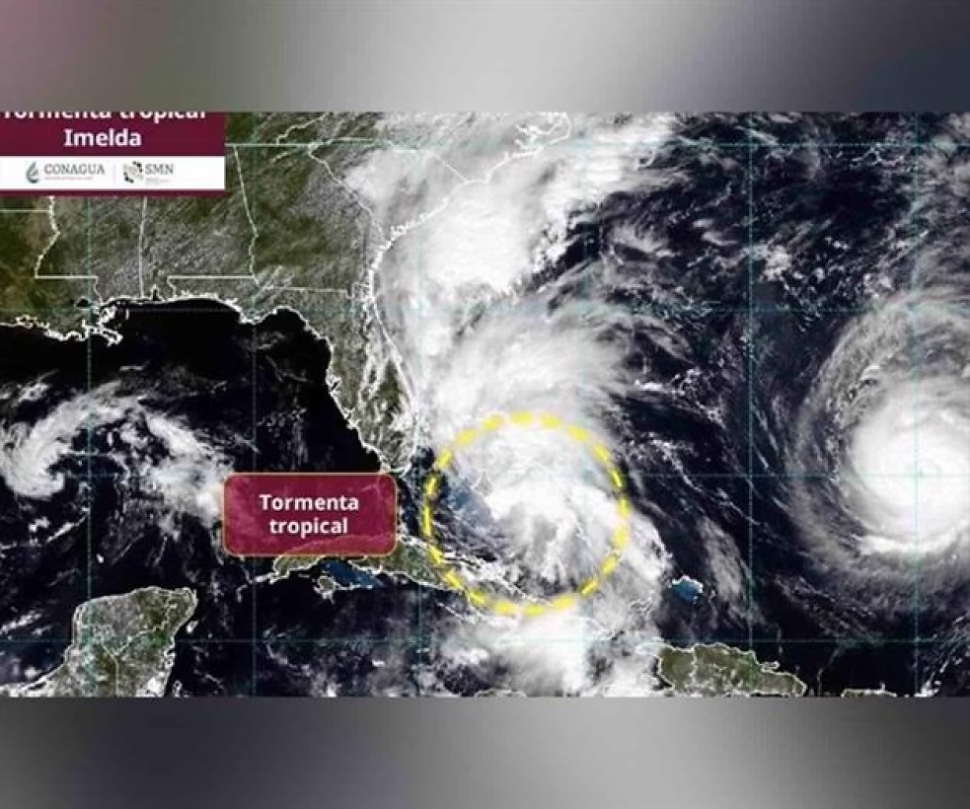
Tropical Storm Imelda forms in the Atlantic

A new cyclonic system is gaining strength in the Atlantic as it advances with intense winds, although without a direct threat to Mexican coasts.

The Birth of a Colossus: Imelda Unleashes her Fury in the Atlantic

In a dramatic twist of meteorological destiny, the waters of the Atlantic Ocean have witnessed the rapturous birth of a new atmospheric titan. The National Water Commission, that tireless watchman of the Mexican skies, has announced with a solemn voice the transformation of what was previously just a modest Tropical Depression Nine into the formidable Tropical Storm “Imelda”. This cyclonic phenomenon has emerged from the ocean depths like a phoenix rising from its own aquatic ashes, challenging the apparent tranquility of the sea with its sudden appearance on the global climate scene.

In these precise moments, while you breathe these words, Imelda is unleashing her primal power approximately 155 kilometers west-northwest of the paradisiacal islands of the Bahamas, and at a shocking distance of 1,025 kilometers east-northeast of the Mexican Caribbean, specifically the tourist jewel of Cancun, in Quintana Roo. This meteorological monster, although young in its development, already presents maximum sustained winds of 65 kilometers per hour, a force capable of destroying everything in its path, felling centuries-old trees and forever altering the lives of those who stand in its destructive path.

RelatedTropical Storm Raymond advances off the Mexican coast

The Relentless Dance: Trajectory and Movements of a Giant

With a determination that shakes even the most experienced meteorologist, this atmospheric colossus moves north at 11 kilometers per hour, in a methodical and relentless dance over the warm waters of the Atlantic. Every kilometer traveled, every unexpected turn, every change in intensity in its winds could mean the difference between calm and catastrophe for millions of souls who inhabit the coastal regions. Imelda’s trajectory has become the most crucial puzzle that scientists are urgently trying to decipher, knowing that countless lives and destinies depend on its solution.

But in the midst of this apparently gloomy panorama, a ray of hope emerges that shines with the strength of a thousand suns. Conagua experts, after hours of exhaustive analysis and studying each atmospheric variable with surgical precision, have declared with cautious optimism that, due to its current distance and projected trajectory, Imelda does not represent immediate danger to Mexican territory. This sentence, pronounced with the authority that comes with years of experience in monitoring tropical cyclones, has become the balm that calms the restless spirits of a nation that has previously experienced the excessive fury of these natural phenomena.

However, history has taught us that in the climate theater, nothing is set in stone. The atmosphere is a capricious entity that can change its mind in a matter of hours, transforming what seems like a distant threat today into an imminent danger tomorrow. Low pressure systems, upper air currents, ocean temperatures and a myriad of factors invisible to the human eye can dramatically alter the course of this newborn giant, turning the current tranquility into a future nightmare.

As Imelda continues her epic journey across the Atlantic, the meteorological services of multiple nations keep their eyes fixed on her every movement, analyzing every sigh, every change of rhythm, every alteration in her internal structure. Forecast models work tirelessly, processing terabytes of information to anticipate the next chapter in this cosmic story. Weather satellites have become the omnipresent eyes that watch every breath of this phenomenon from above, capturing images that reveal the majestic and terrifying beauty of this constantly evolving system.

The formation of Imelda reminds us of the fragility of our existence in the face of the titanic forces of nature, but also celebrates the human capacity to anticipate, prepare and adapt. Each tropical storm that is born in the ocean waters is a reminder that we inhabit a living, dynamic and constantly changing planet, where beauty and danger coexist in a precarious balance that defies our understanding.

Would you share this crucial meteorological information with your loved ones on social networks? Spread this report to keep your community informed about the development of these atmospheric phenomena. Explore more content related to extreme climate events on our digital portal and become a citizen better prepared for the eventualities of nature.

CNDH calls for strengthening the fight against sexual torture in Mexico

Agency warns that extreme sexual violence persists in detention centers.

The National Human Rights Commission (CNDH) called for strengthening actions against sexual torture in Mexico. He considered it one of the most serious forms of violence and discrimination that especially affects people in vulnerable situations.

Call for institutional coordination

During a symposium on the topic, Rosario Piedra Ibarra, president of the CNDH, stressed the need to improve coordination between federal, state and municipal authorities. The objective: to prevent, investigate and punish these events effectively.

The organization recalled that, through the National Mechanism for the Prevention of Torture, it maintains permanent surveillance in centers of deprivation of liberty. Since 2021, it has issued reports with recommendations to improve institutional practices with a gender focus.

Equity of the problem

Representatives of state human rights organizations warned that sexual torture continues to be a current problem. It requires specialized attention, active prevention and mechanisms that avoid impunity to guarantee justice for the victims.

The CNDH pointed out that, although Mexican legislation does not establish different modalities of torture, international instruments such as the Istanbul Protocol recognize it as an especially serious practice. Therefore, it must be combated with specific measures.

He emphasized the importance of addressing this problem from a gender perspective. The victims are, for the most part, people in vulnerable situations. The proposed actions seek not only to punish those responsible, but also to prevent future cases and ensure access to justice.

CNDH pide reforzar combate a la...

Continue reading

SCJN: the crimes of the ABC Nursery case do not prescribe

The Court determined that the tragedy in Sonora can be investigated without a time limit.

No expiration date

The Supreme Court of Justice of the Nation ruled that the crimes related to the fire at the ABC Daycare do not prescribe. The incident occurred in 2009 in Hermosillo, Sonora, and left 49 girls and boys dead.

The decision was made after analyzing an appeal from Sergio Antonio Salazar Salazar, former director of Economic and Social Benefits of the IMSS. He argued that the charges against him had already become invalid due to the passage of time. The highest court rejected that approach.

The Court noted that imprescriptibility seeks to avoid impunity, clarify the facts and guarantee comprehensive reparation for the victims. It also took into account the special protection that children and adolescents require.

The case will return to the corresponding Collegiate Court, which must apply the new criteria. The resolution opens a new chapter in one of the most sensitive human rights cases in Mexico.

SCJN: los delitos del caso Guardería...

Continue reading

Second round of the T-MEC ends without progress

Without concrete agreements, Mexico and the US are moving towards reviewing the T-MEC.

Conversations without progress

The second round of dialogues prior to the review of the T-MEC concluded without concrete agreements. The meeting was held in Washington, according to the Secretary of Economy, Marcelo Ebrard. The Mexican delegation presented proposals and points of view, but no agreements or additional details were released.

Topics addressed included rules of origin, economic security, agricultural sector and automotive industry. These issues are fundamental to the operation of the trade agreement between Mexico, the United States and Canada.

The formal review of the treaty will begin on July 1 with a virtual trilateral meeting. A third round of negotiations will take place on July 20. Everything occurs in a context of trade tensions, with tariffs imposed by the United States on various products.

Mexico and Canada have expressed interest in maintaining and extending the agreement. However, the doubts raised by US President Donald Trump generate uncertainty about the future of the USMCA.

Continue reading