Tractors and burning tires protest in the Zacatecas countryside

The tractors take over the toll booths in a show of force that paralyzes the state and exposes a conflict that goes beyond the asphalt.

The field is planted (literally) on the road

It seems that in Zacatecas they have decided that the best way to water the crops is with the sweat of the brows… of motorists trapped in a monumental traffic jam. With the elegance of an elephant in a china shop, several contingents of agricultural producers have turned their tractors into tools of political protest, blocking the main federal road accesses in the state. The glorious tollbooths of Calera, Osiris and Las Arcinas are no longer just a place to pay and suffer, but the perfect setting for a piece of social theater with heavy delivery machinery. Imagine the scene: endless rows of trucks and cars, while the real owners of the land, the tractors, do what they do best: take up space.

The artists of this performance are the members of the Unión de Pozos Agrícolas de Zacatecas, who, in a burst of enviable punctuality, mobilized early to park their mobile farm fleet on the most strategic roads. Their caravan was not going towards a field, but towards a more forceful objective: paralyzing the entrances to the capital and the crucial routes of federal highways 45 and 54. Because, what better way to be heard than to prevent anyone from getting anywhere? A communication strategy, without a doubt, innovative.

RelatedGiant freshwater aquifer discovered under the Atlantic Ocean

Collateral consequences and warnings to air navigators

The reaction of the authorities was immediate, although perhaps the drivers did. Given the road chaos on federal 45, the Zacatecas International Airport issued a notice to passengers. His message, a gem of bureaucratic euphemism: “schedule your departures in advance.” Translation: “Your flight takes off in 3 hours, but getting here from the city can take 6, so arm yourself with patience and a good audiobook.” Meanwhile, the protesters, in a gesture of moving magnanimity, consider the possibility of opening traffic for ten minutes every hour. Quite a handout of mobility! They admit, of course, that they were “forced” to tighten the measures. Because in the catalog of options for dialogue, between “send a letter” and “paralyze a state”, the one that has the most impact on the news is always chosen.

The root of the problem: Water for everyone or dry fields?

And what is the reason for this nice mess? Nothing less than the reform of the sacred (and controversial) National Water Law. The farmers argue, with a certain dramatic logic, that the legislative changes would strongly affect them, because Zacatecas – surprise – does not have the same water conditions as, say, Tabasco. Their requirement: an availability study before approving anything. A request that, one would think, should be the previous step to any reform, not the consequence of a blockade. But where would the fun be in doing things in order?

In addition, they point out that the initiative would force them to return the concessions to the State and would infinitely complicate their renewal with a tangle of administrative requirements. To top off the idyllic panorama, the elimination of energy quota subsidies has caused a “great decapitalization of the countryside.” In Christian: planting has become so expensive that perhaps it is more profitable to use the tractor to block roads. A sad metaphor for how, sometimes, the fight for vital resources ends up suffocating the normality of an entire state.

The moral? When the countryside gets angry, it doesn’t throw tomatoes… it parks tractors. And the city, which depends on its food, is stuck in diesel smoke and desperation, pondering the real price of food and water.

Did you find this clash between the field and the asphalt as ironic as we did?Share this story on your social networks and help us so that more people see the less pastoral side of agriculture. Explore more content related to socio-environmental conflicts and the rural economy on our site.
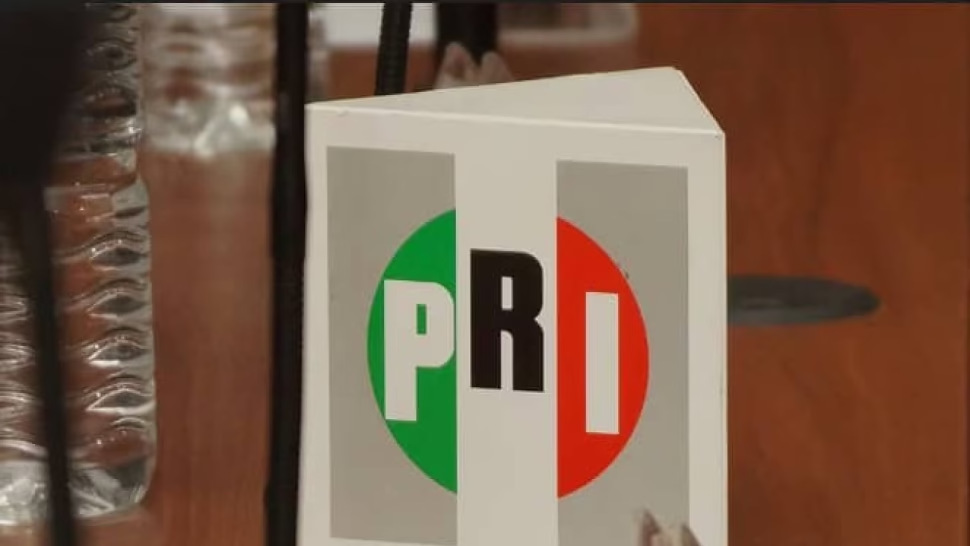
PRI arrasa en Coahuila: gana los 16 distritos electorales

El tricolor duplicó los votos de Morena-PT y reafirma su dominio en el estado.

Resultados contundentes en Coahuila

El Partido Revolucionario Institucional (PRI) obtuvo una victoria sólida en las elecciones para renovar el Congreso de Coahuila. Se llevó los 16 distritos electorales con 684 mil 515 votos, el 55.01% del total. Duplicó así los 326 mil 012 sufragios de la coalición Morena-Partido del Trabajo, que alcanzó el 26.20%.

Este desempeño no es casual. El 4 de junio de 2023, el priista Manolo Jiménez Salinas ganó la gubernatura con el 56.94% de los votos (741 mil 731 sufragios). La base electoral del tricolor en la entidad se mantiene firme.

RelatedAttolini reconoce derrota en Coahuila; PRI arrasa en los 16 distritos

A nivel nacional, el antecedente más relevante data del 7 de junio de 2015. Durante el sexenio de Enrique Peña Nieto, el PRI competía por 300 distritos. En alianza con el Partido Verde, obtuvo 185 distritos, consolidándose como la principal fuerza legislativa. El PAN quedó segundo con 55; el PRD, tercero con 34. Morena, en sus inicios, logró 14 distritos, marcando el arranque de su expansión.

La victoria del PRI en Coahuila no solo confirma su liderazgo local, sino que abre preguntas sobre el futuro de las coaliciones y la competencia electoral en el país.

Continue reading

Convocan Marcha de las Antorchas rumbo al Mundial 2026

Colectivos sociales marcharán el 10 de junio al Estadio Azteca.

Organizaciones estudiantiles, de derechos humanos y colectivos sociales anunciaron la Marcha de las Antorchas, una protesta programada para el 10 de junio en la Ciudad de México, un día antes de la inauguración de la Copa Mundial de Futbol 2026.

Detalles de la movilización

La marcha partirá a las 16:00 horas desde la estación del Tren Ligero y avanzará hacia el sur de la capital. El destino final será el Estadio Azteca, sede del partido inaugural del torneo.

RelatedAntigentrification march in CDMX concludes without serious incidents

Entre los convocantes se encuentran colectivos estudiantiles, familiares de los 43 normalistas desaparecidos de Ayotzinapa y agrupaciones vinculadas a la Coordinadora Nacional de Trabajadores de la Educación (CNTE).

Contexto de la protesta

La movilización se enmarca en el 54 aniversario del 10 de junio de 1971, una fecha que los organizadores consideran símbolo de la represión en México. Exigen justicia social y el esclarecimiento de violaciones a derechos humanos.

Las autoridades capitalinas no han emitido hasta el momento un pronunciamiento oficial sobre la ruta o posibles medidas de seguridad.

Continue reading

Comerciantes del Centro bloquean Eje Central por vallas y plantón

Comerciantes del Centro Histórico exigen retiro de vallas por caída en ventas. Diálogo con autoridades continúa.

Decenas de comerciantes del Centro Histórico bloquearon este lunes el cruce de Eje Central y avenida Juárez. Exigen el retiro de las vallas metálicas y del plantón de la Coordinadora Nacional de Trabajadores de la Educación (CNTE). Señalan que sus ventas han caído drásticamente en las últimas semanas.

Los locatarios corearon consignas como “queremos trabajar” y “fuera vallas”. Afirman que las restricciones de acceso han paralizado la actividad comercial en una de las zonas más transitadas de la capital. Pidieron a las autoridades una solución inmediata.

RelatedComerciantes exigen retiro de vallas en el Centro Histórico

Diálogo con el gobierno

Al lugar llegó el subsecretario de Gobierno de la CDMX, Fadlala Akabani, para dialogar con los inconformes. Mientras tanto, elementos de tránsito realizaron cortes y desvíos viales para minimizar el impacto del bloqueo.

La protesta complicó la circulación de automovilistas y transporte público. Varios camiones y autobuses quedaron varados. Las autoridades recomendaron rutas alternas mientras continuaban las negociaciones.

Contexto de las vallas

Las vallas fueron colocadas por el gobierno capitalino para limitar el acceso al Zócalo durante el plantón de la CNTE. Comerciantes y empresarios han solicitado modificaciones al operativo. Autoridades aseguran que mantienen el diálogo para garantizar la movilidad y la actividad económica en el Centro Histórico.

Continue reading