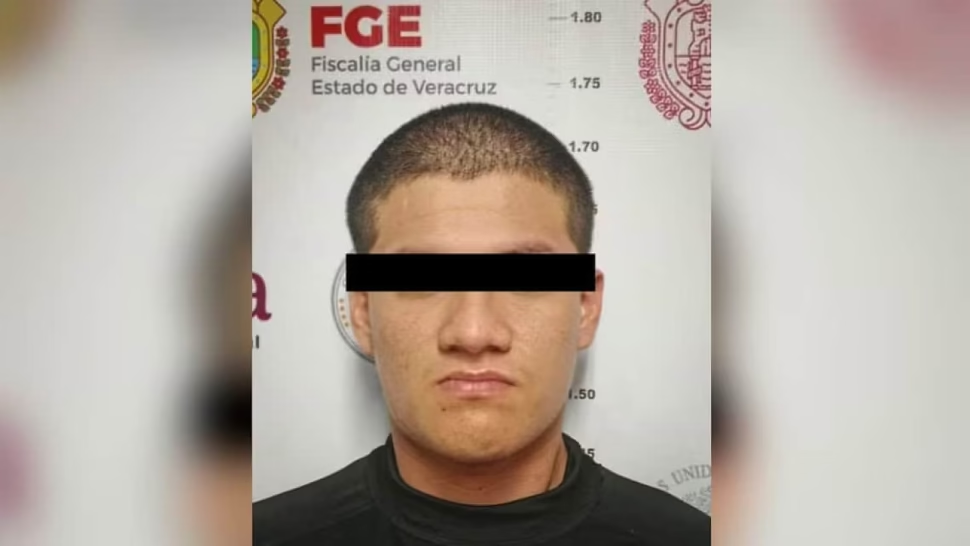
Executory Sentence Against Members of the Jalisco New Generation Cartel
The Attorney General of the Republic (FGR) confirmed the final sentence of 14 years in prison imposed on three alleged members of the criminal organization Jalisco New Generation Cartel (CJNG). Those sentenced, identified as Omar “V”, José “F” and David “C”, will serve their sentence in the Federal Center for Social Readaptation number 12, located in the municipality of Ocampo, Guanajuato, a high-security penitentiary center.
A federal judge specialized in organized crime issued this resolution after a legal process in which multiple crimes were proven. The sentence consolidates the criminal responsibility of the accused for the crimes of organized crime, collection of firearms for the exclusive use of the Army, possession of cartridges and magazines reserved for the Armed Forces, and against health in the form of possession for commercial purposes of methamphetamine hydrochloride and marijuana.
The Operation and the Determinant Confiscation
The events that led to this conviction date back to December 2024, when elements of the National Guard acted quickly in the municipality of Irapuato, Guanajuato. The intervention originated from a citizen report that warned about the entry of an armed person to a commercial establishment. Upon arriving at the site, security forces managed to identify and arrest the subject described in the complaint.
During the intervention, two other individuals who accompanied the main suspect adopted an attitude of aggressiveness and confrontation, which did not prevent their arrest. The search and seizure procedure resulted in the discovery of an arsenal of considerable power. The authorities seized four long firearms (possibly assault rifles) and three short weapons (probably semi-automatic pistols). The ballistic equipment included 17 magazines and 361 useful cartridges, all of calibers for exclusive military use.
One of the most significant elements, which directly linked the detainees to the CJNG, was the seizure of four ballistic vests that visibly displayed the acronym “CJNG” (Jalisco New Generation Cartel). This discovery constitutes key material evidence to demonstrate their membership in this organized crime group. In addition, a considerable amount of cash in national currency was seized, presumably the product of illicit activities.
In relation to crimes against health, a batch of marijuana and a significant amount of methamphetamine hydrochloride, a synthetic psychoactive substance with a high impact on public health, were seized. The operation also revealed a high level of danger, with the seizure of a hand-made explosive device or improvised explosive device (IED), which indicates the group’s operational capacity for more violent activities. The two vehicles seized are presumed to have been used for logistics and transportation of its arsenal and drugs.
Legal Process and Support of the Sentence
After the arrest, the Federal Public Ministry (MPF) took over the investigation and was in charge of integrating the investigation folder. The work of the prosecutors consisted of presenting to the judge the necessary and compelling evidence to support the accusation of the crimes. This body of evidence included, with high probability, the expert analysis of the weapons, the illicit substances, the vests with the cartel’s initials, and the testimonies and technical reports of the elements of the National Guard who participated in the operation.
The meticulous presentation of this evidence allowed the federal judge to issue a final conviction of 14 years in prison for each of those involved. This judicial resolution represents a significant setback for the operational structure of the CJNG in the Bajío region, an area that has been the scene of constant territorial disputes between criminal organizations. The sentence not only punishes the possession of drugs and weapons, but fundamentally punishes participation in a criminal organization, a complex crime that violates the rule of law.
This case exemplifies the importance of cooperation between institutions and the effectiveness of action protocols for citizen reports. The rapid response of the National Guard, followed by a robust prosecutorial investigation, culminated in a court ruling that contributes to security and justice. The conviction sends a clear message about the capacity of the Mexican State to investigate, prosecute and sentence individuals linked to organized crime groups, even when they operate with a significant level of weapons and logistics.
Share this important achievement in terms of security and justice on your social networks to keep your community informed. Explore more content related to operations against organized crime on our portal.