The United States seizes the largest amount of fentanyl in its history

US authorities hit organized crime with an unprecedented operation.

Historic operation against drug trafficking in the United States

The Attorney General of the United States, Pam Bondi, confirmed this Tuesday the seizure of three million fentanyl pills, marking a milestone in the fight against drug trafficking. This seizure, equivalent to 11.5 kilograms of the substance, represents the largest amount intercepted in the country’s history, surpassing previous operations against drug trafficking networks.

Technical details of the operation

The DEA (Drug Enforcement Administration) coordinated the operation in collaboration with local, state and federal agencies. The pills, with an estimated value on the illegal market of hundreds of millions of dollars, were found in Albuquerque, Phoenix and Utah. In addition to the drugs, assets linked to organized crime were confiscated, including vehicles and significant sums of cash.

RelatedDEA declares that cartels’ fentanyl loses potency

Fentanyl, a synthetic opioid 50 times more powerful than heroin, has been responsible for 70% of overdose deaths in the US in recent years. Its production and distribution are dominated by cartels that operate with highly armored structures. “These leaders completely isolate themselves, making it difficult to capture them,” Bondi explained during the press conference.

Strategic implications

This blow directly affects one of the most dangerous drug trafficking and terrorism organizations, according to the prosecutor’s office. The operation not only dismantles logistical flows, but also weakens the financial infrastructure of these groups. Security experts emphasize that fentanyl is key in the cartels’ strategy due to its high profitability and ease of transportation.

Authorities highlighted the use of advanced intelligence and inter-institutional cooperation to track shipments. “Every pill seized saves lives,” said a DEA spokesperson, recalling that a dose of 2 milligrams can be lethal.

What’s next? The case shows the need to strengthen border controls and clandestine laboratories. Meanwhile, the prosecutor’s office is preparing charges against those involved, who could face sentences of up to life in prison.

Share this information to raise awareness about the impact of fentanyl and explore more content on public health and safety on our social networks.

Note: This article was updated with official data and analysis from narcotics experts.
Russia attacks kyiv with missiles and drones: one dead and multiple injured

Russian attack with missiles and drones leaves one dead and eleven injured in kyiv.

Night attack in kyiv

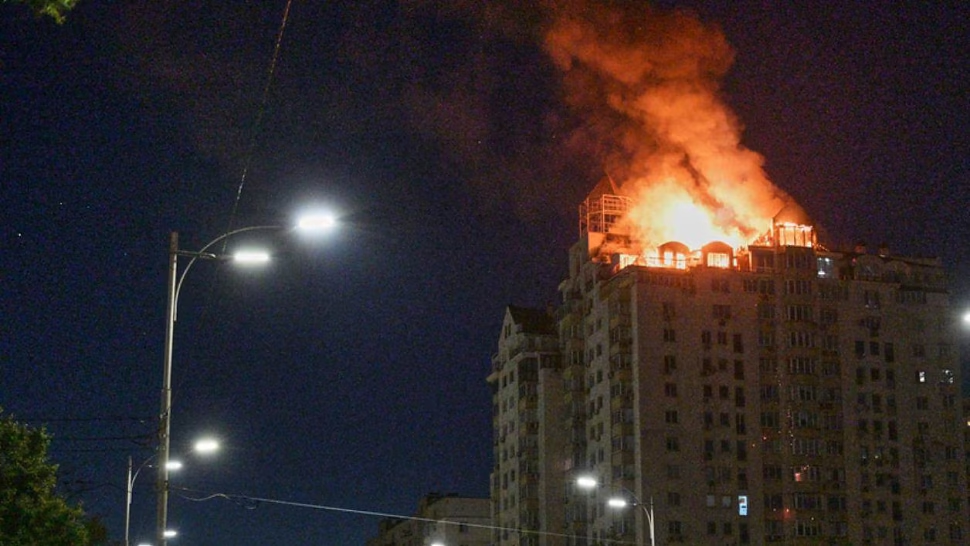
Russia launched a missile and drone attack against kyiv during the early hours of Thursday. The bombings shook the Ukrainian capital and caused damage to residential buildings.

The head of the kyiv Military Administration, Tymur Tkachenko, reported that one person died and several were injured. Mayor Vitali Klitschko said that at least 11 people suffered injuries.

The attack reached all 10 districts of the city, on both banks of the Dnipro River. The first warnings were issued by President Volodymyr Zelenskyy and other officials. Many residents took refuge in subway stations.

Recorded damages

Klitschko reported that five people were injured in the Shevchenkivskyi district, including a paramedic in critical condition. In Desnianskyi, a nine-story building was damaged and trapped people were rescued. In Holosiivskyi, a fire broke out on the roof of a multi-story building. House fires were also reported in the Sviatohynskyi and Darnytskyi districts.

Response from authorities

Tkachenko detailed that the attack partially destroyed a residential building in Desnianskyi, caused fires near homes in two parts of the Pecherskyi district, and another fire near an administrative building in Solomianskyi. Authorities also recorded damage in the Obolonskyi and Podilskyi districts.

In recent weeks, Russia has stepped up its attacks on kyiv. Meanwhile, Ukraine has deployed long-range drones against Russian military targets and energy facilities, creating fuel shortages and affecting supply lines within Russia. Klitschko urged residents to stay in shelters in the face of what he called a “furious enemy attack.”

Continue reading

Venezuela: hospital crisis after earthquakes and thousands of people affected

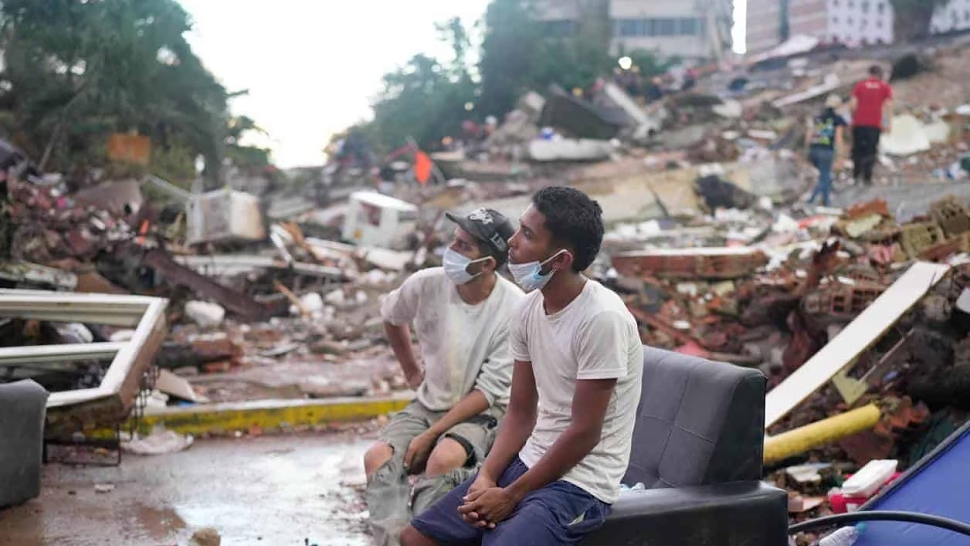
The earthquakes in Venezuela left more than 1,700 dead and a health crisis that overwhelmed hospitals.

Last week’s earthquakes in Venezuela have collapsed the health system. More than 1,700 people died and thousands were injured. Hospitals operate at their limit, according to international organizations.

Hospital damage and disease risk

The WHO reports dozens of hospitals affected, several out of service. Those that work face overcrowding, lack of staff and delays in surgeries. In addition, thousands of displaced people live in makeshift shelters. The UN warns of possible outbreaks of measles, dengue, malaria and yellow fever due to overcrowding.

Figures and call for help

Venezuelan authorities count more than 15,000 affected, but the number could be higher, according to international organizations. NASA estimates that 59,000 buildings were damaged or destroyed. UNICEF estimates that 680,000 children need humanitarian assistance. While search and rescue efforts continue, national and international organizations are asking to reinforce humanitarian and medical aid. The priority is to care for the affected population, prevent the spread of diseases and strengthen the response capacity of the health system to the magnitude of the emergency.

Continue reading

The ‘Flemish Revolution’ shakes Albania against Kushner’s project

Albanian environmentalists use foam flamingos to protest a tourism project linked to Jared Kushner.

The ‘flamingo revolution’ that challenges a Kushner project in Albania

Thousands of people have demonstrated in Tirana against a luxury tourism megaproject linked to Jared Kushner, son-in-law of US President Donald Trump. The mobilizations, baptized as the “flamingo revolution”, have a peculiar symbol: figures of flamingos made of foam by the activist Natma Paja, used to make visible the rejection of development.

The project includes hotels, villas, apartments and a marina on Sazan Island and Narta Lagoon, a protected area that is home to migratory birds. Civil organizations denounce a risk to biodiversity and demand the suspension of the works.

The government defends investment

Prime Minister Edi Rama has backed the project, arguing that it will boost high-end tourism, strengthen the economy and support Albania’s aspiration to join the European Union. But the opposition does not give in.

As protests continue, the Special Prosecutor’s Office against Corruption and Organized Crime opened an investigation into the case, without revealing details. The European Union, for its part, monitors that the initiative complies with the environmental standards required of the candidate country.

Rama has reiterated that he will not stop the project, which he describes as a historic opportunity. The conflict keeps open the debate between economic growth, environmental protection and transparency in large investments.

Continue reading