The United States resumes student visas with controversial requirements

The US government requires access to social networks from student visa applicants in a controversial measure.

A dramatic twist in the American dream

In a move that has shaken the foundations of international education, the US Department of State has unleashed a storm of controversy by announcing the resumption of student visas… but with a condition that has left the entire world breathless. Applicants must hand over the keys to their social networks to the North American government!

The price of opportunity

As in a scene straight out of a political thriller, the authorities have declared that every publication, every like, every private message could be scrutinized by consular officials. “We look for any sign of hostility towards our nation,” they have declared, while thousands of young people in Beijing, Mumbai and Mexico City hold their breath at the thought of that hasty tweet or that meme shared in jest.

RelatedThe tense game of student visas under the security magnifying glass

The Chinese student Chen, whose full name he is afraid to reveal, lives these days as if on an emotional roller coaster. “I update the page every hour, as if my life depended on it,” confesses this 27-year-old doctoral student, whose future now hangs in the balance of a digital thread, in a broken voice. Their story is repeated in the Philippines, India and Mexico, where brilliant young people see their academic dreams collide with the wall of geopolitics.

The shadow of suspicion

The new guidelines, implemented under the Trump administration, have turned the visa process into a minefield where a misconfigured privacy setting could mean the end of educational aspirations. “They must make public what is private,” demands the official statement, while officials search between digital lines for signs of danger that not even the applicants themselves could anticipate.

The tension reaches its climax in the halls of Harvard, that prestigious institution that is now waging its own epic battle against government restrictions. With a quarter of its enrollment dependent on international students, the university sees the dream of global education fade in the face of increasingly strict requirements.

Meanwhile, in consulates around the world, officers examine social profiles with the meticulousness of detectives, searching in every photo, in every comment, for the ghost of a threat that justifies denying access to the land of opportunity. How far will this scrutiny go? What will happen to those whose only crime was sharing a political opinion years ago?

The clock ticks relentlessly towards the start of the school year, and with every minute that passes, the anxiety of thousands of students grows like an unstoppable tide. Their suitcases are packed, their scholarships approved, their hearts full of hope… but now their fate depends on algorithms and privacy settings.

Share this powerful story! The future of international education is at stake, and the world needs to know about these crucial developments. What do you think about this controversial requirement? Explore more content on global education in our special section.

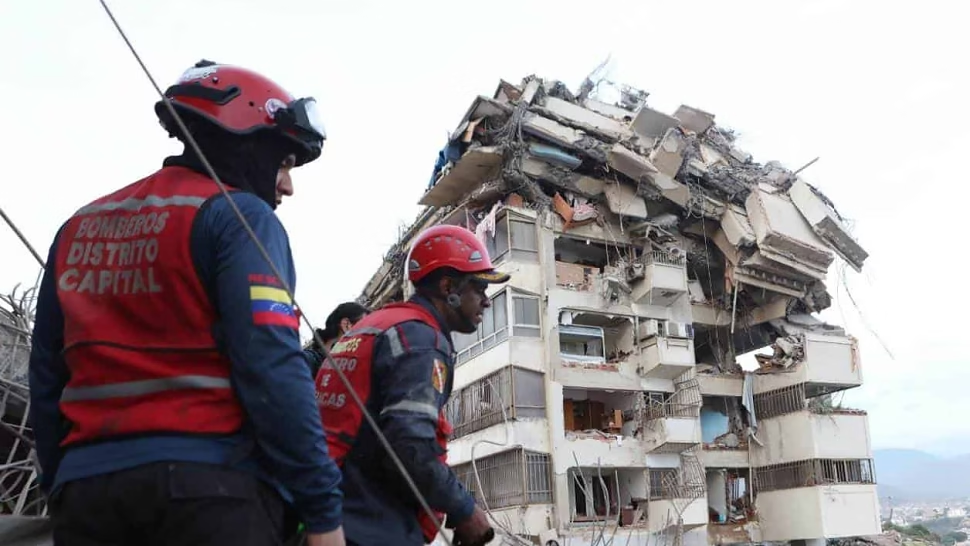
Venezuela raises the death toll from earthquakes to 589

589 dead and 2,980 injured after the earthquakes. La Guaira will be militarized.

The interim president of Venezuela, Delcy Rodríguez, updated this Friday the number of victims from the earthquakes that hit the country. The death toll amounts to 589 and there are 2,980 injured, more than doubling the previous toll of 235 deaths. The number is expected to increase, as thousands of people remain missing.

“Unfortunately, we now have 589 deaths,” Rodríguez declared before military and civilian officials. “We will go to save the trapped people, we work tirelessly on this task,” he added.

La Guaira under military control

The coastal state of La Guaira, north of Caracas and near the epicenter of both earthquakes, will be militarized. It is the most affected area. At least 100 buildings, including residential skyscrapers, collapsed in the city of the same name.

The authorities have intensified rescue efforts and are committed to recovering the devastated areas. The situation continues to evolve as evaluations progress. The magnitude of the earthquakes has caused a humanitarian crisis, and efforts are being made to provide assistance to those affected.

Continue reading

Rescuers improvise due to lack of equipment in La Guaira

Neighbors dig with their hands to rescue those trapped after the earthquake.

Freehand rescue in La Guaira

Twenty-seven hours after the earthquake, desperation is growing among the relatives of those still under the rubble. Rescue teams are scarce and lack machinery to move the mountains of concrete. In various parts of the city, the residents themselves dig with their bare hands, together with firefighters and volunteers.

Many of them maintained communication with their trapped loved ones, speaking to them to keep them conscious. As the hours passed, the voices became weaker until they died out forever.

“My wife couldn’t get there. She was bathing when the tremors hit. We tried to escape. I managed to get out of the building, but she fell, hit her head and was trapped. I know she was left naked, I would like to reach her, at least to cover her body,” said a visibly affected man through tears.

Urgent call

The situation is critical. Rescuers urgently need tools, heavy machinery and logistical support to continue their work. Meanwhile, the community organizes as best it can, moving debris with their own hands, in a race against time to find survivors.

Continue reading

UN reports 6.8 million people affected by earthquakes in Venezuela

UN preliminary evaluation estimates 6.8 million people affected in Venezuela.

UN Evaluation

After the two strong earthquakes that shook Venezuela on Wednesday, the International Organization for Migration (IOM) estimates that up to 6.8 million people could have been affected. According to the UN, approximately two million people reside in the Caracas metropolitan area alone. This is a preliminary evaluation that will be updated as work continues in the affected areas.

The IOM notes that the collapse of buildings and damage to essential infrastructure limits access to basic services. The priority remains the search for survivors in the rubble. UN agencies warn that the number of displaced people will increase as new damage is detected and the hardest hit areas are evacuated.

Government actions and international response

During a press conference, UN agencies reported that around twenty emergency hospitals in the states of La Guaira, Miranda, Aragua, Carabobo, Falcón, Zulia, Yaracuy and Lara, as well as in the Capital District, suffered structural damage.

The government of interim president Delcy Rodríguez requested the United Nations to send three emergency medical teams with surgical capacity. One of them has already left from the United States. Caracas also requested medicines, equipment and medical supplies, which the UN is acquiring and preparing for transfer via Panama or directly to Venezuela.

Continue reading