The mysterious fate of El Cuchillo’s water in the debt with the United States

Official silence hides the destination of millions of cubic meters after a controversial decision that exhausts vital resources.

A Secret that Drips in the Dark

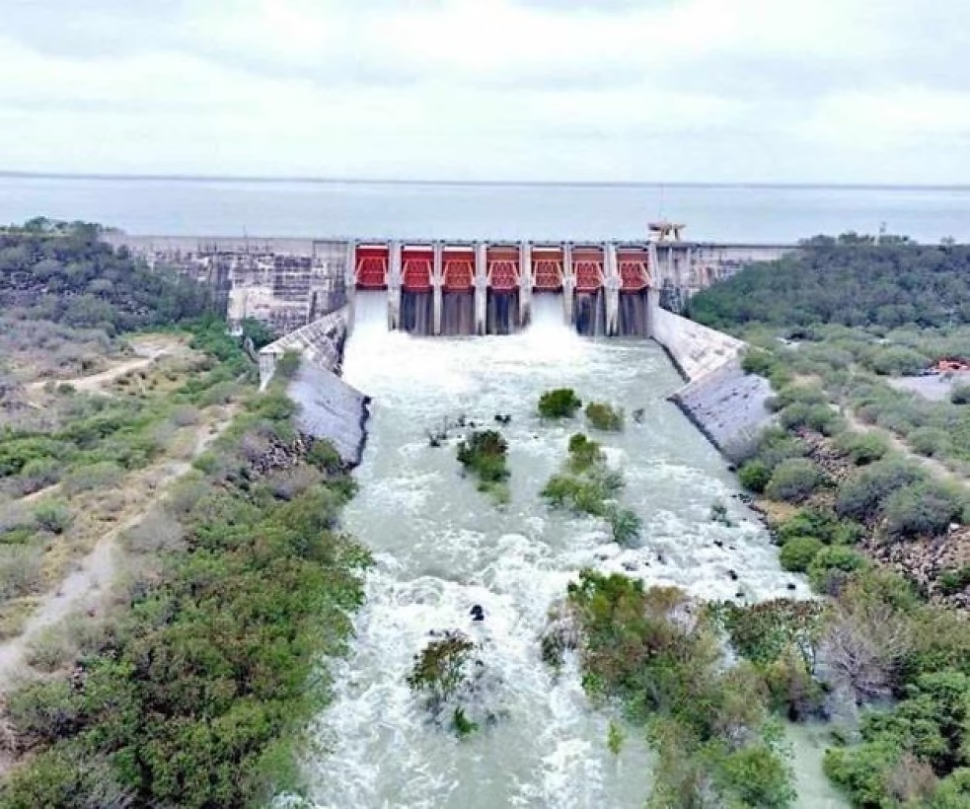
In the shadows of bureaucracy, a deafening silence surrounds the fate of millions of cubic meters of water, a resource more precious than gold in arid lands. Since the news broke that the El Cuchillo Dam, Nuevo León’s water jewel, was being looted to pay the debt with the northern giant, the CILA has vanished all transparency. What do truncated reports hide? Why did the breakdown of payments by basin evaporate like drops in the sun?

The River That Should Never Be Part of the Game

The latest report, dated May 4, reveals a shocking figure: 136.8 million cubic meters flowed into Texas this year, but 73%—100.5 million!—flowed from the San Juan River, a tributary that did not even appear in the 1944 treaty. It was President Claudia Sheinbaum who, under pressure that still whispers in the corridors of power, signed the permit that converted this wealth into currency. The experts cry out to the heavens: that historic release in January, where 130 million vanished downstream, was only the first act of an announced tragedy.

RelatedAccelerated release at the El Cuchillo Dam exceeds projections

And then, as if fate was mocking the thirsty, in April Conagua repeated the move: another 130 million released, but this time without trace or explanation. Where did this vital liquid end up? The authorities maintain a silence that chills the blood.

A Debt That Drowns the Future

Last Wednesday, the CILA released a piece of information that left everyone breathless: 343.1 million cubic meters have already crossed the border in 2025, 277% more than the entire previous year. The math doesn’t lie: the 260 million extracted from El Cuchillo are the key piece of this puzzle. While Texas celebrates, in Mexico the questions burn like the desert sun: At what cost? Who is accountable when aquifers drain and crops wither?

This is not a simple administrative procedure; It is the looting of an irreplaceable resource, a drama where every drop counts and every decision marks the future of generations. The clock keeps ticking, and with it, the patience of those who demand answers.

Share this story before the truth evaporates like water in the desert! Discover more investigations that expose the hidden threads of power in our special reports section.

SICT boasts historic highway modernization during 2026

Federal government reports investment of 224,875 million pesos in roads; highlights supervision operations.

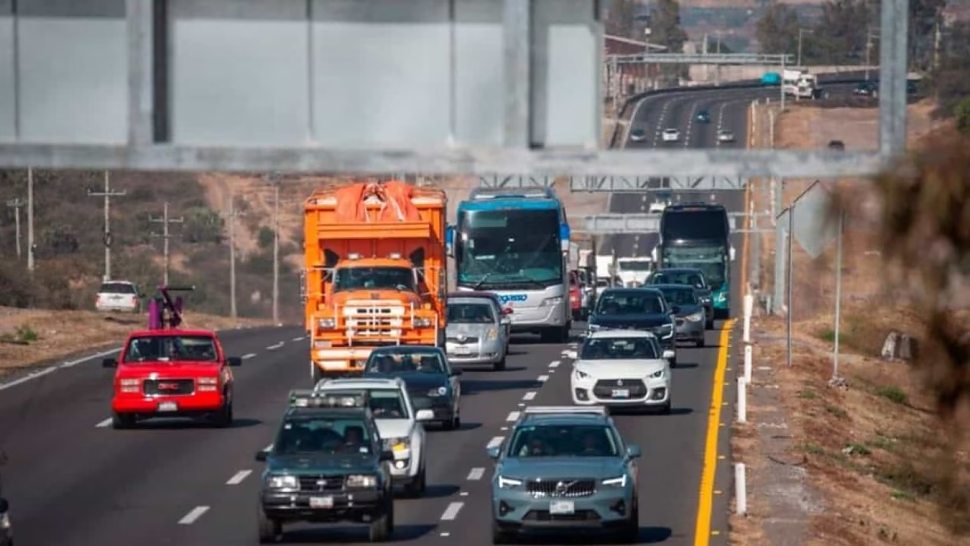
The Secretary of Infrastructure, Communications and Transportation (SICT), Jesús Esteva Medina, stated that in 2026 an unprecedented modernization was achieved in the national highway network, with an estimated investment of 224,875 million pesos at the end of the year.

“A historic modernization was achieved,” he declared during a meeting with the Infrastructure Commission of the Chamber of Deputies.

The official explained that 52 thousand kilometers of federal highways were intervened, both free and toll roads. 47,590 million pesos were allocated for conservation work, focused on resurfacing, repairing potholes and general maintenance.

Security and supervision

Between January and June 2026, the SICT carried out 1,060 supervision operations, with 68,400 reviews. 2,054 sanctions were applied for detected non-compliance.

In rail transport, Esteva announced that investment will continue to grow. For 2026, 173,131 million pesos are projected, and for 2027 more than 209 billion, within a plan that extends until 2030.

The airport sector will receive nearly 26 billion pesos in 2026 for works in 620 terminals. The accumulated investment for the period 2025-2030 amounts to 136 billion.

In addition, progress is being made in social infrastructure and monitoring systems to respond to emergencies due to rain and meteorological phenomena.

Continue reading

Fed tightens anti-money laundering rules for US banks

Fed proposes that banks focus resources on high-risk clients to stop money laundering.

The United States Federal Reserve presented a proposal to strengthen the prevention of money laundering in the banking system. The objective is for financial institutions to concentrate their supervisory resources on clients and operations that represent the highest risk.

What changes?

The US central bank proposes that banks allocate their compliance resources based on a risk assessment. In addition, they must align their programs with the priorities of the Financial Crimes Enforcement Network (FinCEN), the agency in charge of combating money laundering.

The initiative seeks to harmonize anti-money laundering requirements with parallel proposals from four other regulatory agencies. This would strengthen the supervisory framework of the country’s financial system.

The Fed Governing Board opened a public consultation period to receive comments from the financial sector before implementing the changes. It is part of the normal regulatory process.

Continue reading

Alert for intense rains in Veracruz, Oaxaca, Chiapas and Tabasco

Alert for intense rains in four southeastern states. Authorities ask for caution.

The National Civil Protection Coordination (CNPC) activated an alert for very heavy to intense rains in Veracruz, Oaxaca, Chiapas and Tabasco. Accumulations of up to 150 millimeters are expected this Tuesday.

The agency asked for extreme precautions and to follow instructions from local authorities. He recommended not throwing garbage in streets to avoid obstructions in drainage and possible flooding.

Civil Protection Recommendations

The National Meteorological Service (SMN) predicts heavy rains in Sonora, Sinaloa, Chihuahua, Nayarit, Colima, Jalisco, Michoacán and Guerrero, with accumulated amounts of 50 to 75 millimeters.

Showers with heavy occasional rains were also forecast in Nuevo León, Tamaulipas, State of Mexico, Mexico City, Campeche, Yucatán and Quintana Roo.

Civil Protection recommended avoiding traveling through flooded areas and not crossing rivers, streams or fords. He asked visitors in coastal areas to stay away from beaches, jetties and breakwaters, and to suspend activities at sea while adverse conditions persist.

Continue reading