The colossal gasoline subsidy that marked an economic era

A colossal investment that kept prices at bay, but that outlines a future of challenges for the country's energy sovereignty.

The Disbursement that Shaken the National Treasury

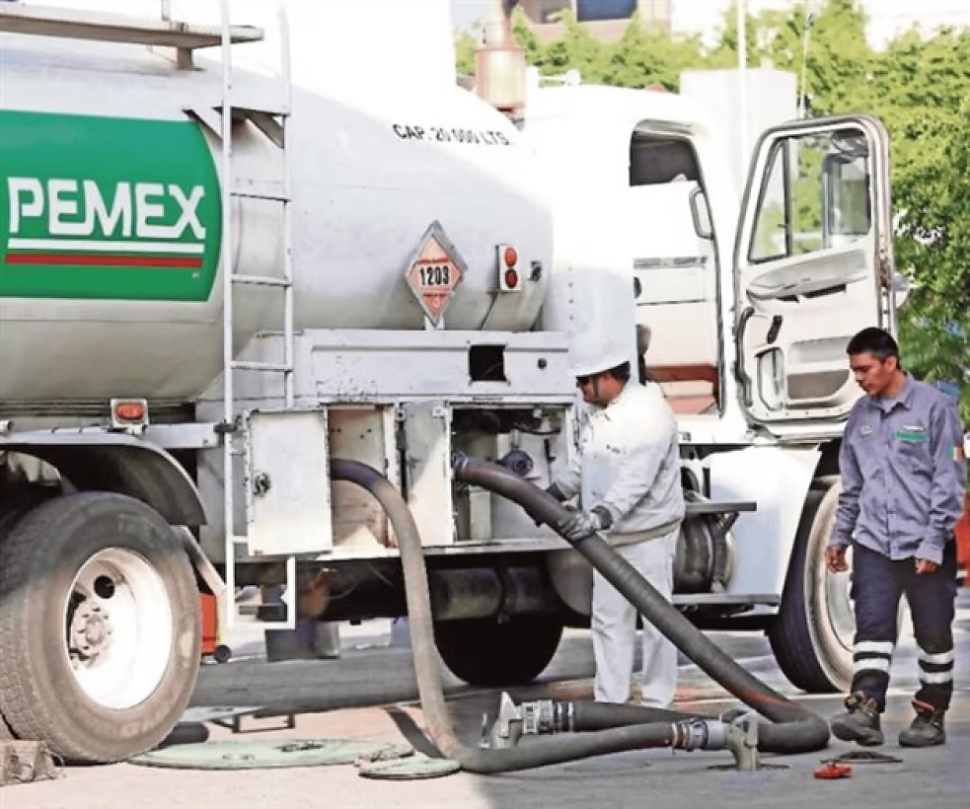
In the annals of Mexico’s recent economic history, a figure emerges as a titan of spending: 833,403 million pesos. This monumental fortune, allocated by the outgoing federal government between 2018 and 2024 to subsidize fuel prices, is not a simple number. It is evidence of an epic battle waged at pumps across the country, a fight to contain a beast called inflation and calm the pockets of millions of Mexicans. An amount so enormous that it rivals the full annual budget of Petróleos Mexicanos (Pemex) or that could be equated to the combined value of emblematic megaprojects such as the Olmeca refinery in Dos Bocas and the Tren Maya railway, including their controversial cost overruns.

This herculean effort, detailed in the Energy Sector Program 2025-2030, achieved its immediate objective: gasoline and diesel navigated turbulent waters with smaller increases than the general price index. However, this historic tax waiver, which in 2024 alone amounted to 26,357 million pesos, is only one side of a coin loaded with drama and profound consequences.

RelatedFederal government withdraws IEPS subsidy for gasoline and diesel

A Two-Sided Policy: Relief and Vulnerability

To understand the magnitude of this decision, we must go back to the previous six-year period (2012-2018), a time of darkness for the consumer where the prices of hydrocarbons skyrocketed mercilessly. Magna gasoline rose by 81%, premium gasoline by 85% and diesel by an overwhelming 89%, reaching historical highs that were close to 25 pesos per liter. That policy, focused on imports, not only eroded the purchasing power of families, but also forged chains of external dependence that tied the country to the vagaries of the international crude oil market.

The massive subsidy was, therefore, an immediate balm but also a patch that, according to the official document, deepened a strategic wound: the lack of self-sufficiency in oil production. This vulnerability left the nation exposed, at the mercy of geopolitical conflicts and global crises that could, in a twist of fate, unleash chaos on domestic prices again.

The Future: A Commitment to Energy Sovereignty

Faced with this legacy of dependence, the horizon that now arises is that of energy independence. The current government’s plan is an industrial epic that seeks to maintain oil production above 1.6 million barrels per day and scale it up to 1.8 million. In this crusade, Pemex must be the champion, contributing up to 86% of that black gold in 2026. The master strategy includes the promotion of mixed development projects, which by 2033 should generate a quarter of national production.

The ultimate goal is not just to extract, but to transform. It seeks to privilege the industrial processing of crude oil and natural gas within the national borders, to finally achieve the desired self-sufficiency in gasoline and diesel. It is a promise of a future where the fuels that move the country come from its own land, in a production that is sworn to be sustainable and respectful of the oil legacy of future generations. The question that floats in the air, full of suspense, is whether this new roadmap will manage to break the chains of the past and write a sovereign ending for this novel of energy, money and power.

Do you think this is the right strategy for Mexico’s energy future? Share this powerful story on your social networks and explore more analysis on the economy and national politics on our site.
Floods in Aguascalientes after intense overnight rains

Storm in Aguascalientes left vehicles stranded and families rescued. Authorities activated protocols.

Rains collapse roads in Aguascalientes

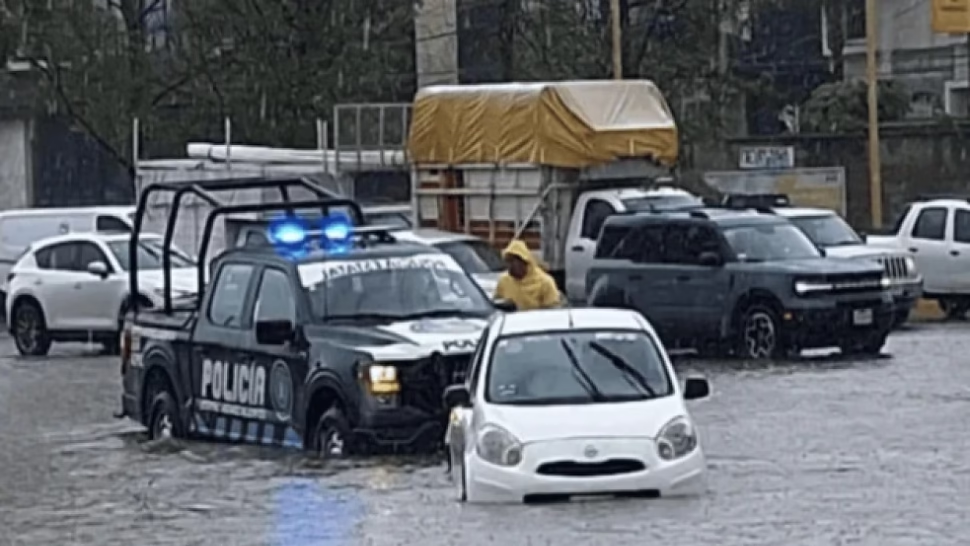
On Saturday night and early Sunday morning, intense rains affected Aguascalientes, Jesús María and Rincón de Romo. Boulevards and avenues were flooded, vehicles were covered in water and entire families were trapped.

Rescues and attention to the population

The greatest impact occurred in the capital. Firefighters and Civil Protection worked for hours to rescue people stranded in different parts of the metropolitan area. They provided assistance to occupants of cars stuck in neighborhoods such as Parques Industrial del Valle, San Francisco de los Romo, the first ring overpass and the exit to Zacatecas.

The overflowing of some channels concentrated the water in the avenues. The State Government reported that security corporations from several municipalities maintain a coordinated operation to provide timely support.

Recommendations and road closures

During the early morning, the authorities asked to avoid driving through flooded areas and to follow official information. The Municipal Public Security Secretariat detailed that the Road Police attended to 42 stranded vehicles and carried out 18 road closures to prevent risks to drivers and pedestrians.

Municipal agents moved entire families, women and minors who could not move due to the storm and flooding to their homes.

Continue reading

CNTE raises a sit-in after 20 days of protest in the Zócalo

The dissident teachers left losses of 410 million pesos and freed up spaces in the Historic Center.

End of the CNTE sit-in

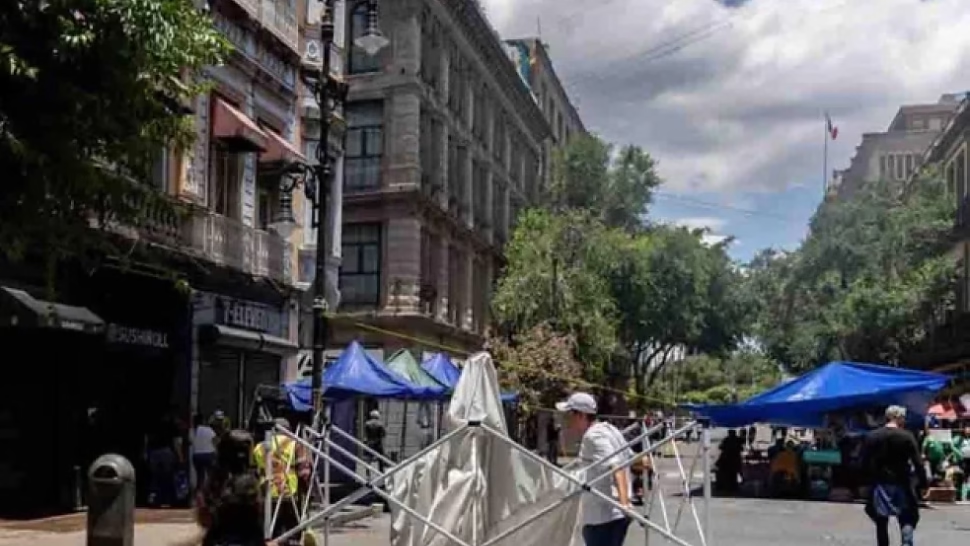
The National Coordinator of Education Workers (CNTE) ended its national strike this Saturday. For 20 days, the mobilizations and the camp in the Historic Center of Mexico City generated losses of more than 410 million pesos to established businesses, according to sector estimates.

Although it did not achieve the repeal of the ISSSTE Law of 2007 or the repeal of the educational reform, the CNTE obtained commitments, financial resources, places, recategorizations and support for education workers in several states.

The leaders assured that the withdrawal is not a defeat. They advanced a stage of reorganization to strengthen the movement and prepare new actions. They insisted that the federal government did not present a proposal to eliminate the ISSSTE Law of 2007 or to reverse the educational reform, demands that will remain in force.

Starting this Monday, around 1.4 million students who remained without classes will be able to return to classrooms in the entities where the CNTE had suspended activities.

Space release

Public space has been gradually freed up. Cleaning workers from the Government of Mexico City removed garbage in streets such as 5 de Mayo, Belisario Domínguez, 20 de Noviembre and República de Cuba. In some areas, the withdrawal was almost total; In others there were still tarps and tents.

A teacher from section 34 of Zacatecas declared: > “We are going to clean it, don’t say that we are going to leave it dirty.”

Merchants expressed relief at the departure of the teaching profession. A worker at the La Blanca restaurant, on May 5, commented: > “It’s good that they’re leaving, it was a very hard month; here we had like a 90% drop in customers.”

A snow seller on the same street indicated that they expected higher sales with the FIFA Fan Fest in the Zócalo, but the arrival of the CNTE reduced their income by 50%.

For his part, the Secretary of Education, Mario Delgado, rejected that the government had “bribed” Section 22 of Oaxaca to hold the sit-in.

Continue reading

Five deaths in bars in CDMX during the early hours of the morning

Two attacks in bars in the capital leave five dead and six arrested.

The early morning left two violent episodes in different parts of the capital

A man lost his life from gunshots outside a bar located in Plaza Garibaldi, Cuauhtémoc mayor’s office. According to the Secretariat of Citizen Security (SSC), the victim was attacked directly in the Lázaro Cárdenas Central Axis and the Republic of Honduras. After the attack, he ran inside the establishment, where he died.

The suspects fled in a gray car, but later returned to the scene along with a blue truck and a subject on a scooter. Agents approached and, after a search, they found packages with one and a half kilos of marijuana and a firearm. They were arrested.

In another incident, an alleged fight inside a bar in the Álvaro Obregón mayor’s office left four people dead and two arrested. One of them was taken to a hospital injured.

Data from the SSC indicate that several people began arguing inside the establishment, in the San Bartolo Ameyalco neighborhood. One of the subjects pulled out a firearm and shot several people. The detainees were placed at the disposal of the authorities.

Continue reading