The arrest that tightens the rope between Mexico and the United States

The capture of a fugitive reignites the debate about the presence of US agents in Mexico and the fragile bilateral cooperation.

The theater of capture: Joint operation or voluntary surrender?

The arrest of Ryan Wedding, one of the FBI’s most wanted fugitives, is not just police news. It is the last act of a political play where Mexico and the United States play carefully choreographed roles before the cameras.

The official Mexican version is clear as day. President Claudia Sheinbaum reiterated it firmly in her morning conference:

“We will never accept joint operations from the United States. The operations in our territory are carried out by Mexican forces.”

According to her, Wedding surrendered peacefully at the American embassy. He even showed a photo as proof, although doubts later arose about whether it was real or created with artificial intelligence.

RelatedThe United States carries out a military operation and captures Maduro in Venezuela

But from Washington other music sounds. The director of the FBI, Kash Patel, assured that it was a capture “hand in hand” and “on the ground” together with Mexican forces. A high risk operation.

Sheinbaum ended up admitting that he did not know the details. And most revealing: when he spoke on the phone with Donald Trump, he didn’t even ask him. “We didn’t touch the subject,” he confessed.

Sovereignty as a political shield

For Sheinbaum, this case strikes the most sensitive chord: national sovereignty. He comes to power promising results in security, but facing Trump’s constant bluster about sending troops to “attack the cartels on the ground.”

Samuel González, former prosecutor against organized crime, explains it bluntly:

“Joint operations occur in all parts of the world… just notifying the country.”

What has changed, according to him, is public discourse. Before, the taboo was whether US agents carried weapons in Mexico. Now it is whether they actively participate in the arrests.

The reality behind the scenes is more complex. During the previous government, the activity of foreign agencies was legally restricted. But there were moments of maximum tension, such as when Mexico accused the DEA of fabricating evidence against former Secretary of Defense Salvador Cienfuegos.

Now Sheinbaum is dancing on a tightrope. On the one hand, he publicly denies DEA announcements about binational initiatives. On the other hand, his government continues sending prisoners to the United States and seizing shipments.

The friend phone (or not?)

After that call where they did not talk about the uncomfortable arrest, both leaders went out to sell cordiality.

Trump tweeted that Sheinbaum was a “wonderful and very smart” leader. She said that “we both agree that we are doing very well” on security issues.

But behind the diplomatic theater there are real and urgent negotiations: Trump wants to knock down the T-MEX with aggressive tariffs. Mexico insists on being publicly optimistic as it tries to save the essentials of the treaty.

The real function is not in the speeches or the questionable photos. It is in that gray space where they exchange information without calling it a joint operation, where they collaborate intensely but deny any active foreign participation.

Meanwhile, Ryan Wedding awaits his trial. And Mexico continues to perform before its audience the play where it always wins while respecting its sovereignty… although sometimes the foreign actors seem to know the script too well.
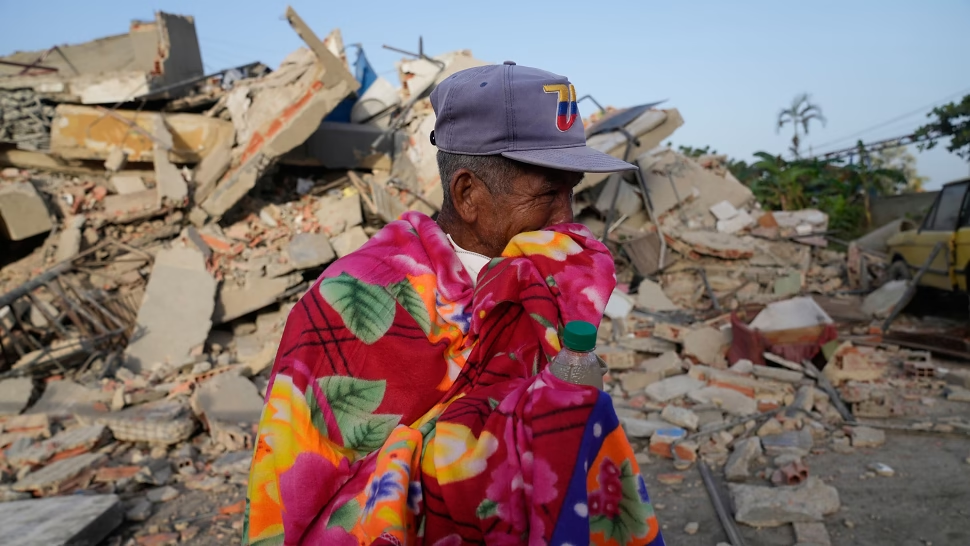

Mexico deploys aid brigade to Venezuela after earthquakes

Mexico sent 250 soldiers and medical supplies to Venezuela after the earthquakes.

Humanitarian aid to Venezuela

Mexico sent a support contingent to Venezuela to address the damage caused by two strong earthquakes that shook the north-central region of the country.

President Claudia Sheinbaum confirmed the measure and reiterated the solidarity of her government.

“Our solidarity with the people of Venezuela. A team of rescuers and medical personnel from the Ministry of Defense leaves today. Once they are established there and after talking with the authorities, we will determine the additional personnel necessary.”

The first emergency brigade is made up of 250 soldiers, five canine units, four aircraft, a drone, specialized investigation equipment and medical supplies.

No collection centers for now

When asked about the possible opening of collection centers, the president clarified that “for the moment, they have asked us for rescuers and health support; they have not asked us for food aid.”

Sheinbaum added that so far no compatriots have been injured, missing or died in the tragedy, and that the situation remains under surveillance.

Continue reading

Telephone line registration: new calendar until December

New staggered calendar to register telephone lines in Mexico. Know the dates according to your number.

The Telecommunications Regulatory Commission (CRT) extended the deadline to register telephone lines until December 2026. So far, only 63 million users (39.1% of the total) have completed the process. Of them, 40.2 million are prepaid and 22.8 million are postpaid.

Calendar by last digit

Registration will be done in stages according to the last digit of the telephone number:

  • 0: August 15
  • 1: August 31
  • 2: September 15
  • 3: September 30
  • 4: October 15
  • 5: October 31
  • 6: November 15
  • 7: November 30
  • 8: December 15
  • 9: December 31

Consequences of not registering

If you do not register before the deadline, your operator will suspend the line within 72 hours. You will only be able to make emergency calls, to citizen services and receive seismic alerts. You will lose access to mobile data, although you will be able to use Wi-Fi networks.

After expiration, you can register your line and service will be fully restored. The procedure is carried out with your operator and requires the CURP. Check your company’s official site for more details.

Continue reading

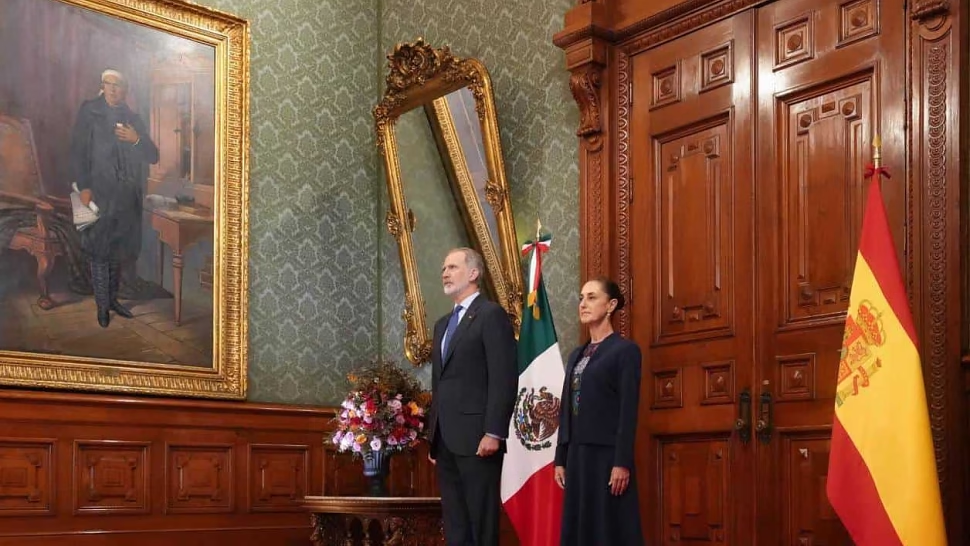
Mexico receives King Felipe VI with honors at the National Palace

Sheinbaum and the Spanish monarch discuss the bilateral relationship in the National Palace.

Welcome ceremony at the National Palace

President Claudia Sheinbaum Pardo received King Felipe VI of Spain this day in the Ambassadors Room of the National Palace. During the official ceremony, the national anthems of both countries were sung, followed by the official photograph of the meeting.

Bilateral meeting

Sheinbaum and the monarch will hold a dialogue about the state of the relationship between Mexico and Spain. Senior officials from both governments attend the meeting.

On behalf of Mexico: the Secretary of Foreign Affairs, Roberto Velasco Álvarez; the head of the Office of the Presidency, Lázaro Cárdenas Batel; and the Mexican ambassador to Spain, Quirino Ordaz Coppel.

For Spain: the Minister of Foreign Affairs, European Union and Cooperation, José Manuel Albares Bueno; the Minister of Education, Vocational Training and Sports, Milagros Tolón Jaime; the head of the King’s House, Camilo Villarino Marzo; the ambassador of Spain in Mexico, Juan Duarte Cuadrado; the diplomatic advisor of the King’s House, Carmen Castiella Ruiz de Velasco; and the head of the Minister’s Office, Sergio Cuesta Francisco.

The visit of King Felipe VI takes place within the framework of his official tour of Mexican territory. Both leaders are expected to address issues of cooperation, trade and culture.

Continue reading