The future of driving, according to Tesla: Running red lights is just the beginning
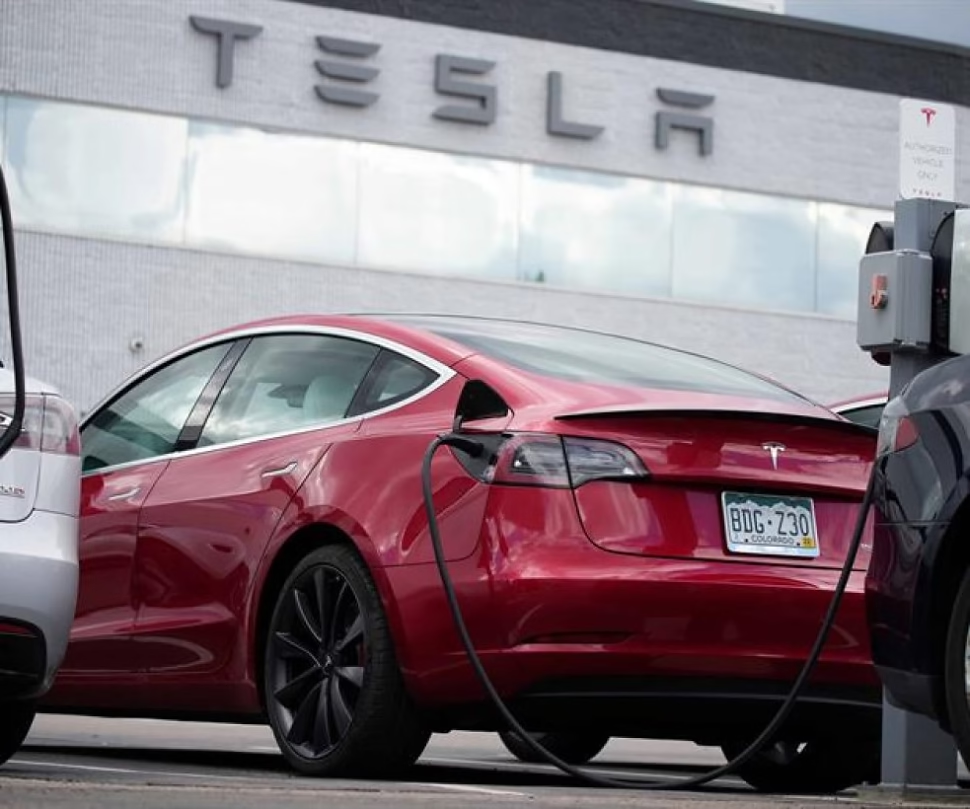
It seems that Tesla’s much-hyped autonomous driving has decided that traffic rules are, as a rebellious teenager would say, more of a suggestion. American regulators, in a fit of boring conservatism, have opened another investigation—because who’s keeping score anymore?—into the technology that allows Tesla vehicles to perform feats like running red lights or deciding that the oncoming lane has a better view. All this, of course, for the sake of a more exciting driving experience and, sometimes, with the bonus of a collision with other cars and injuries to people. Because adventure has its price.
The National Highway Traffic Safety Administration, known to its friends as the NHTSA, has taken out its magnifying glass to examine 58 reports of incidents where Teslas, in an act of pure digital free will, gleefully violated traffic safety laws while operating in Full Autonomous Driving mode. The funniest thing—if by funny we mean deeply worrying—is that, according to the drivers’ own accounts, the cars gave them no warning about their unexpected behavior. Come on, the car got creative and the driver was left as a spectator of his own road horror movie.
A history of “successes” and broken promises
So that no one thinks that this is something isolated, let us remember that in August, a jury in Miami, probably bored with watching series, determined that Tesla was partially responsible for a fatal accident in 2019 in Florida. The accident involved its Autopilot technology — which, be careful, is different from the Full Autonomous Driving system, because in the Tesla world it is vital to make subtle distinctions between systems that can also fail miserably. The verdict was that the company must pay the victims more than $240 million in damages. Tesla’s response, with unmatched corporate elegance, was that it will appeal the decision. Because when reality doesn’t favor you, the best thing is to appeal to… well, something.
This new research is so ambitious that it covers a whopping 2,882,566 vehicles. Basically, all Teslas equipped with Full Self-Driving (FSD) technology. This is where things get juicy. It turns out there are two types: Level 2 driver-assistance software, or “Full Autonomous Driving (Supervised),” which requires drivers to pay “full attention” to the road (a radical idea, I know), and a version that the company is still testing that, in theory, requires no driver intervention. The latter is the one that the owner and CEO, the always optimistic Elon Musk, promised to launch years ago. Apparently, on Musk’s calendar, “coming soon” can mean “in a decade or more.”
In case anyone doubted it, this new investigation joins a parade of other investigations into the FSD function, which is attributed the dubious honor of being behind several injuries and deaths. Tesla’s official stance is that the system cannot drive itself and that human drivers must be ready to intervene at all times. Come on, you pay tens of thousands of dollars for an autonomous driving system only to be told later that you are the reserve pilot, permanently on alert. What a bargain!
But NHTSA doesn’t stop there. It is also researching technology that allows drivers to tell their cars to drive to their location for pickup, a feature that has reportedly resulted in some minor parking lot crashes. Because nothing says “luxury and innovation” like your $60,000 car scraping against a pylon while trying to find you. Additionally, an investigation into driver-assist features in 2.4 million Teslas was opened last year following several crashes in foggy and other low-visibility conditions, including one where a pedestrian was tragically killed.
And as if to prove that bureaucracy has a sense of humor, too, NHTSA opened another case in August to investigate why Tesla apparently wasn’t reporting accidents in a timely manner to the agency, as its rules require. Who would have thought, right? It seems that reporting your own bugs isn’t as fun as promising flying cars.
The pressure on Musk and the mirage of the robotaxi
Meanwhile, Mr. Musk is, how can I put it, under a little bit of pressure. It should prove that Tesla’s latest advancements in its driver-assist features have not only fixed these little “glitches,” but have improved them so much that drivers won’t even need to look out the window anymore. A bold vision, to be sure: a world where you blindly trust a machine that reportedly sometimes ignores red lights. Recently, the CEO again promised to put hundreds of thousands of Tesla autonomous vehicles and robotaxis on the roads by the end of next year. At the current rate, one wonders if those robotaxis will come with a sign saying, “Sorry for the crashes, this is a beta feature.”
And, as often happens when the news isn’t exactly brilliant, Tesla shares were down 2% in pre-close trading on Thursday. A market reaction that we could describe as “prudent”, or perhaps “terrified”. Regulatory agency investigations can often lead to recalls, a scenario that would undoubtedly delight shareholders. Because nothing boosts investor confidence more than knowing that your fleet of vehicles could be recalled for not understanding a simple red light.
In short, the journey towards full vehicle automation appears to be bumpier than anticipated. As Tesla navigates this maze of regulatory inquiries and broken promises, drivers are left with a system that demands their constant attention but is sold as autonomous, a paradox as big as a Cybertruck. The future of mobility is here, and it comes with an instruction manual that says: “Watch the self-driving car.”
Has this news surprised you? Share this article on your social networks and make your contacts also enjoy this gem of innovation with feet of clay. And be sure to explore more content related to the revolution of electric and autonomous vehicles on our website.