Téllez questions the Senate about the secret beauty salon

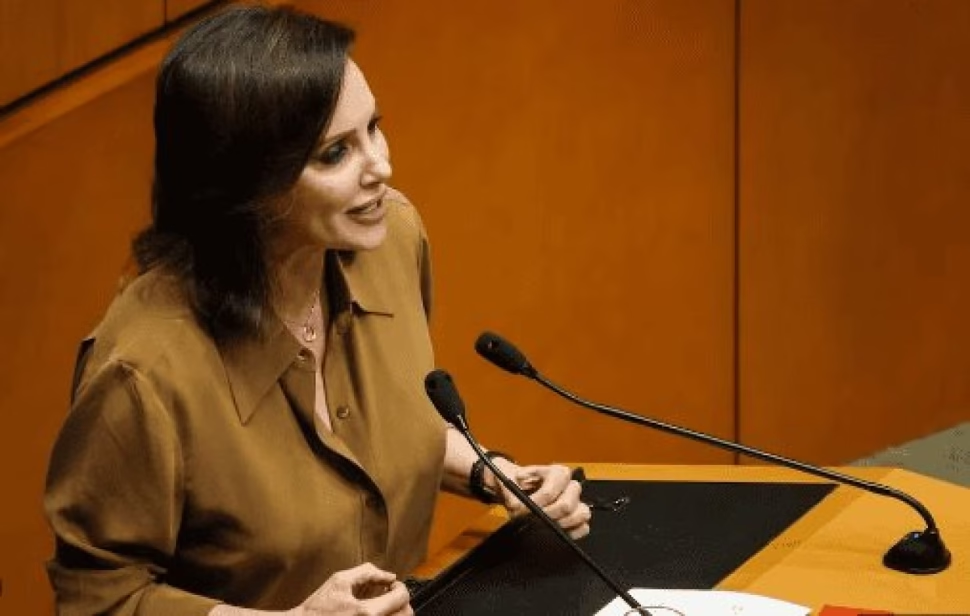
Senator Lilly Téllez demands explanations about a beauty salon inside the Senate and its expenses with public money.

The million dollar question: who paid for the makeup?

Lilly Téllez, the PAN senator who seems to have a detector of institutional nonsense, has just dropped a bomb. It’s not a missile, it’s a letter. But with 21 questions so sharp that they cut off any attempt at evasion.

Addressed to the president of the Senate, Laura Itzel Castillo, the letter demands clear accounts about that beauty salon that operated inside the Commission Tower. A place where, apparently, the perfect hairstyle was prioritized over legislative work.

“Any opacity… in the allocation of spaces for purposes unrelated to the legislative function is legally unacceptable,” warns Téllez in his writing.

And here comes the good thing. The senator does not ask for half-explanations. He goes straight to the bone with questions that are a basic manual for detecting irregularities.

RelatedLilly Téllez reveals political maneuvers in the Senate election

The 21 uncomfortable questions

Who authorized this? With what money? Was there a contract? Was rent paid? The questions are so specific it hurts. Ask for a copy of the official letter, the agreement, the contract. Requires the RFC of the business and invoices.

But there is one that resonates with special cynicism: how do you justify a beauty salon when there is a lack of space for advisors and commissions?

Another gem: it mentions documented purchases from a marketer for almost 200 thousand pesos in makeup and brushes. What bag did that money come from? From the treasury? The question hangs in the air, waiting for an answer that will probably never come.

And then there is the issue of access. Was it exclusive for brunettes? Téllez requests that the complete list of users be made public, with name, position and service received. Something tells me that this list will be more elusive than a political commitment in an election year.

The misogynistic defense and the ghost boleros

While Téllez plays the prosecutor, another senator, Beatriz Mojica from Morena, brings out the misogyny card. Their argument: there have been boleros here for 50 years and no one bothers.

“I think it’s an extremely misogynistic topic…no one has noticed that boleros clean men’s shoes,” Mojica declared.

The comparison is curious. On the one hand, an informal and visible service (the boleros) in front of a commercial establishment installed with luxury supplies paid for… perhaps with public money. It is not the same, Madam Senator.

In addition, the boleros charge 35 pesos for service directly to the client. There is no evidence (for now) that the Senate buys their bitumen or pays their salary.

Perfect timing and selective amnesia

The most revealing thing is question 15. Castillo had said that the room “was nothing out of the ordinary” and that we all “have to be well presented”. But after the media scandal… closure! What changed? Ethics or cameras?

Téllez also asks if this establishment had been closed before and then reopened. Because in this country historical memory is conspicuous by its absence, especially when it is convenient.

In the end, the message is clear:

  • Total transparency or nothing
  • Generic answers will not be accepted
  • This smacks of privilege disguised as aesthetic necessity

While millions grapple with the economy, some in the Senate seem concerned about having perfectly plucked eyebrows. Irony hurts more than a clamp.
IMSS and Fonacot update agreement to improve services for workers

IMSS and Fonacot renew their alliance until 2030 to streamline procedures and protect labor rights.

Strategic alliance for labor rights

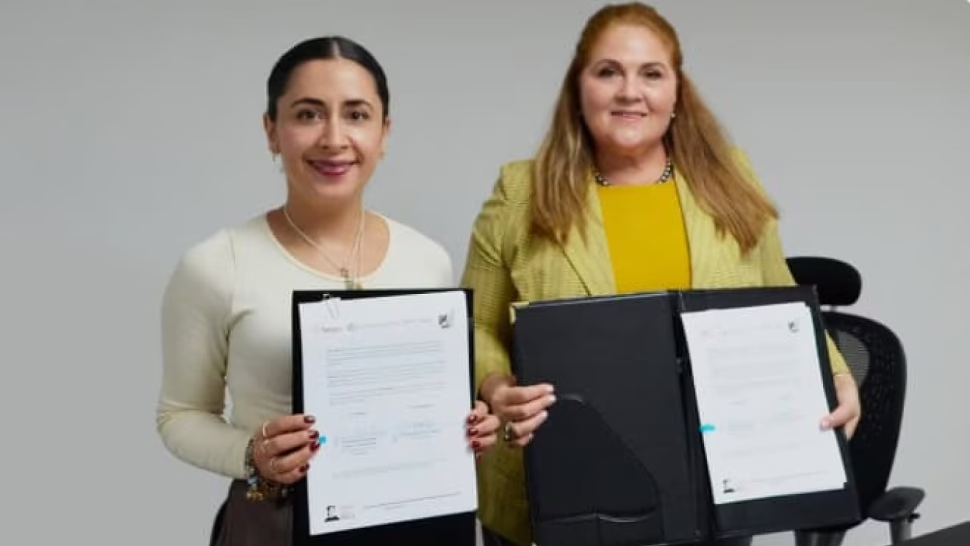
The Mexican Social Security Institute (IMSS) and the National Fund for Workers’ Consumption (Fonacot) signed a collaboration agreement that updates their exchange of information and services. The objective: respond to the current operational, technological and regulatory needs of both agencies.

The agreement was signed by Wendolyne Retana Alarcón, general director of Fonacot, and Luisa Obrador Garrido Cuesta, director of Incorporation and Collection of the IMSS. It will be valid until September 30, 2030, with the possibility of extending it for two more years.

The relationship between both institutions dates back to 2007. Since then they have maintained a constant flow of data to facilitate procedures and guarantee better credit and social security conditions for working people.

With this update, the aim is to streamline processes, reduce response times and strengthen the protection of the rights of the country’s formal workers.

Continue reading

Energía Costa Azul makes first shipment of LNG in the Pacific

First shipment of liquefied natural gas from the Mexican Pacific marks an energy milestone.

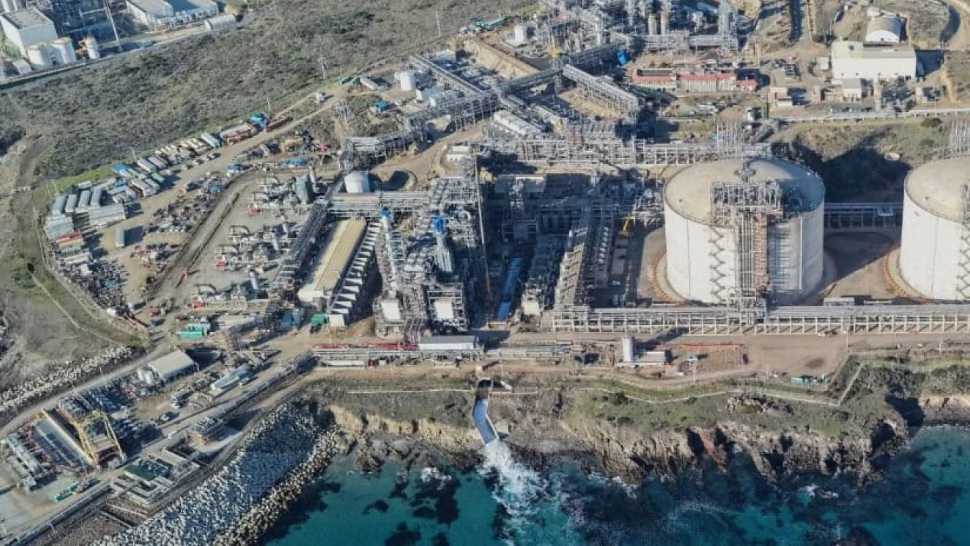
The Energía Costa Azul project, in Ensenada, Baja California, completed the first shipment of liquefied natural gas (LNG) from the Mexican Pacific coast. The Sempra Infrastructure company confirmed that the shipment is part of the tests prior to the start of commercial operations.

International context

This movement occurs in a context of high demand for energy security. Tensions in the Strait of Hormuz, through which nearly 20% of global LNG trade passes, have accelerated the search for new supply routes.

Strategic advantage

Sempra Infrastructure noted that phase 1 of the project will connect North American gas with Asian markets, taking advantage of the strategic location of the Mexican Pacific coast. Researcher Adrián Duhalt highlighted that the proximity to the gas-producing basins of the United States represents a competitive advantage for Mexico.

Continue reading

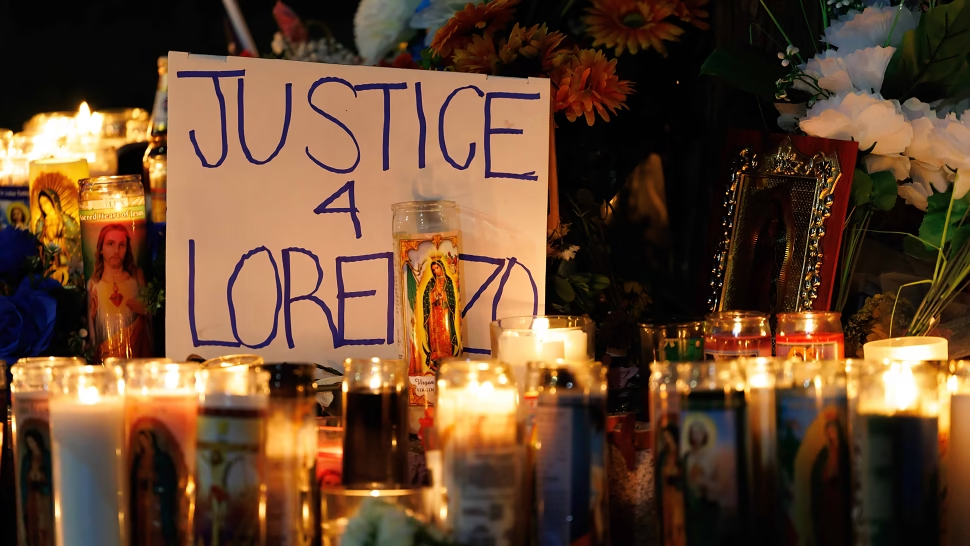
Mexico pressures the US over the death of a migrant at the hands of ICE

Mexico demands investigation after death of compatriot at the hands of ICE.

The Mexican ambassador to the United States, Roberto Lazzeri, confirmed that the diplomatic representation will accompany the family of Lorenzo Salgado Araujo, a Mexican citizen who died after being shot by agents of the Immigration and Customs Enforcement Service (ICE).

What actions will Mexico take?

Lazzeri announced that all available resources will be used to demand a serious and transparent investigation. The case joins a list of 17 Mexicans deceased in events linked to ICE operations or in immigration detention centers.

On instructions from President Claudia Sheinbaum and Foreign Minister Roberto Velasco, the Embassy in Washington and the Consulate in Houston will meet with US authorities: Department of State, Department of Homeland Security and ICE itself.

Meeting details

Mexico will request a detailed review of what happened and the implementation of clear protocols to prevent similar events from being repeated. “We do not seek to question the right of the United States to apply its laws, but rather to guarantee respect for life and human dignity,” Lazzeri said.

The diplomat reiterated that Mexico will maintain a firm stance in the defense of its compatriots in US territory.

Continue reading