Starbucks baristas rebel against new dress code

The barista rebellion shakes Starbucks as the new uniform lights the fuse of discord.

The Rising of the Green Aprons

In a twist worthy of the most epic labor battles, Starbucks baristas have raised their milk foams as shields and their filter holders as weapons. No, it’s not a metaphor: more than 2,000 caffeine warriors in 120 stores in the United States have declared war on the coffee giant. The trigger? A dress code that, according to them, smothers their identity under a cloak of black fabric.

The Battle for the Forbidden Colors

As of Monday, corporate edict requires employees to dress like living shadows: black T-shirts, khaki or navy pants. Starbucks claims this will make its iconic green aprons “shine,” but baristas see a trap. “Does the color of my shirt affect the taste of your latte?” cries Paige Summers, a supervisor in Maryland, while the Starbucks Workers United union accuses the company of imposing rules without negotiating.

RelatedStarbucks gives up control of its business in China for 4 billion

The irony is cruel: the same company that sells sweatshirts with its logo prohibits wearing them at work. And although they offered two free black t-shirts, employees ask: Is this a gesture of goodwill or a patch on an open wound?

The Front Expands

On Wednesday, 75 more stores joined the rebellion. Starbucks downplays its importance: “99% of our branches continue to operate,” they say, but between the lines you can read the tremor of an empire that never imagined that its baristas—those anonymous heroes of the mornings—could paralyze its machinery. In some stores, the doors were closed for less than an hour, but the message resonated like a bitter espresso: labor dignity is not negotiable.

Meanwhile, public opinion is divided. “In other jobs there are also uniforms,” ​​some argue. Others counterattack: “Wouldn’t it be better to improve salaries than to control locker rooms?” The union, which since 2021 has organized 570 stores, knows that this strike is not just about fabrics: it is the spark that could set the future of labor rights in the industry on fire.

What’s next? The world is watching. Every cup served, every silent protest with a backwards apron, is another chapter in this saga. And you, whose side are you on?

Share this story and join the conversation about labor rights! Explore more content on union struggles in our dedicated section.
Death of Mexican in Houston sparks support campaign

Hispanic community in the US raises funds and demands investigation after the death of Lorenzo Salgado.

The case of Lorenzo Salgado Araujo

The death of Mexican Lorenzo Salgado Araujo, 52, on July 7 in Houston after being shot by an Immigration and Customs Enforcement (ICE) agent, has generated shock in the Hispanic community.

The League of United Latin American Citizens (LULAC) launched a GoFundMe campaign to support the family. As of this Thursday, 242,109 dollars (4.2 million pesos) had been raised out of a goal of 350,000. Among the donors, the activist Carlos Eduardo Espina stands out.

“Lorenzo was taken from those who loved him most. He was a husband, father of three children, owner of a small business and the soul of his family,” the campaign states.

The funds will go towards funeral and legal expenses and daily needs of the wife and children.

The Department of Homeland Security (DHS) states that Salgado attempted to flee and rammed his vehicle into an agent, who fired in self-defense. However, the family and activists demand an independent investigation. A video spread on social media shows ICE chasing the truck, not the attacking Mexican.

LULAC recalled the case of Renee Good, where a similar version was denied by videos.

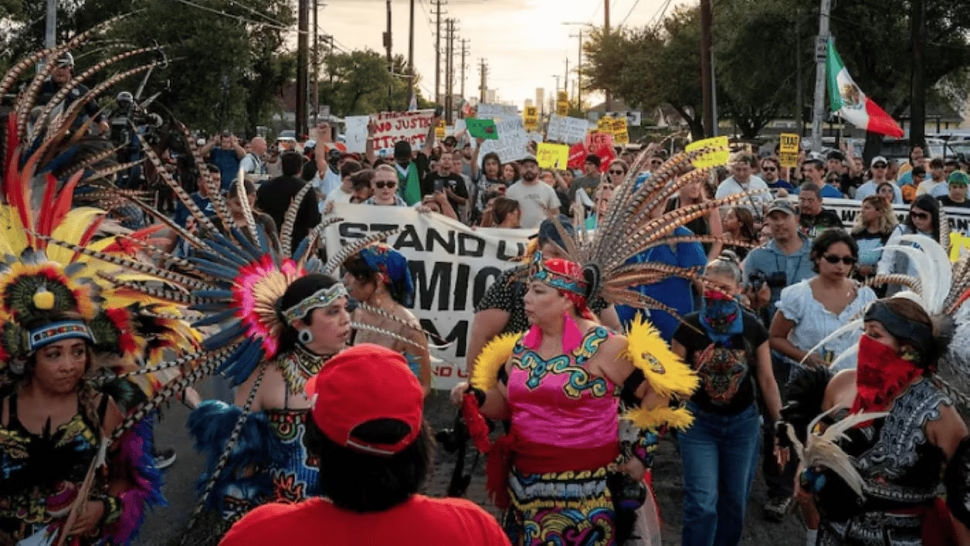
Hundreds of people protested Wednesday in the Magnolia Park neighborhood. César Espinosa, from FIEL Houston, declared:

“This is the place where Lorenzo breathed his last. If they come for one of us, they come for all of us.”

Activist Conchita Reyes, on behalf of the family, said:

“My dad was shot and bled to death. He didn’t deserve to die. He deserved to come home to his wife.”

The organization demands that Lorenzo Salgado’s name be repeated and that the facts be clarified.

Continue reading

US and Iranian attacks threaten Middle East ceasefire

New US airstrikes on Iran and Iranian retaliation put the truce in the region at risk.

New attacks and reprisals

Early Thursday morning, the United States launched new airstrikes against Iran. In response, Tehran attacked Persian Gulf countries allied with Washington. The escalation puts at risk a provisional agreement that sought to end the war in the region.

Warning sirens sounded at least three times in Bahrain, headquarters of the US Fifth Fleet. Missiles also hit Kuwait and Qatar. Later, Jordan, where the US has troops and aircraft, also raised its alarms.

Iranian reaction and victims

An Iranian official accused Washington of attacking the area around the country’s only nuclear power plant. During the afternoon, more explosions were reported in other areas.

According to Iran’s Ministry of Health, the two days of bombing have left at least 14 dead and 78 injured. The majority belonged to the armed forces.

In Kuwait, one person was injured by debris when air defenses shot down three ballistic missiles, a cruise missile and 10 drones. Bahrain reported that it intercepted incoming fire, without further details. Jordan, through its spokesman Mohammad al-Momani, confirmed that all Iranian fire was intercepted.

Iranian state television reported that the Revolutionary Guard fired missiles at a US base in Jordan. So far there are no reports of damage in Qatar.

The actions come hours after President Donald Trump warned that Iranian attacks on ships in the Strait of Hormuz meant the end of the fragile ceasefire. He threatened to escalate the conflict if the attacks did not stop. The international community fears that the region will once again fall into a multiple war, which could block energy shipments through the strait, vital for the global economy.

Continue reading

Irishman sentenced to 14 years for death of tourist in Budapest

An Irish tourist faces 14 years in prison for a homicide in Budapest.

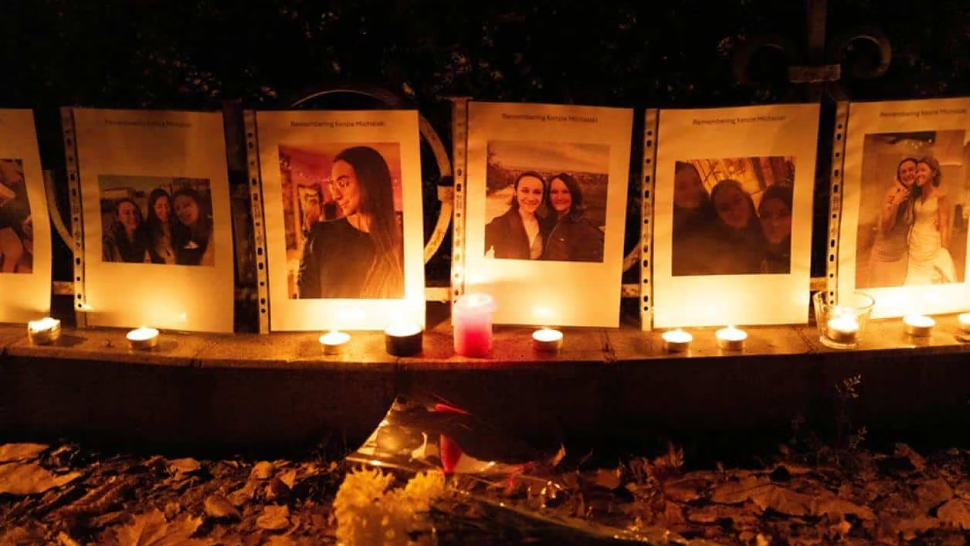
A Budapest court sentenced an Irish citizen to 14 years in prison for the death of an American tourist. The victim, Mackenzie Michalski, 31, of Portland, Oregon, disappeared on November 5 after being last seen at a nightclub.

Police reviewed security footage and observed Michalski with a man at several clubs that night. The suspect, identified as L.T.M. and 37 years old, was arrested on November 7 and confessed to the homicide.

According to the authorities, both met at a club, danced and then went to the man’s apartment. During an intimate encounter, the subject hit and suffocated the victim. Subsequently, he tried to hide the crime: he cleaned the place, hid the body in a closet, put it in a suitcase and rented a car to transport it to Lake Balaton, 150 kilometers from Budapest, where he abandoned it in a wooded area.

The Budapest Metropolitan Court found him guilty of murder and sentenced him to 14 years without parole. The time in preventive detention will be deducted from the sentence. In addition, he must pay 2.5 million forints (almost $8,000) in court costs. His lawyer appealed the verdict.

The police revealed that the man had conducted internet searches on how to dispose of a body, police procedures and whether pigs or wild boars consume human remains. A video showed the subject leading authorities to the place where he left the body.

After serving his sentence, he will be deported from Hungary.

Continue reading