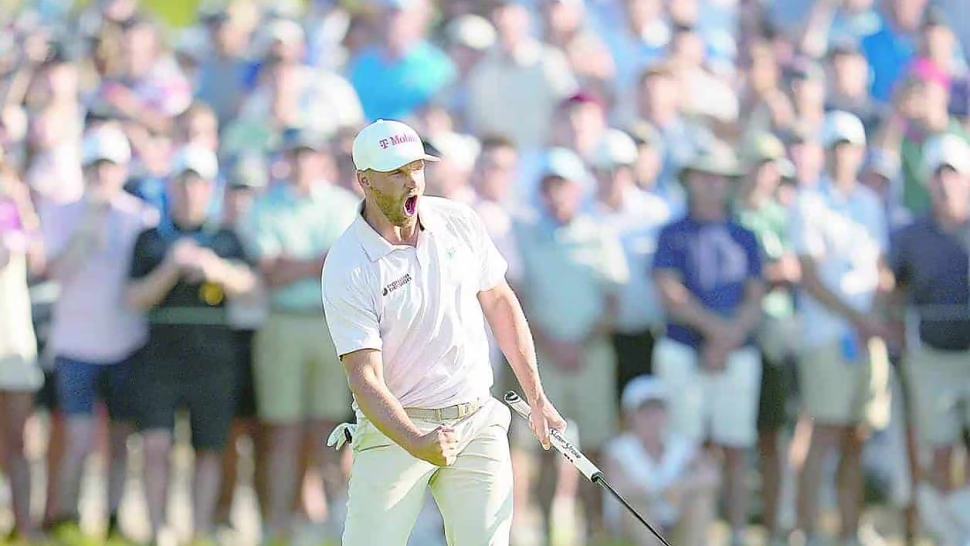
The day Springer’s side played tricks on Toronto
In a twist that no one, except perhaps a fortune teller or fate itself with a peculiar sense of humor, saw coming, George Springer was graciously invited to take a seat on the bench for the fourth and crucial game of the World Series. The reason? An untimely pain in the right side that decided to appear right in the middle of a swing, because what better time for an injury than the climax of the season?
Manager John Schneider, demonstrating a planning capacity that would make a military strategist pale, confessed to having two lineups prepared: one with Springer and one without him. A decision as complex as asking someone if they prefer coffee or tea, but with the small difference that this involves a star player in the World Series. With an opacity worthy of a spy agency, Schneider refused to reveal the results of the MRI, leaving everyone wondering whether it was a tear or simply a deep desire not to face the boos of Los Angeles again.
“He’s just trying to move and swing. I think the swing is going to be the key to determining whether he’s ready or not,” Schneider declared with a pearl of wisdom comparable to stating that “getting wet is key to determining whether you’ve fallen into a pool.” He added that Springer, in a fit of dedication, was the first to arrive and received “a lot of treatment.” Because nothing cures a side injury like a good dose of… well, absolute secrecy.
The unexpected relief and the golden advantage of Los Angeles
In the absence of the experienced outfielder, the role of designated hitter fell to Bo Bichette, who until recently had as close a relationship with the field as a hermit does with social life. Bichette, with limited mobility due to a sprained knee, was the chosen option. Because clearly, when you’re missing a key player, the logical thing to do is replace him with someone who is also in the process of remembering how to bend your legs without pain. Meanwhile, Isiah Kiner-Falefa appeared at second base, completing a defensive puzzle that seemed more like a tactical experiment than a conventional lineup.
While Toronto improvised, the Los Angeles Dodgers were enjoying their 2-1 series lead, gained after an epic 6-5 victory on Monday, decided by Freddie Freeman’s home run in the 18th inning. Because what is postseason baseball without a little extra drama, extreme physical wear and tear, and the feeling that the stadium could become the permanent home of some players?
The injury, the boos and a ghost called 2017
Springer’s injury occurred in the seventh inning of Game 3, when he missed a sinker by Justin Wrobleski. The pain was so compelling that it forced him to leave the match, proving once again that the human body has a timing for injuries that rivals that of a stand-up comedian. To make matters worse, his performance up to that point was not exactly something to write home about: zero hits and two strikeouts in three at-bats.
But the real show was not on the diamond, but in the stands of Dodger Stadium, where the home fans greeted Springer with a symphony of boos before each inning. And the collective memory in baseball is longer than a fan’s list of complaints on social media. Dodgers fans have not forgotten, nor will they ever forget, that Springer was the Most Valuable Player of the 2017 World Series with the Houston Astros, the team that took the title from them in seven games in a series that was later marred by the sign-stealing scandal. So naturally, every time Springer steps up to the plate, he gets a loving audible reminder of that “little misunderstanding.”
Springer came into this game with 14 hits in 57 at-bats in the postseason, including four home runs. His three-run homer in Game 7 of the American League Championship Series was instrumental in the Blue Jays eliminating the Seattle Mariners and advancing to their first World Series since 1993. Ironically, in that same ALCS, he was hit in the right kneecap by a 96 mph pitch from Bryan Woo, which had already forced him out of one game. Because, apparently, Springer’s postseason wouldn’t be complete without a good hit or a colorful injury to add a little extra drama.
Was this exclusion a masterstroke of caution or an act of tactical desperation? Only time, and perhaps the results of that MRI that Schneider keeps as a state secret, will tell.
Do you think this drop was decisive? Share this tragicomic play of destiny on your social networks and discover more analysis of the most absurd moments in sport.