Sonora faces a wave of minors recruited by organized crime

The alarming number of children recruited into crime in Mexico reveals a crisis that goes beyond gangs.

When the “gang game” becomes too real

Imagine if, instead of worrying about your child spending too much time on TikTok, you had to fear that they would be recruited to transport drugs in an armored monster. This is how stark the reality is in Sonora, where 344 children (yes, you read correctly, children) have been arrested this year for being sidekicks of organized crime. The age range? Between the ages of 10 and 12, that is, when they should be more interested in Minecraft than modifying vehicles for “combat” (a fancy term for “shootouts”).

The “bad kids” that no one wants on their team

According to Sergio Méndez, FGR delegate in Sonora (and probably the man with the most depressing job in the state), these “little boys”—as he calls them with a touch of bureaucratic tenderness—are recruited without understanding the consequences. That is, basically like when you accept the terms and conditions of an app without reading, but with bullets involved.

RelatedJawy’s appointment as a laborer at La Granja VIP

The most surreal thing is that some are not even local: they are imported from other states, as if organized crime were doing their own version of “Talent Pool”, but instead of soccer players, they look for preteens for their operations. Recruiter of the year? Probably a guy who trades candy for loyalty to a cartel.

Méndez, who since 2021 has tried not to lose his sanity in office, proposes tripling the penalties for those who recruit minors. Because, of course, if something works with organized crime, it is legal threats (said with as much sarcasm as possible). Meanwhile, parents are singled out for not “watching” their children, as if the problem were that they escaped from between their legs instead of a system that normalizes violence from the cradle.

From 22 to 344: when statistics are scarier than a jumpscare

In September of last year, Méndez reported 22 detained minors. Today, the number multiplied as if someone had applied a cheat code in GTA: 344 children with weapons, modified vehicles and zero concern for math homework. The macabre detail? Some operate in the northwest region, where the “big events” are not concerts, but confrontations between cartels.

And in case drama was missing, this coincides with the wave of violence in Sinaloa, where Los Chapitos and La Mayiza are fighting for the throne like in Game of Thrones, but with more narcocorridos and fewer dragons. The result: children used as pawns in a war they don’t even understand.

What’s next? Daycares with workshops on “How to avoid being recruited by a cartel”? Meanwhile, the numbers continue to rise, parents remain desperate, and organized crime continues to see children as disposable material. And we, as a society, continue scrolling as if it were not our problem.

Did this note outrage you? Share it and let’s make what really matters go viral. If you want more content like this, explore our investigations on security and violence in Mexico. #ChildrenNotSoldiers

*Note: No children were consulted for this text, but I hope someone is listening to them in real life.

UAT students win bronze for gum against HPV

Natural gummy project against HPV wins bronze medal in Ibero-American final.

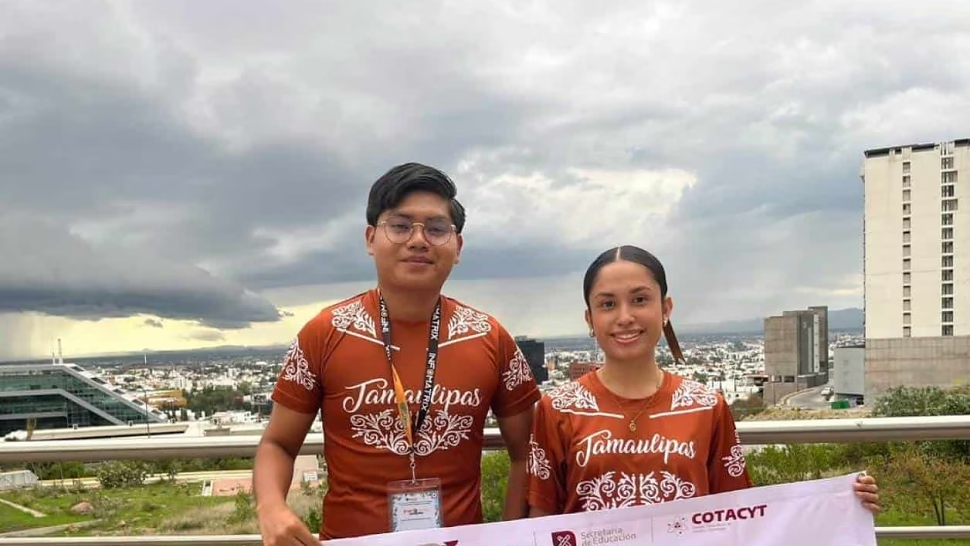
Two students from the Autonomous University of Tamaulipas (UAT) achieved third place in the Ibero-American Final of Infomatrix 2026, one of the most important science and technology competitions in the region.

Juan Pablo Hernández Hernández and Yuridia Guadalupe Ruiz García, from the Tampico Faculty of Nursing, presented “V-Guard Gummies”, a gummy made with natural extracts that seeks to strengthen the immune system and support the prevention and treatment of the human papillomavirus (HPV).

High level competition

The event was organized by the Latin American Society of Science and Technology (SOLACYT) at the Tecnológico de Monterrey, San Luis Potosí Campus. It brought together 610 exhibitors and representatives of 250 finalist educational institutions from all over Latin America.

The young people reached this stage after obtaining the gold medal in the Gulf North regional phase. Their project received direct accreditation to the international phase thanks to the high score, quality and medical impact of the prototype.

The rector of the UAT, Dámaso Anaya Alvarado, promotes research and academic excellence as part of university education. This result reflects the work of students and teachers in developing accessible solutions to public health problems.

Continue reading

Foreign SIMs do not prevent cell phone registration in Guatemala

Users seek to avoid registering lines with chips from abroad, but the CRT warns of restrictions and costs.

The deadline for the mandatory registration of cell lines in Guatemala is about to expire. Given this, some users are exploring the use of SIM cards from other countries to maintain their service without handing over personal data.

Limited alternatives

The Telecommunications Regulatory Commission (CRT) clarified that contracting a line abroad does not allow evasion of the provision. Users must meet the requirements to retain their mobile services.

While unlocked phones can run on international chips, authorities noted restrictions from foreign carriers. There are also higher costs for prolonged use outside the country of origin.

The measure seeks to strengthen security and prevent anonymous use of lines. The authorities insist that there are no valid shortcuts for those who intend to skip registration.

Continue reading

Sheinbaum responds to Ken Salazar’s book about the capture of El Mayo

Sheinbaum clarifies that AMLO did not fear statements from Zambada, but rather intervention from the US.

National sovereignty at the center of the controversy

Diplomatic tensions between Mexico and the United States were reignited after the released fragments of former ambassador Ken Salazar’s memoirs. In the text, Salazar states that former President Andrés Manuel López Obrador expressed concern about the capture of Ismael “El Mayo” Zambada in unclarified circumstances.

President Claudia Sheinbaum responded this Monday. He noted that López Obrador’s concern did not revolve around possible statements by the criminal leader. The real concern was the possible intervention of US agencies in Mexican territory during the detention. Sheinbaum described the issue as a matter of national sovereignty.

Sheinbaum recalled that the bilateral relationship had already entered a “pause” during the previous six-year term. That pause was due to differences with the US embassy and criticism about internal reforms. The president reiterated that security cooperation must be based on coordination and mutual respect.

The book, titledBorders. My Fight for an Inclusive United Statesalso describes the deterioration of the diplomatic relationship at the end of López Obrador’s government. Salazar maintains that the arrest of “El Mayo” could be the result of negotiations between organized crime factions and US authorities. This version continues to generate political controversy in both countries.

Continue reading