Six detainees and arsenal seized in Culiacán

Two operations in Culiacán lead to six detainees and an arsenal seized after anonymous calls.

Operations in Culiacán leave six detainees and an arsenal

The emergency lines rang again. This time, it was anonymous calls that alerted about civilians with weapons in two parts of the city. The result: six people detained and war loot that seems to have been taken from a warehouse.

In the Hacienda del Valle subdivision, state agents noticed a gray Mazda. Upon reviewing it, the surprise was capital.

Two AK-47 rifles, an M-4 type rifle, twelve magazines supplied for 7.62X39 caliber, six more for 5.56X45 caliber weapons, 180 useful cartridges and three tactical vests were found.

But the inventory didn’t end there. Inside the car there was also a white bucket with 74 steel points to damage tires. A detail that speaks of preparation, not of an outburst.

RelatedArmy dismantles criminal camp in Miguel Alemán with seized arsenal

While they were processing that scene, the second alert came. This time in the Adolfo López Mateos neighborhood. Another Mazda, another story.

The occupants tried to escape by shooting. One was injured jumping a fence. In the end, two men and a woman fell.

He seized five firearms, including an M-16 rifle, six magazines, ninety cartridges and a Mazda vehicle reported stolen.

The authorities already have the six before the Attorney General’s Office of the Republic. Their mission now is to trace the origin of that arsenal that was circulating through the streets.

The official message is clear: keep reporting. Anonymous calls work. But one can’t help but wonder: where do so many weapons come from? And how many more Mazdas are on the road with a similar load? Memory is short, but arsenals seem inexhaustible.


SCJN will review decree that protects works by Frida Kahlo

The Court will analyze whether the ban on exporting Frida Kahlo paintings is constitutional.

The SCJN takes up the Frida Kahlo case

The Supreme Court of Justice of the Nation (SCJN) decided to resume its jurisdiction to analyze a key case on the protection of Frida Kahlo’s work. The plenary session of the highest court will study whether it is constitutional to prohibit the definitive departure from the country of paintings by the artist that are in the hands of individuals.

The presidential decree of 1984

The central point is article 6 of the decree issued in 1984, during the government of Miguel de la Madrid. The provision declared Kahlo’s entire production an artistic monument and prohibited its permanent export. Now, the Court must determine whether this restriction exceeds the powers of the Executive Branch.

The case strikes a balance between the protection of cultural heritage and property rights. The resolution will set a precedent on the scope of the State to limit the circulation of private artistic goods.

The SCJN has not set a date for the discussion in plenary, but the debate promises to be intense between ministers. Meanwhile, collectors and heirs are closely following the process.

Continue reading

Oaxacan transporters maintain road blockade for the second day

They demand regularization of units and a dialogue table with SICT.

Mobilization of transporters in Oaxaca

Federal passenger transportation service providers keep federal highway 190 blocked for the second consecutive day, near the SICT delegation in Oaxaca. They demand the regularization of their units and attention to their demands from the federal authorities.

The mobilization is led by the General Coordinator of Oaxacan Transporters. With Urvan-type vehicles and buses, they prevent circulation in both directions. According to leader Francisco Santos, nearly 500 units are participating in the protest, which will be indefinite until a favorable response is obtained.

Historical demands

The transporters point out that the conflict has continued for more than three decades. The lack of regularization prevents them from having legal certainty to operate on federal highways. For this reason, they ask for a dialogue table with SICT officials to advance a reorganization of federal motor transportation.

In addition, they denounce the alleged invasion of routes by the Binni Bus system, which they accuse of operating without authorization on federal highways and generating unfair competition for concessionaires.

Road effects

The blockade occurs in one of the main accesses to the Oaxacan capital. The protesters reiterate that they will not withdraw their protest until they receive a concrete response from the federal authorities regarding their demands.

The situation reflects a historical problem in the transportation sector in Oaxaca. Transporters insist on the need for effective dialogue to resolve the conflict that affects mobility in the region.

Continue reading

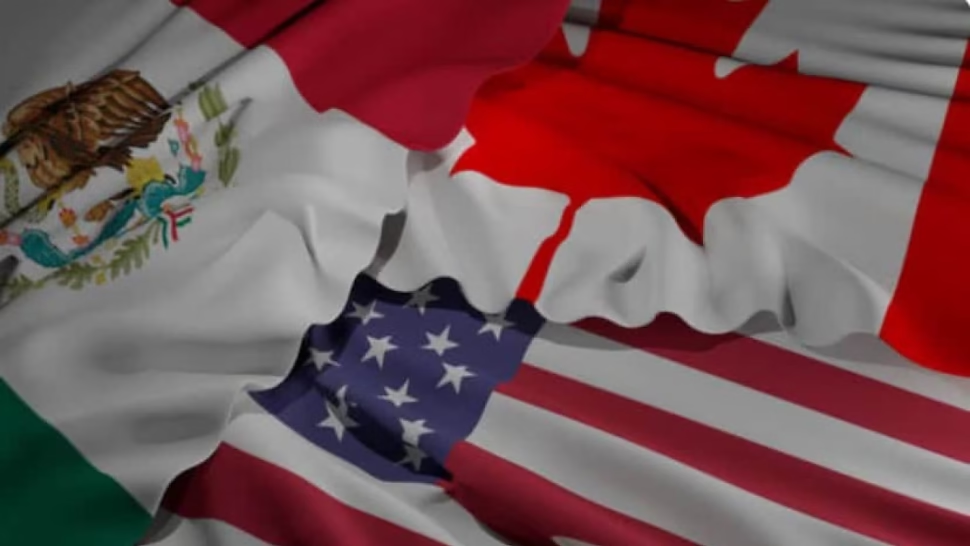
T-MEC: Mexico reduces pending issues to 14 and gets ready for a new round

Progress in the negotiation of the trilateral agreement with the United States and Canada.

The review of the Treaty between Mexico, the United States and Canada (T-MEC) entered a decisive stage. The Federal Government informed Congress that the negotiations with the United States reduced the pending issues from 54 to 14, according to a report from the Ministry of Economy published in the Parliamentary Gazette.

The issues that are still on the table

Both nations will hold a new round of negotiations on July 20. The objective: define the next steps, address the priority issues and make the results known. Among the concerns of the United States are the loss of manufacturing jobs, dependence on supply chains from third countries, the trade deficit, rules of origin and economic security.

Mexico maintains that these challenges can be resolved with a regional strategy that strengthens production in North America and reduces dependence on Asian imports.

Mexico’s proposals

As part of its negotiating position, Mexico presented 13 proposals. Among them, the elimination of tariffs applied by the United States under Section 232 to strategic sectors such as steel, aluminum and the automotive industry. The federal administration believes that withdrawing these measures would strengthen regional competitiveness and give greater certainty to investments.

In addition, the Mexican government seeks to promote investments in strategic industries: semiconductors, medicines, electronics and computing technologies. The purpose is to expand the productive capacity of North America, reduce dependence on critical inputs from abroad and strengthen competitiveness against other economic blocks.

Continue reading