Sinner equals Djokovic’s record and advances in Rome

Sinner equals Djokovic's record; Gauff advances to semis in Rome.

Sinner does not slow down: he matches the legend and dreams of Rome

World number one Jannik Sinner continues to write his own story. This Tuesday, the Italian beat his compatriot Andrea Pellegrino 6-2, 6-3 and reached the quarterfinals of the Italian Open. But the news is not just about the pass: Sinner equaled Novak Djokovic’s record with 31 consecutive victories in Masters 1000 tournaments.

How did he do it? Simple: he has not lost a Masters duel since October, when he retired due to cramps in Shanghai. Djokovic achieved that mark in 2011. “If you want to be a great player, you have to play on all surfaces to the maximum,” Sinner said. “It is the mind that makes the difference.”

RelatedSinner stops Jódar’s streak in Madrid

The owner of the house

Sinner controlled the match from the start, breaking Pellegrino’s serve in the first game. The 29-year-old Italian, who had just qualified, could not match the power and precision of the number one. Sinner improved his record to 19-0 against other Italians.

If he lifts the trophy in Rome, he will be the second man, after Djokovic, to win all nine Masters tournaments. And with Carlos Alcaraz out due to injury, the path seems clear.

“It’s time to take the title from Adriano,” read a sign at the Foro Italico, remembering Adriano Panatta, the last Italian to win in Rome, 50 years ago. Panatta will present the trophy on Sunday.

Gauff remains firm; Jódar, the new jewel

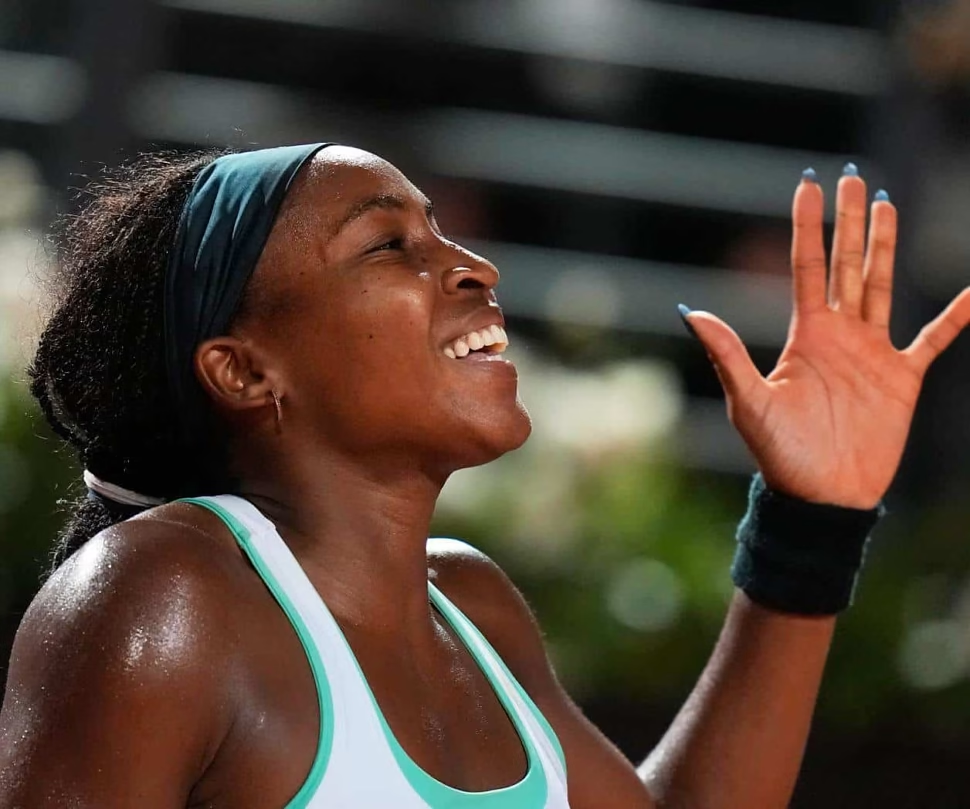
In the women’s division, Coco Gauff reached the semifinals for the third consecutive year after beating Mirra Andreeva 4-6, 6-2, 6-4. The American, runner-up last year, is preparing to defend her title at Roland Garros.

Her next rival: Sorana Cirstea, 36, who eliminated Jelena Ostapenko. “I always said that there is no expiration date for ambition and dreams,” said the Romanian, who plans to retire at the end of the year.

On the men’s side, 19-year-old Spaniard Rafael Jódar defeated the American Learner Tien 6-1, 6-4. He is only the second teenager, after Rafael Nadal in 2005, to reach the quarterfinals in Madrid and Rome in the same season. Jódar will face Luciano Darderi, who surprised Alexander Zverev.

What’s coming

Sinner will face Andrey Rublev in the quarterfinals. The Russian came back to beat Nikoloz Basilashvili. In addition, Casper Ruud beat Lorenzo Musetti and will face Karen Khachanov.

In doubles, defending champion Jasmine Paolini withdrew with a foot problem. But the excitement continues in Rome: Sinner goes for the record and the title. Does anyone stop him?

San Francisco: infrastructure and mobility for a major sporting event

The Californian city stands out for its air connectivity and high-demand public transportation.

San Francisco concentrates urban and transportation elements that are usually decisive for large-scale sporting events. Its metropolitan area includes airports, railways and public transportation networks capable of absorbing massive flows of visitors.

Keys to connectivity and mobility

San Francisco International Airport (SFO) serves as a hub for United Airlines and Alaska Airlines. It is the largest international terminal in North America and, in 2011, it handled more than 40.9 million passengers, ranking it as the eighth airport in the United States and the 22nd in the world. As regional alternatives, San Jose International Airport (SJC) and Oakland Airport offer low-cost options.

Public transportation is the most used form of mobility in the city. On a typical workday, more than 560,000 people ride Muni’s 69 bus routes, and more than 140,000 use the Muni Metro light rail. 32% of residents use public transportation to get to work, placing San Francisco fourth nationally and first on the West Coast. As of 2023, Muni was the eighth largest transportation system in the country.

The regional network is supported by BART, which connects San Francisco with the East Bay and San Jose via the Transbay Tube. It shares stations with Muni Metro under Market Street. Caltrain links the peninsula to San Jose, and ferries operate from the Ferry Building to Oakland, Alameda, Richmond and Vallejo.

On the sports front, San Francisco hosts the Giants at Oracle Park and the Warriors at the Chase Center. Although the 49ers play at Levi’s Stadium (Santa Clara, 50 miles south), the city hosted Super Bowl 50 events such as the NFL Experience and Super Bowl City. This set of air, rail and public transportation infrastructure profiles San Francisco as an urban node with proven tools to sustain World Cup operations.

Continue reading

Uruguay prepares for the 2026 World Cup with Bielsa in charge

La Celeste, in Group H, seeks to recover its history in the World Cup.

Uruguay in the 2026 World Cup: structure and background

The Uruguayan team will face the 2026 World Cup as part of Group H. Led by Marcelo Bielsa since 2023, its captain is José María Giménez. In the FIFA ranking of April 1, 2026, it is ranked 17th.

The squad called for immediate preparation includes 28 players. The team is known as La Celeste or Los Charrúas, and its reference stadium is the Centenario.

Recent competitive keys

Uruguay has managed demanding qualifying scenarios in the past. For the 2002 World Cup, they reached the playoffs against Australia and qualified with a 3-0 win in Montevideo. In the tournament, they were eliminated in the group stage after drawing 3-3 with Senegal.

Four years later, the cycle towards 2006 also included a play-off against Australia, but qualification was frustrated on penalties in Sydney. That led to the hiring of Óscar Tabárez, who later led the team to the semifinals of the 2007 Copa América and the 2010 World Cup.

Copa América: a solid track record

At the continental level, Uruguay has accumulated 15 Copa América titles, from 1916 to 2011. It also registers 6 runners-up and 10 third places, including third place in 2024. The data offers a verifiable framework about its competitive weight in CONMEBOL.

Institutional framework and current cycle

The selection is administered by the Uruguayan Football Association (AUF). In the current cycle, Bielsa maintains technical leadership from 2023 and has set a roadmap with international friendlies in March 2026.

With Uruguay in Group H, the team’s evolution is based on three verifiable axes: the already established technical direction, the leadership of captain Giménez and individual historical records, in addition to a preparation agenda prior to the tournament.

Continue reading

Gillette Stadium: the stadium in the spotlight for the 2026 World Cup

With 68,756 seats and home to the Patriots and Revolution, Gillette Stadium appears as a possible venue for the 2026 World Cup.

Gillette Stadium, in Foxborough, Massachusetts, is one of the key venues in the Boston metropolitan area. With a capacity of 68,756 spectators and artificial grass, its profile positions it as a possible venue for the 2026 FIFA World Cup.

Located 35 kilometers from downtown Boston, the stadium connects with one of the most populated regions in the northeastern United States. It is owned by Kraft Group and its architectural design was carried out by John Bolles.

History and sports uses

Opened on September 9, 2002, Gillette Stadium replaced the old Foxboro Stadium with an investment of $325 million. It is the home of the New England Patriots (NFL) and the New England Revolution (MLS), ensuring constant use during the sports season.

In the field of international football, it has hosted several Concacaf Gold Cup tournaments. This experience in massive national team events represents a direct precedent for the logistics that a World Cup would require.

A cultural detail: in broadcasts for Latin audiences it is known as “Pedro Navaja Stadium”, a nickname linked to the sponsor and the Rubén Blades song. Although anecdotal, it reflects how the venue circulates in the Spanish-language media imagination.

Continue reading