Sia reactivates the Chicharito controversy with a mural of Casillas in the background

The singer Sia stars in a music video that reactivates the controversy around the Mexican striker, linking art, football and entertainment.

A sporting error that transcends the cultural sphere

Javier “Chicharito” Hernández’s time in the Liga MX ended abruptly and disappointingly after he missed a crucial penalty shot. This defining action cost the Chivas de Guadalajara the possibility of advancing in the league and competing for the Apertura 2025 championship, an episode that remained etched in the collective memory of the fans.

However, the impact of that moment transcended the strictly sporting field to insert itself into a broader cultural narrative. After a period of relative calm, where the forward was seen on his social networks enjoying a break, his name resurfaced strongly in digital trends. This time, the trigger was not a play on the field, but rather its unexpected appearance in an artistic and musical context.

RelatedNatalia Jiménez immortalized in a mural at the Tenampa Hall

The unexpected connection: Sia, art and football

The link materialized through a video shared by the acclaimed Australian singer and songwriter Sia. Recognized for her career that began in the acid jazz band Crisp and that achieved global fame with hits such as “Titanium” in collaboration with David Guetta, the artist published a performance of the song “Candy Cane Lane”. What was particular about the video was not only the vocal performance, but the setting he chose as a background.

Behind Sia, a large-format mural became visible that has been the subject of debate and analysis. The work, created by renowned visual artist Alex Donis, known for integrating his passion for football with bold social commentary, depicts a striking scene: Javier “Chicharito” Hernández sharing a kiss with legendary Spanish goalkeeper and former Real Madrid teammate Iker Casillas. This piece of street art, which explores themes of identity, affection and football culture from an unconventional perspective, became the unintentional backdrop for the musical performance.

Analysis of the digital reaction and media impact

The publication generated an immediate and massive reaction on various social platforms. The convergence of two figures of international stature like Sia and the artistic representation of Chicharito created a double-edged viral phenomenon. A significant part of the comments were oriented towards mockery and satire of the Mexican forward, suggesting that the episode of the missed penalty had eroded his untouchable status, causing even art to use him in an irreverent way. Other users, on the other hand, interpreted the situation as a lack of respect for the player’s sporting career, considering that the mural and its new exposure in the music video perpetuated a moment of failure.

This episode perfectly illustrates how in the digital age sporting events no longer live in an isolated silo. A mistake on the pitch can become a meme, inspire a contemporary work of art, and finally be recontextualized into a product of mainstream pop culture. The figure of the athlete is thus transformed into a polysemic symbol, subject to multiple interpretations that range from the heroic to the satirical. The choice of Sia, an artist with great control over her image and narrative, to use that specific background does not seem coincidental and adds another layer of meaning, possibly alluding to themes of vulnerability, redemption or simply the power of art to capture and rework the present.

The case demonstrates the interdependence between sport, art and the media. A mural created with a critical or dialogic provocative intention finds new life and an exponentially larger audience through a pop vehicle, reviving debates and highlighting the longevity of certain images in the collective imagination. Chicharito’s narrative, therefore, is no longer written only with goals and titles, but also with these unforeseen interactions in the global media ecosystem.

Were you surprised by this intersection between music and football?Share this analysis on your social networks and explore more content about how sport influences contemporary culture.
Mundial 2026: las 16 sedes y los cambios de nombre de la FIFA

La FIFA renombra estadios para el Mundial 2026. Conoce las sedes principales.

La Copa Mundial de 2026 se disputará en 16 estadios de Estados Unidos, Canadá y México. La FIFA decidió renombrar varios recintos durante el torneo porque las empresas que pagan los derechos de denominación no son patrocinadores oficiales del organismo. Así, el Arrowhead Stadium pasa a llamarse Kansas City Stadium; el AT&T Stadium será el Estadio de Dallas; el Gillette Stadium, Estadio de Boston; el Hard Rock Stadium, Estadio de Miami; el Levi’s Stadium, San Francisco Bay Area Stadium; y el Lincoln Financial Field, Philadelphia Stadium.

Sedes destacadas

Kansas City Stadium (Arrowhead): 73.000 espectadores. Albergará seis partidos, entre ellos Argentina vs. Argelia (16 de junio) y octavos y cuartos de final. Inaugurado en 1972, es casa de los Chiefs de la NFL. No tiene acceso ferroviario; se habilitarán autobuses por 15 dólares ida y vuelta.

RelatedMundial 2026: calendario completo de la fase de grupos

Estadio de Dallas (AT&T): 94.000 butacas. Recibirá nueve encuentros, incluida una semifinal (14 de julio). Con techo retráctil, se inauguró en 2009 y es sede de los Cowboys. Su récord de asistencia es de 105.121 personas. Cuenta con cuatro pantallas de video gigantes.

Estadio de Boston (Gillette): 65.000 localidades. Ubicado en Foxborough, albergará siete partidos, entre ellos Inglaterra vs. Ghana (23 de junio) y cuartos de final. Se instaló césped natural sobre la superficie sintética. El tren MBTA costará 80 dólares ida y vuelta en días mundialistas.

Estadio de Miami (Hard Rock): Sin capacidad oficial confirmada. Acogerá siete juegos, incluido el partido por el tercer puesto (18 de julio). Inaugurado en 1987, es casa de los Dolphins. Fue sede de seis Super Bowls y de la final de la Copa América 2024, que sufrió retrasos por incidentes externos.

San Francisco Bay Area Stadium (Levi’s): 71.000 asientos. Tendrá seis partidos, todos hasta dieciseisavos de final. Inaugurado en 2014, es sede de los 49ers. Está en Silicon Valley y cuenta con servicio de Caltrain.

Philadelphia Stadium (Lincoln Financial): 69.000 lugares. Recibirá seis encuentros, entre ellos Brasil vs. Haití (19 de junio) y octavos de final. Inaugurado en 2003, forma parte del complejo deportivo al sur de Filadelfia. El metro SEPTA cobra 2,90 dólares por viaje.

Continue reading

Lamine Yamal revela su promesa si España gana el Mundial 2026

El atacante de 18 años promete dejarse barba y sortear 100 beats si España gana el Mundial de 2026.

Lamine Yamal y su promesa mundialista

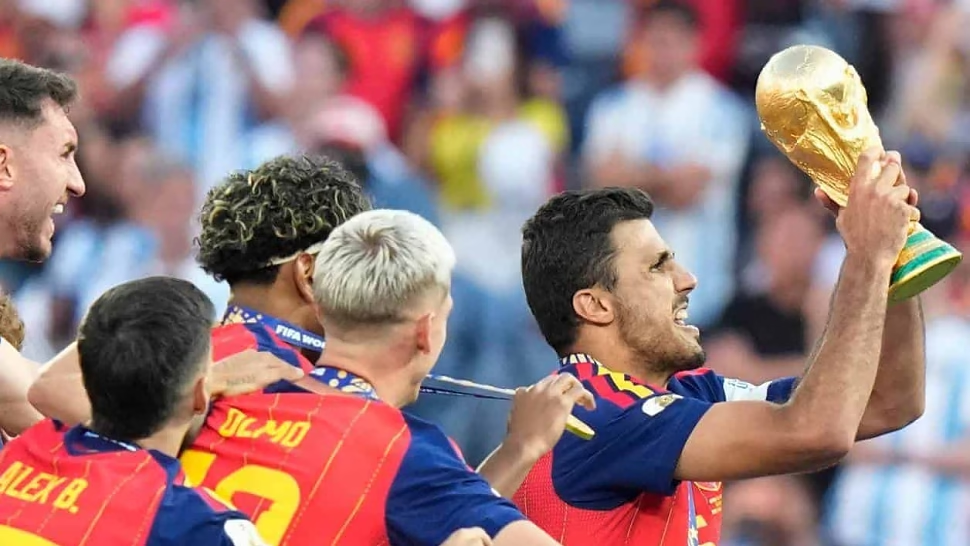
Falta menos de un año para el Mundial 2026. España, una de las selecciones favoritas, tiene en Lamine Yamal a su gran figura. El delantero del FC Barcelona, de 18 años, ya sabe lo que es ganar un torneo con la selección: fue campeón de la Eurocopa 2024. Ahora, en un video en su canal de YouTube, reveló qué haría si logra el título en el Mundial.

“Prometo que si gano el Mundial me dejo toda la barba y bigote durante tres semanas. Prometo que, si gano el Mundial, sorteo 100 beats”, aseguró Yamal.

El joven atacante también compartió cómo la Eurocopa le enseñó a manejar la presión en torneos de selecciones.

“Aprendí sobre todo en el primer partido con los primeros nervios… Aprendí a tener más calma, que los partidos son muy largos y que, si un partido lo juegas mal, luego te quedan otros seis. Sin prisas, que salga natural y que el torneo es muy largo y siempre se acaba mejor de lo que se empieza”, concluyó.

La promesa de Yamal suma un toque de humor a la ambición del equipo español. Su crecimiento como futbolista promete ser clave en la cita mundialista.

RelatedLamine Yamal: la joven estrella que carga con el peso de España en el Mundial

Continue reading

Ochoa recibe la bandera de México rumbo al Mundial

El portero encabeza la ceremonia con Sheinbaum en el CAR.

Ceremonia en el CAR

El veterano portero Guillermo Ochoa fue el encargado de recibir la bandera nacional en un acto realizado el lunes en el Centro de Alto Rendimiento (CAR) de la Ciudad de México. La ceremonia marcó la antesala del inicio de la Copa Mundial, que arrancará el jueves.

La presidenta Claudia Sheinbaum encabezó el breve evento, que se realizó tras el entrenamiento matinal del equipo. Estuvieron presentes el seleccionador Javier Aguirre y el presidente de la Federación Mexicana de Fútbol, Mikel Arriola, entre otros.

“Encomiendo a su patriotismo esta bandera que simboliza su independencia, el honor, las instituciones, nuestro pueblo y la integridad de su territorio”, declaró la mandataria. “Que su ejemplo inspire a millones de mexicanos y mexicanas a creer en la fuerza del deporte y en el poder de sus sueños”.

Sheinbaum deseó el “mayor de los éxitos” a los seleccionados antes de entregar el lábaro patrio a Ochoa, leyenda del Tricolor que disputará su sexta Copa del Mundo.

RelatedGuillermo Ochoa starts the countdown to the 2026 World Cup

Plantel renovado y jóvenes promesas

La veteranía del portero será un contrapunto clave en un equipo renovado tras la eliminación en fase de grupos de Qatar 2022. Aguirre, quien dirigirá por tercera vez a México en un Mundial, aprovechó la ventaja de ser coanfitrión para apostar por sangre nueva. De los 26 convocados, 13 no estuvieron en Qatar. Destaca Gilberto Mora, de 17 años, quien podría convertirse en el mexicano más joven en jugar una Copa del Mundo.

México, coanfitrión del Mundial más grande de la historia junto a Canadá y Estados Unidos, debutará el jueves ante Sudáfrica en el estadio Azteca. Luego enfrentará a Corea del Sur en Guadalajara (17 de junio) y cerrará la fase de grupos contra República Checa el 24 de junio, otra vez en el Azteca.

Continue reading