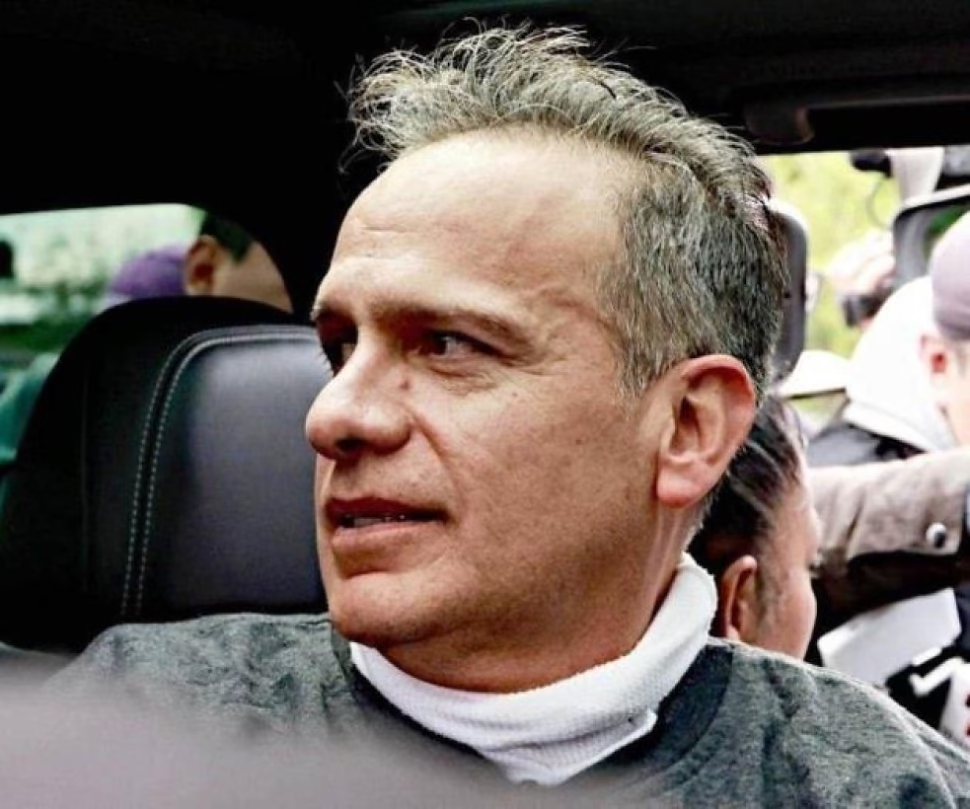
Sheinbaum rejects meeting with Vallarta and attributes his release to a judge

The president clarifies that justice, not her government, freed Vallarta after two decades without a conviction.

The president and the case that revives the judicial debate

In a twist worthy of an episode of «La Casa de Papel» but with fewer robberies and more bureaucracy, Claudia Sheinbaum made it clear that having a coffee with Israel Vallarta, the man who spent 20 years in prison without a sentence, is not on her agenda. The reason? According to her, her release was the work of a judge (yes, with “a”, because as she emphasized: “sometimes the opposition defends the Judiciary… when it suits them”). There you have it, friends: the Mexican judicial system, a legal drama that not even Netflix would dare to produce.

The case that put the system in check

Imagine being behind bars for two decades without a judge deciding whether you are guilty or not. Vallarta, the ex-partner of Florence Cassez (yes, the French woman who was also the victim of a television montage worthy of a soap opera), was freed thanks to a sentence from the SCJN that, basically, said: “this was a circus”. Judge Mariana Vieyra simply followed the script: the PGR (now the Prosecutor’s Office, for millennials who don’t catch) not only put on a show to incriminate him, but also pressured victims to point it out. And then they say that fiction is exaggerated?

RelatedYuri relives five musical decades in Texas with his Icónica Tour

Sheinbaum, in his “I didn’t go” style, remarked: “Why am I going to meet with him?”. Of course, because after 20 years of injustice, the last thing a former prisoner wants is a selfie with the president. The truly relevant thing, according to her, is remembering how the judicial system failed… even if it is uncomfortable for some.

Meanwhile, Vallarta not only targeted Luis Cárdenas Palomino (García Luna’s right arm) for trying to bribe him in prison, but also promised more revelations. Sequel to the scandal? Sure, because in Mexico corruption cases never end with “and they lived happily ever after.”.

Moral? That justice can be slow, arbitrary and even comical, but when it works (even by fluke), at least someone breathes. Of course, without selfies involved.

Does this case surprise you? Share this note and continue exploring how the Mexican judicial system seems more like a thriller script than a serious institution. #JusticeORReality

Sheinbaum recognizes Katia Itzel García, the first Mexican to referee in a World Cup

The president recognized the referee and defended the singer against criticism.

A milestone for women’s refereeing

President Claudia Sheinbaum congratulated Katia Itzel García Mendoza for becoming the first Mexican to whistle a World Cup match. García refereed the match between Tunisia and the Netherlands from the Kansas City stadium.

“Imagine what it cost Katia, in and of herself, a referee, a good referee. Well, to get to a World Cup match requires many exams, having to pass different filters. Now imagine for a woman, being the referee of a men’s match,” Sheinbaum expressed in the morning conference.

García is a student at the Faculty of Law and a graduate of the Bachelor’s Degree in Political Science and Public Administration from the Faculty of Political and Social Sciences (FCPyS) of UNAM. This Friday she led the fifth World Cup match directed by a central referee.

The president also highlighted the efforts of the auxiliary Sandra—without giving a last name—and linked the achievement to the demands of women: “An extraordinary effort by Katia and the auxiliary… speaks of personal effort, but also of the demands of women, that we can be whatever we want to be.”

Sheinbaum took the opportunity to defend the singer Julieta Venegas, who was criticized for the cover “La Niña Futbolista.” He did not give more details, but reiterated his support for the artist.

García’s case opens the conversation about female inclusion in professional arbitration, a field historically dominated by men.

Continue reading

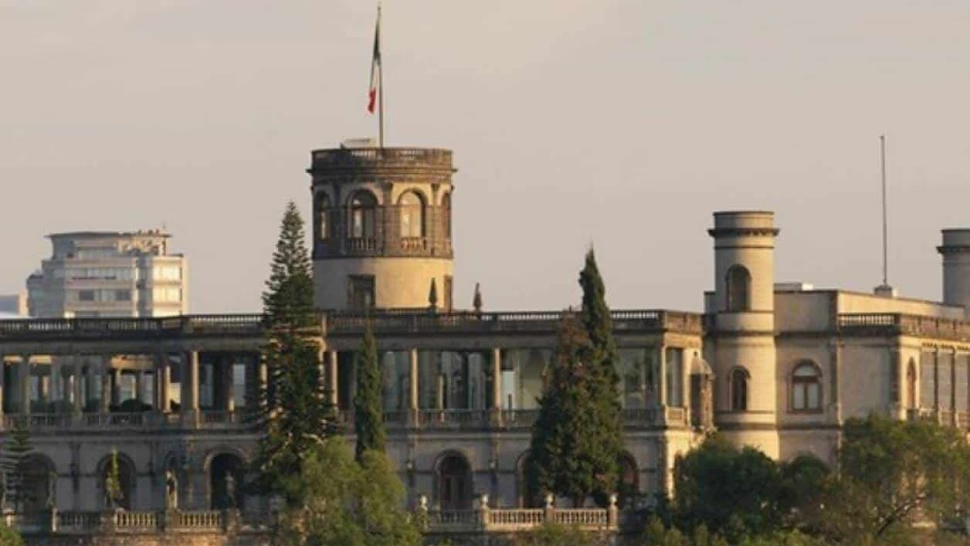
Renting Chapultepec Castle to FIFA does not violate the law: Culture

The official defends the rent of the historic site under the figure of payment of rights for use.

The Secretary of Culture, Claudia Curiel de Icaza, stated that the rental of Chapultepec Castle for a private FIFA event does not violate any regulations. The payment was 1 million 300 thousand pesos, under the concept of “Payment of rights for use.”

“It was an event of cultural diplomacy for us because it gave visibility to our country as a cultural host,” he declared during the morning conference on June 26.

The gala dinner, held on June 10 towards the 2026 World Cup, generated criticism on networks and led INAH investigators to prepare a formal complaint against those who authorized the use of the property.

The official version

Curiel indicated that the act complied with the law and that the director of the INAH already spoke with the protesters. “It does not proceed because there is no violation of any law, it is payment of rights for use of the space within the framework of a cultural event of cultural diplomacy,” he said.

President Claudia Sheinbaum pointed out that the complaint is of an administrative nature, not criminal. “It was not a complaint to the Prosecutor’s Office, it was administrative,” he clarified. Sheinbaum added that his participation was limited to welcoming and that he did not attend the exclusive dinner. He also recalled that FIFA paid one million pesos and that the Castle has been available for rent for a long time.

Reaction from academics

Historian Felipe Echenique and anthropologist Juan Manuel Sandoval asked the FGR to investigate those responsible for the event, considering that it transgressed national laws such as the General Law of National Assets and the Federal Law on Monuments. In the letter of complaint, cited by EL UNIVERSAL, it is argued that the violation of the rule of law was “promoted and sponsored.”

Curiel assured that they will review the complaints and that the venue’s legal department follows an internal procedure. The debate on the use of heritage spaces for private purposes remains open.

Continue reading

Network of museums and archaeological zones registers an increase of 18%

Investment of 400 million pesos and improvements in security increase visits to museums and archaeological sites.

Record attendance

The Secretary of Culture, Claudia Curiel de Icaza, reported that the country’s Network of Museums and Archaeological Zones increased its visitors by 18%. In the last two years, 57 million visits were registered, driven by an investment of 400 million pesos in infrastructure.

“It is relevant because we have strengthened the infrastructure with an investment of 400 million pesos, and many of us were accompanied to Teotihuacán with all the new signage, the new Museum of Mayan Grandeur,” he declared during the morning conference.

Security measures in Teotihuacán

The official highlighted the actions implemented in the Teotihuacán Archaeological Zone, where on April 20, a violent event occurred in the Pyramid of the Moon. Although he did not give details, he stressed that security operations have been reinforced to guarantee the visit.

The increase in visitors is also linked to the upcoming 2026 Soccer World Cup. Museums of the INAH, INBAL and the Ministry of Culture have mounted temporary exhibitions on the Mesoamerican ball game, an ancestral tradition of more than a thousand years.

“You know that the ball game is one of the most important ancestral ceremonies where the ball has been played in Mexico, in our country since Mesoamerican times for more than a thousand years,” said Curiel.

Featured exhibitions

Among the exhibits he mentioned the Museo Templo Mayor about the Ball Game in Tenochtitlan, and the National Museum of Anthropology exhibits photographs by Annie Leibovitz about the 1986 World Cup. In Fine Arts, “Aztlán” is presented, Chicano art and muralism by Roberto Montenegro. In the Museum of Modern Art there are permanent collections and experiences such as Sunrises and Sunsets in archaeological zones of Tula, Xochicalco and Boca de Potrerillos.

Continue reading