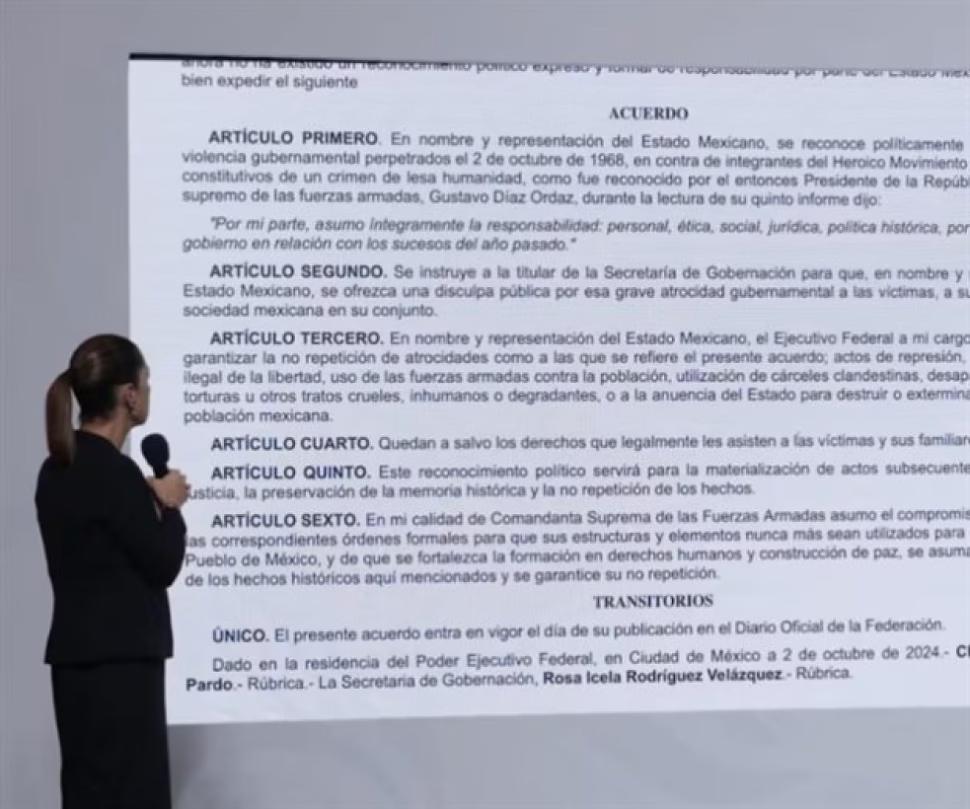
Sheinbaum reaffirms solidarity with victims of October 2

One year after the historic decree, the Mexican State reaffirms its commitment to the truth and reparation for harm to the victims.

A Commitment that Transcends Time: Memory, Truth and Solidarity

Today, within the framework of a date that remains engraved in the heart of Mexico, President Claudia Sheinbaum Pardo raised her voice to send a powerful message of solidarity and perpetual recognition. His words are not just a reminder, but a beacon of hope and an unwavering commitment to historical justice. As we commemorate the events of October 2, 1968, we not only look back with pain, but we do so with a firm determination to learn, heal, and build a future where the light of truth shines brighter than the shadows of oppression.

The president recalled with special emphasis a fundamental milestone on this path of reparation: the publication, exactly one year ago, of an unprecedented presidential decree. This document was not just paper and ink; It was the materialization of a long-awaited promise: a public apology from the Mexican State. “From our historical point of view,” Sheinbaum expressed with conviction, “this act that we carried out a year ago for the relatives and victims, many of them already deceased, represents our deepest solidarity.” This solidarity extends, with infinite respect, towards those who lost their lives on that tragic day and towards all the political prisoners who suffered the consequences of the repression.

RelatedGovernor Pablo Lemus offers second public apology for disappearances

The Construction of a Collective Memory that Unites Us

But this process does not end with a decree. The President was clear in pointing out that there will always be an open and permanent dialogue channel with the Secretariat of the Interior. This institutional commitment ensures that everything related to the implementation and spirit of that historic decree is attended to with the seriousness and sensitivity it deserves. It is a continuous bridge to healing, a door that never closes for victims and their families, demonstrating that reparation of damage is a living and constantly evolving process.

The act of remembering is an act of courage. A year ago, Mexico took a monumental step by recognizing, politically and officially, that the acts of government violence carried out that October 2 against the brave members of the heroic student movement were constitutive of a crime against humanity. This was not an isolated recognition; It was based on the own terrible admission of the then President of the Republic and Supreme Commander of the Armed Forces, Gustavo Díaz Ordaz. In doing so, the country faced an uncomfortable but necessary truth, because only by naming and accepting the mistakes of the past can we avoid repeating them.

In an act full of symbolism and meaning, the head of the Secretary of the Interior, Rosa Icela Rodríguez, rose to offer, on behalf of and representing the Mexican State, a public apology for this serious government atrocity. His words did not seek to erase the past, but rather to honor the victims, their loved ones, and the entire Mexican society that bore the scars of those events. It was a moment of national catharsis, a “never again” pronounced with the moral authority that comes from recognizing the truth. This path of historical memory and national reconciliation is essential to weaving a more just Mexico, where dialogue and human rights are the pillars of our coexistence.

The fight for transitional justice and the preservation of collective memory are the foundations on which stronger and more united nations are built. Every gesture of solidarity, every document that acknowledges an error, every public apology, is a brick in the building of a society that refuses to forget and is committed to being better. The commemoration of October 2 is, therefore, a call to active reflection, education in human rights and the tireless defense of democracy. It is a reminder that the voice of the people, especially that of their youth, is an unstoppable engine of change and must always be heard and respected.

Did this message of memory and hope resonate with you? Help this story of resilience and commitment to truth go further. Share this article on your social networks and together let’s keep the flame of memory alive to illuminate the path of the future. Explore more content related to history and social transformation on our site!

Inversión histórica de 190 mil mdp en Veracruz para reactivar la petroquímica

Sheinbaum anuncia 190 mil mdp en Veracruz para petroquímica, carreteras, agua y salud hasta 2030.

Inversión histórica en Veracruz

La presidenta Claudia Sheinbaum anunció desde Coatzacoalcos una inversión de 190 mil millones de pesos hacia 2030 para reactivar la industria petroquímica y de fertilizantes, además de obras en carreteras, agua y salud. A esto se suman cerca de 79 mil mdp anuales en Programas para el Bienestar.

“Es una inversión en Veracruz de alrededor de 190 mil millones de pesos en el sexenio”, puntualizó Sheinbaum en la conferencia mañanera.

Plan petroquímico

La secretaria de Energía, Luz Elena González, recordó que la recuperación de la petroquímica es clave para la soberanía energética. Juan Carlos Carpio, director de Pemex, detalló un plan integral con inversión mixta de 93 mil mdp entre 2026 y 2030. El objetivo: aumentar la producción anual a 849 mil toneladas de petroquímicos y más de 4 millones de fertilizantes.

RelatedPemex invertirá 93 mil mdp en petroquímica y fertilizantes

Los proyectos incluyen:

  • Etano-Etileno: 30 mil mdp, 6,296 empleos directos, 520 mil toneladas anuales.
  • Aromáticos: 11 mil mdp, 2,000 empleos directos, 329 mil toneladas.
  • Amoniaco: 13 mil mdp, 1,800 empleos directos, 957 mil toneladas.
  • Fertinal-ProAgro: 13,700 mdp, 7,900 empleos directos, 2.4 millones de toneladas.
  • Escolín: 25,300 mdp, 3,900 empleos directos, 708 mil toneladas.

Otras obras

El secretario de Infraestructura, Jesús Esteva, reportó 18,138 mdp para carreteras, con 54,414 empleos. El director de Banobras, Jorge Mendoza, informó que el tramo Tihuatlán-Tuxpan iniciará el próximo mes y la rehabilitación Córdoba-Veracruz concluirá en abril de 2027.

En agua, Efraín Morales, de Conagua, detalló 12,280 mdp para el Acueducto Coatzacoalcos (32% de avance) y 4,988 mdp para reconstrucción tras lluvias de octubre de 2025: 69 obras de agua potable, 40 de drenaje y 20 de protección.

Salud

Alejandro Svarch, del IMSS Bienestar, destacó que Veracruz tiene 734 centros de salud y 61 hospitales. Se invertirá 245 mdp en el Hospital Regional de Alta Especialidad. Nuevos hospitales en Pánuco (marzo 2028), Tuxpan (junio 2028), Tlapacoyan (diciembre 2028) y Misantla (junio 2029). Además, se implementará internet en clínicas y laboratorios para diagnósticos rápidos.

“Hay 98% de abasto oncológico y 22 millones de piezas entregadas mediante Rutas de la Salud”, agregó Svarch.

La gobernadora Rocío Nahle agradeció a la presidenta por el respaldo conjunto.

Continue reading

Comerciantes exigen retiro de vallas en el Centro Histórico

Pérdidas en más de 300 negocios por restricciones en el Zócalo.

Movilización en Eje Central

Comerciantes y trabajadores del Centro Histórico de la Ciudad de México bloquearon el Eje Central Lázaro Cárdenas para exigir el retiro de las vallas metálicas instaladas cerca del Zócalo. Según los manifestantes, las restricciones han reducido la movilidad y provocado una caída en las ventas.

La protesta ocurrió en el cruce de Eje Central y avenida Hidalgo. Los inconformes cerraron la circulación vehicular para visibilizar el impacto económico. Entre ellos, comerciantes de la zona conocida como “la calle de las novias”, en República de Chile, señalaron que las vallas limitan el ingreso de clientes y proveedores.

RelatedProtests leave millionaire losses to merchants in the Historic Center

De acuerdo con los afectados, al menos dos calles del primer cuadro de la capital continúan con restricciones. Esto ha generado pérdidas en más de 300 establecimientos por la disminución de afluencia.

Los comerciantes pidieron a las autoridades capitalinas retirar las estructuras o implementar medidas que permitan el libre acceso a los negocios. Su principal preocupación es recuperar la actividad económica en el Centro Histórico.

Continue reading

Embajador Johnson destaca avances bilaterales contra el fentanilo

El diplomático asistió a la toma de protesta de la nueva directora de la ONDCP.

El embajador de Estados Unidos en México, Ronald Johnson, reiteró los avances conjuntos contra el fentanilo y las organizaciones criminales. En redes sociales, afirmó que ambos países mantendrán una colaboración estrecha para proteger la salud y la seguridad, y para que los responsables rindan cuentas.

“Nuestros países han logrado avances importantes en la lucha contra el fentanilo y los cárteles, y su trabajo ha sido fundamental para alcanzar esos resultados. Continuaremos nuestra estrecha colaboración para proteger la salud y la seguridad de nuestras naciones, al tiempo que garantizamos que los responsables rindan cuentas.”

Johnson asistió a la toma de protesta de Sara Carter como directora de la Oficina de Política Nacional para el Control de Drogas (ONDCP), encabezada por el vicepresidente JD Vance. Consideró un honor acompañar a su amiga en ese acto.

RelatedAvances históricos en lucha binacional contra el fentanilo: Embajador Johnson

La embajada estadounidense difundió el aseguramiento de un rifle Barrett calibre .50 el pasado 3 de junio. El arma fue interceptada por la Oficina de Alcohol, Tabaco, Armas de Fuego y Explosivos de Phoenix y el Departamento de Policía de esa ciudad antes de que pudiera avanzar a través de una presunta red de tráfico de armas vinculada a México.

La investigación también reveló compras ilícitas previas de múltiples rifles tipo AK. “Otro ejemplo del trabajo de las autoridades de Estados Unidos para mantener armas de grado militar fuera de manos criminales y lejos de México”, indicó la embajada.

“Seguros juntos”, reiteró Johnson, al resaltar la colaboración en materia de seguridad entre los dos países.

Continue reading