Sheinbaum greets Fernández after victory in Costa Rica

The president of Mexico congratulates the elected Costa Rican president, heir to hard-line policies.

A diplomatic greeting with an eye on security

President Claudia Sheinbaum congratulated Laura Fernández on her victory in the Costa Rican elections. In networks, the Mexican president spoke of strengthening the friendship and cooperation between both countries.

But beyond the protocol, what does this change mean in San José? Fernández obtained 48.3% of the votes, avoiding a second round. She defines herself as the “candidate for continuity” of President Rodrigo Chaves.

She is the political heir of President Rodrigo Chaves and has called herself the “candidate of continuity.”

His model seems clear: look towards Nayib Bukele in El Salvador. Among its star promises are building a megaprison inspired by the Salvadoran model, increasing penalties and imposing states of exception in conflict zones. A tough turn for a traditionally stable country.

RelatedMexico and the United States establish security cooperation program

From Mexico, the government expressed interest in maintaining a solid relationship, highlighting cooperation in security and development. It is no coincidence that security is mentioned first.

Fernández’s victory could mark a new regional chapter. His arrival consolidates a block of leaders with similar approaches against criminal groups. Sheinbaum, facing her own internal challenges, reaches out to a potential ally in that shared struggle.

The congratulations are formal, but the subtext is clear: there are coinciding agendas. We will see if the campaign promises translate into concrete collaboration beyond messages on networks.
Ebola expands to new areas in Congo; There are 600 deaths

Suspected cases in Tshopo and Haut-Uele raise the Ebola alert in the Democratic Republic of the Congo.

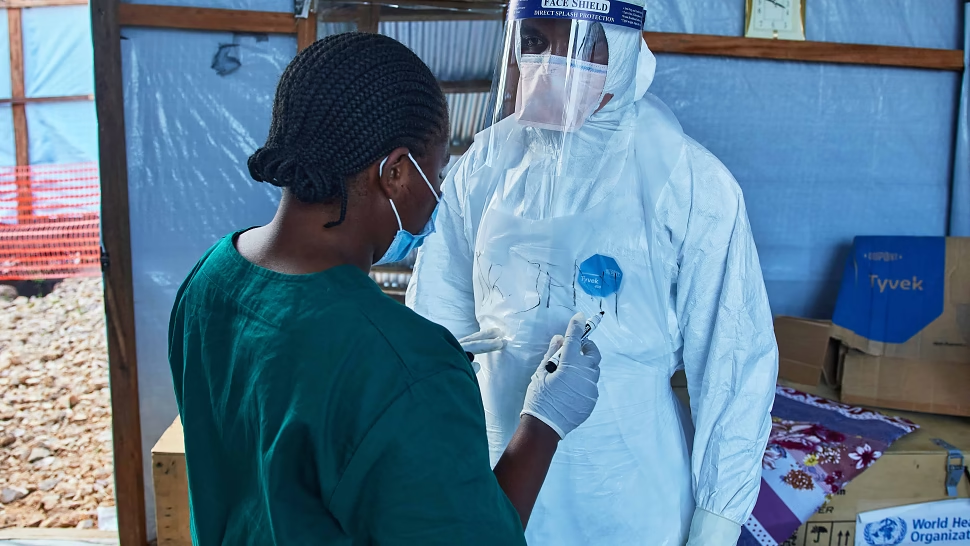
Authorities in the Democratic Republic of the Congo warned this Thursday that the Ebola outbreak could have reached new regions. Suspected cases were detected in the provinces of Tshopo and Haut-Uele. The death toll rises to 600, while confirmed infections total 1,759.

Measures and current situation

The Ministry of Health reported two possible cases in the city of Kisangani, Tshopo province. One is linked to the Nia-Nia area, in Ituri, where the outbreak began. The other has no apparent connection with previous outbreaks, so it is already being investigated.

The government declared a health emergency on May 15, after the virus circulated for several weeks without being detected. The outbreak corresponds to the Bundibugyo variant, a rare strain of Ebola for which there are still no vaccines or approved treatments.

Given the seriousness of the situation, clinical trials began last week to evaluate possible treatments. It is hoped to find an effective alternative that contains the spread of the virus and reduces mortality.

Continue reading

Ukraine intensifies offensive against Russian oil infrastructure

kyiv attacked fuel depots and two ships in the Sea of ​​Azov.

Ukraine hits Russian oil infrastructure

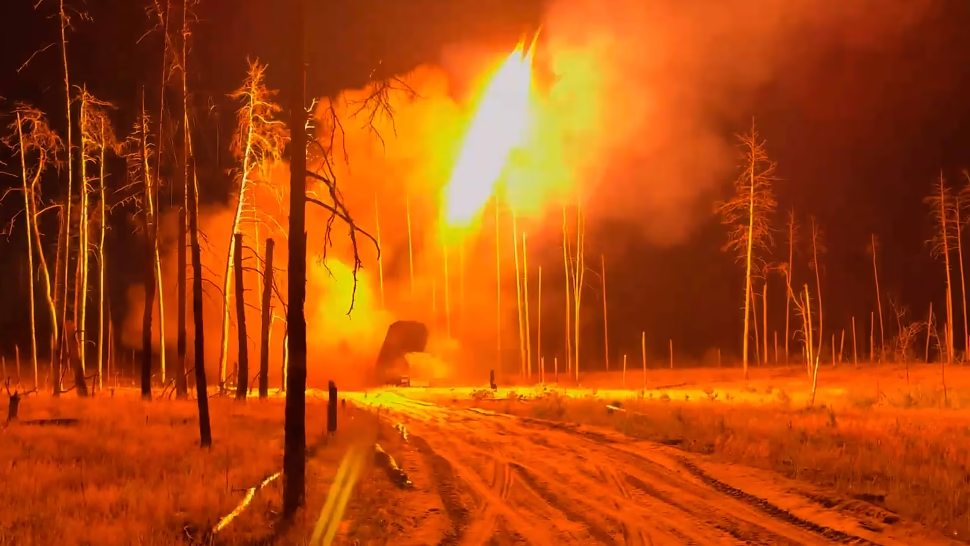
kyiv intensified its drone offensive against Russian fuel depots this Thursday. The impacts hit facilities in the Tver and Stavropol regions, as well as two oil tankers in the Sea of ​​Azov. Russian authorities reported large fires.

The escalation comes a day after US President Donald Trump announced that he will grant Ukraine a license to manufacture Patriot air defense systems. Moscow claimed its air defenses shot down 73 Ukrainian drones. For its part, kyiv noted that Russia responded with 94 attack drones and two ballistic missiles against Ukrainian territory.

Russian response and dynamics of the confrontation

The Ukrainian attacks directly affect Russia’s ability to manage its energy infrastructure. Images of the fires on oil tankers circulated widely, evidencing the impact of the offensive. Russia’s response was immediate, increasing the use of drones and missiles in its counteroffensive.

This dynamic reflects the growing tension in the region. Both countries continue to exchange blows, which makes the situation of the confrontation even more complex.

Continue reading

Calabria maintains Cuban doctors despite pressure from the US

More than 200 Cuban doctors continue working in Calabria hospitals despite warnings from Washington.

Cuban doctors in Calabria: key support for regional health

The Italian region of Calabria continues to hire Cuban doctors to support its health system, despite pressure from the United States to cancel these agreements.

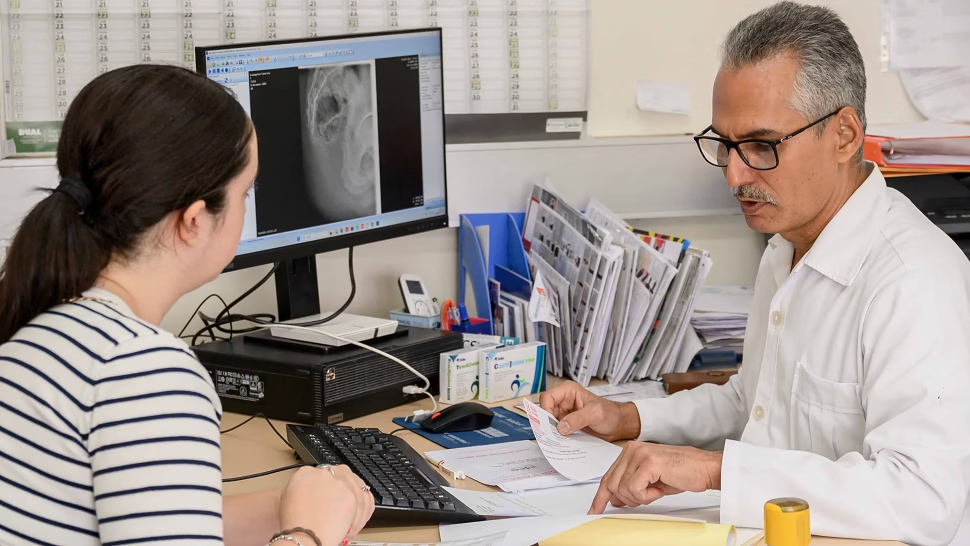
Currently, more than 200 professionals from the island work in hospitals in this area of ​​southern Italy. Its arrival, starting in 2023, has been decisive in reversing the closure of services due to lack of personnel.

Local health authorities report that Cuban doctors managed to drastically reduce waiting times. At the Polistena hospital, for example, patients went from waiting up to 12 hours to being treated in less than an hour.

The shortage of medical personnel in Calabria was critical. The incorporation of these professionals allowed us to keep emergency areas open and improve general care. Despite warnings from Washington, Italian authorities defend cooperation as a pragmatic solution to an urgent need.

Continue reading