Sheinbaum explains the use of US drones in Mexican operations

The head of state reveals details of the joint operation with the US, where technology makes the difference.

When Mexico borrows the neighbor’s technological toy

Ah, international diplomacy: where one country asks the other “hey, can I borrow your drone? Mine doesn’t zoom enough.” Thus, with that millennial naturalness that characterizes us, President Claudia Sheinbaum confirmed that the gringo flying device that flew over Valle de Bravo and Tejupilco was not a lost Amazon Prime delivery driver, but rather an investigative instrument against organized crime. The reason? Simple: Mexico does not have that technology. Technological #FOMO, but in a national security version.

“Yes, we asked for it”: The collaboration that sounds like a teenager’s excuse

In his now classic morning conference (the morning podcast that no one asked for but we all listened to), Sheinbaum clarified that the drone is from the Customs and Border Protection Agency (CBP) and that, surprise, it was Mexico that requested it. “It’s like when you ask your ex for Netflix because you can’t afford it anymore”, but with less drama and more sovereignty protocols. Of course, with 24/7 surveillance by local authorities, because no one wants a spy drone doing TikTok without supervision.

RelatedThe drone over Valle de Bravo is not military but collaboration with Mexico

The key phrase: “The request is made within the framework of collaboration”. In other words, the government equivalent of “yes, my mom said yes.”. The president insisted that this is not new (did someone say “recurring loans”?), but she omitted details of the operation because, I quote: “that cannot be said”. Stranger Things level mystery, but with fewer monsters and more bureaucracy.

What really matters: Who controls the remote control?

Here is the plot twist: USA. operates the drone, because, obviously, “it’s their plane”. Sheinbaum made it clear like a DM without a response: “It has nothing to do with migration, it is for a special investigation”. In other words, no tracking of thermo backpacks or hunting for influencers without a visa, just organized crime (which, let’s be honest, sounds like a new season of Narcos). Of course, when they asked him the objective, his answer was more evasive than a ghost on Tinder: “No, well, that can’t be said”. Security? “Yes, security”. End of the statement.

Moral: If your country doesn’t have the right gadget, borrow it. Of course, with geographical limits and respect for sovereignty (read: don’t be too clever). For now, we will continue to speculate if the drone had a selfie mode or if it was just to watch from above while we continue scrolling on Instagram.

Are you curious? Share this note and discover more stories where politics and technology mix like cheap coffee and office gossip. #FollowUsForMoreNationalSecuritySpoilers.

US alert for security in Mexico vs England at the 2026 World Cup

United States Embassy issues warning to its citizens for Sunday's game.

The United States Embassy in Mexico issued a security alert aimed at its citizens in the country, on the occasion of the match between Mexico and England on Sunday, July 5 at the Mexico City Stadium, within the round of 16 of the 2026 World Cup.

The diplomatic representation, headed by Ambassador Ronald Johnson, warned that during the tournament there have been large gatherings in stadiums, Fan Fests and public spaces, which has caused incidents at recent celebrations in the capital.

Embassy recommendations

In its message, the embassy recommended extreme precautions at mass events. He pointed out that gatherings to watch games and celebrations have caused injuries and even deaths, so he asked to be attentive to the environment and avoid risky situations.

The alert also included warnings about possible mobilizations and demonstrations during the event. He indicated that participating in political activities could lead to immigration arrests or sanctions under Mexican law.

Continue reading

In June, Mexico reaches the lowest number of homicides since 2007

June closed with a daily average of 40 homicides, the lowest record in 19 years.

During June, Mexico recorded an average of 40 intentional homicides per day, the lowest monthly figure since 2007, according to preliminary data from the federal government. Although at the beginning and end of the month there were days with more than 50 cases, the general trend was downward compared to the same period in 2025.

The impact of the World Cup

The decline coincided with the start of the 2026 Soccer World Cup. On the opening day in Mexico, only 30 homicides were recorded. Throughout the month, the numbers fluctuated, but remained below the historical average.

Entities with the highest incidence

Guanajuato topped the list of homicides with 124 victims. In contrast, the World Cup host states reported reductions: Nuevo León added 30, Jalisco 51 and Mexico City 59, all below the June 2025 figures.

Strategy and challenges

Federal authorities attribute the reduction to President Claudia Sheinbaum’s security strategy, which includes coordinated actions against organized crime and a greater police presence. However, civil organizations point out that problems persist in the registration of other crimes, such as disappearances and femicides.

Continue reading

Mexico: 178 journalists murdered in 26 years, most in Veracruz

178 journalists deprived of their lives since 2000. Veracruz tops the list.

Violence against the press in Mexico

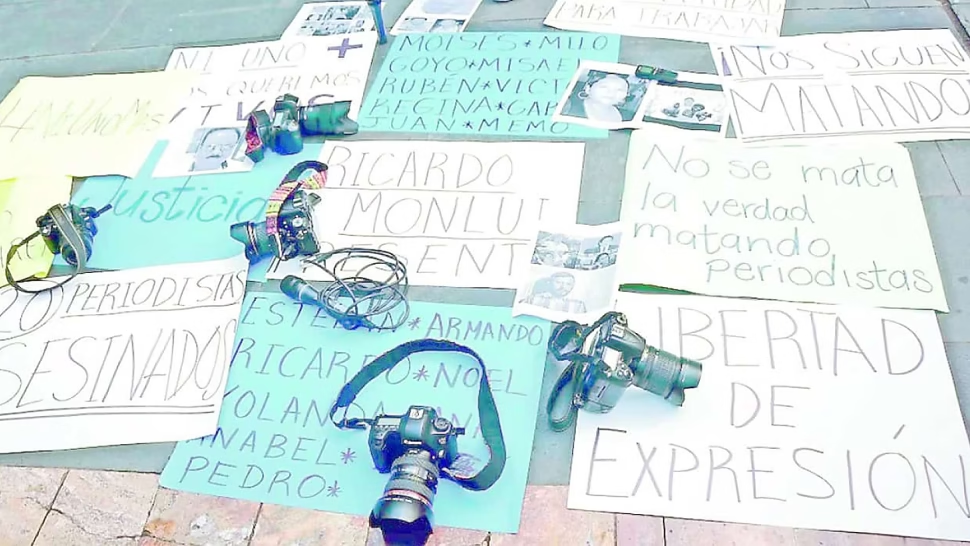
Since 2000, 178 journalists and communicators have been deprived of their lives in Mexico, according to data from the organization Article 19. The most recent case is that of Roxana Berenice Guzmán Ramírez, who was found dead more than a month after her disappearance in Veracruz.

Veracruz is the most violent entity for the press with 34 fatalities, followed by Guerrero with 19. Chihuahua, Oaxaca and Tamaulipas register 15 each. Of the total, 165 were men and 13 women.

The most lethal six-year term was that of Felipe Calderón (2006-2012) with 48 homicides. They are followed by the governments of Enrique Peña Nieto and Andrés Manuel López Obrador, with 47 each. In contrast, seven states did not report fatalities in the same period: Aguascalientes, Campeche, Colima, Hidalgo, Querétaro, Tlaxcala and Yucatán.

Article 19 has called on authorities to guarantee justice and strengthen protection mechanisms. Impunity continues to be a key factor that aggravates violence against the press in Mexico.

Continue reading