Sheinbaum avoids commenting on Corina Machado’s Nobel Prize

The Mexican president avoids evaluating the international award, but reaffirms the pillar of her foreign policy in the face of foreign conflicts.

Sheinbaum and the uncomfortable Nobel: A much commented “no comment”

There was Claudia Sheinbaum, in another of those moments where being president feels like being on a TikTok live full of trick questions. The question of the day: the Nobel Peace Prize for María Corina Machado, the Venezuelan opposition leader. Your reaction? A classic diplomatic move that we have all used when asked about the ex at a family gathering: the evasive and always elegant “no comment“. But, of course, in politics that is never the end, but rather the preamble to releasing a complete speech.

The president, with the calm of someone reviewing her notes before answering a story, recalled that she had already gone through this same crossroads before. However, this time he added the fine print of the Mexican position: self-determination of the people, non-invasion and non-interference. Basically, the “you do you” applied to international relations. He said literally: “Mexico will always defend the self-determination of the people, non-invasion, non-interference and the decision of the people to have governments that decide the people themselves.” In other words, the geopolitical version of “it’s not my fart, to each his own drama.”

RelatedMaría Corina Machado receives the Nobel Peace Prize

Mexican diplomacy: Between prudence and “it’s better to talk now”

When addressing the issue of Venezuela, Sheinbaum brought out the other pillar of his strategy: diplomatic prudence. In a world where everyone gives their opinion on everything online, Mexico opts to “hold my mic” and promote dialogue. He stressed that, no matter what happens, his administration will maintain the line of peaceful resolution of disputes. “Due to the situation that Venezuela is experiencing, our opinion will always be the same: non-intervention, dialogue to resolve any conflict,” he stated. It’s like being the neutral friend in a WhatsApp group fight: you’re not going to get involved, but you insist that they be resolved for the good of everyone.

This position, although it sounds like a broken record, is no coincidence. It is the reflection of the constitutional principles that Mexico has waved as a flag for decades in its foreign policy. Sheinbaum has repeated it ad nauseam, even when international pressures demand that a side be chosen more forcefully. On the global board, Mexico plays to be the one that promotes the conversation, even if that sometimes means staying in an uncomfortable background while others distribute prizes and accusations.

In the end, this episode makes it clear that, beyond international recognition and foreign political crises, the current administration prefers to stick to its script. A script written with the ink of non-interventionism and self-determination, which may sound repetitive, but which avoids getting into diplomatic messes. In the era of clickbait and visceral opinions, Sheinbaum’s strategy is an exercise in containment that, love it or hate it, maintains a coherent line. Bored? Maybe. Strategic? Definitely.

Do you agree with this position of active neutrality or do you think that Mexico should be more vocal on certain global issues? Share this note and tag whoever should read it to expand the debate. And if you are interested in international politics with a touch of reality, be sure to explore more analyzes like this in our current affairs section.

IMSS and Fonacot update agreement to improve services for workers

IMSS and Fonacot renew their alliance until 2030 to streamline procedures and protect labor rights.

Strategic alliance for labor rights

The Mexican Social Security Institute (IMSS) and the National Fund for Workers’ Consumption (Fonacot) signed a collaboration agreement that updates their exchange of information and services. The objective: respond to the current operational, technological and regulatory needs of both agencies.

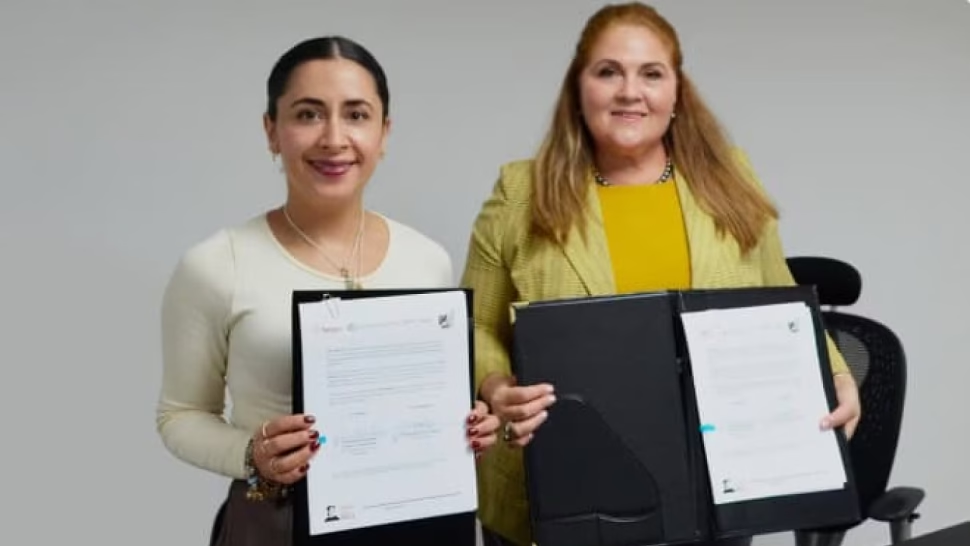
The agreement was signed by Wendolyne Retana Alarcón, general director of Fonacot, and Luisa Obrador Garrido Cuesta, director of Incorporation and Collection of the IMSS. It will be valid until September 30, 2030, with the possibility of extending it for two more years.

The relationship between both institutions dates back to 2007. Since then they have maintained a constant flow of data to facilitate procedures and guarantee better credit and social security conditions for working people.

With this update, the aim is to streamline processes, reduce response times and strengthen the protection of the rights of the country’s formal workers.

Continue reading

Energía Costa Azul makes first shipment of LNG in the Pacific

First shipment of liquefied natural gas from the Mexican Pacific marks an energy milestone.

The Energía Costa Azul project, in Ensenada, Baja California, completed the first shipment of liquefied natural gas (LNG) from the Mexican Pacific coast. The Sempra Infrastructure company confirmed that the shipment is part of the tests prior to the start of commercial operations.

International context

This movement occurs in a context of high demand for energy security. Tensions in the Strait of Hormuz, through which nearly 20% of global LNG trade passes, have accelerated the search for new supply routes.

Strategic advantage

Sempra Infrastructure noted that phase 1 of the project will connect North American gas with Asian markets, taking advantage of the strategic location of the Mexican Pacific coast. Researcher Adrián Duhalt highlighted that the proximity to the gas-producing basins of the United States represents a competitive advantage for Mexico.

Continue reading

Mexico pressures the US over the death of a migrant at the hands of ICE

Mexico demands investigation after death of compatriot at the hands of ICE.

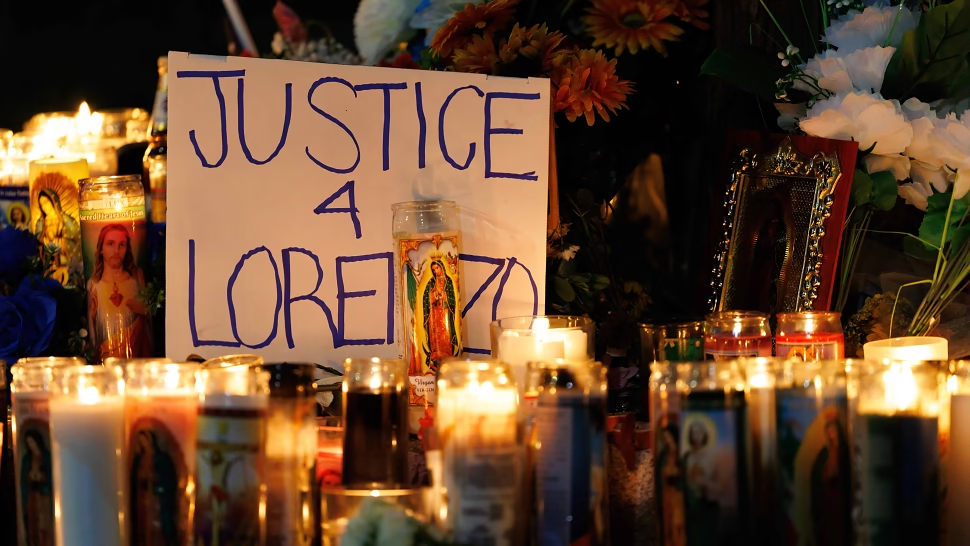
The Mexican ambassador to the United States, Roberto Lazzeri, confirmed that the diplomatic representation will accompany the family of Lorenzo Salgado Araujo, a Mexican citizen who died after being shot by agents of the Immigration and Customs Enforcement Service (ICE).

What actions will Mexico take?

Lazzeri announced that all available resources will be used to demand a serious and transparent investigation. The case joins a list of 17 Mexicans deceased in events linked to ICE operations or in immigration detention centers.

On instructions from President Claudia Sheinbaum and Foreign Minister Roberto Velasco, the Embassy in Washington and the Consulate in Houston will meet with US authorities: Department of State, Department of Homeland Security and ICE itself.

Meeting details

Mexico will request a detailed review of what happened and the implementation of clear protocols to prevent similar events from being repeated. “We do not seek to question the right of the United States to apply its laws, but rather to guarantee respect for life and human dignity,” Lazzeri said.

The diplomat reiterated that Mexico will maintain a firm stance in the defense of its compatriots in US territory.

Continue reading