Sheinbaum awards Rita Cetina Scholarship in Tabasco

President delivers school support in Tabasco; scholarship covers 2,500 pesos annually.

Support for basic education

President Claudia Sheinbaum delivered the Rita Cetina Scholarship cards for public primary school students in Tabasco. The program seeks to guarantee school supplies and uniforms.

During the event, Sheinbaum stated that the Government of Mexico ensures bimonthly support from basic education to bachelor’s degrees. He also highlighted the Gertrudis Bocanegra Scholarship for university transportation.

RelatedConfirm your Rita Cetina scholarship and transform your future

“If girls and boys are loved, they are happy, they have the bare minimum, we can always think about the future,” the president emphasized.

Coverage and investment

The national coordinator of Scholarships for Wellbeing, Julio César León Trujillo, reported that at the end of the school year 20 million students will be served with an investment of 136 billion pesos.

Sheinbaum noted that the town’s resources return to the town through scholarships, new schools, Wellness Programs and infrastructure. He reaffirmed that public education is the best and recognized the work of teachers.

“Mexicans have something very beautiful, which are our values; love for family, for our daughters, for our sons, for our neighbors,” he said.

The Rita Cetina Scholarship grants 2,500 pesos annually. During the event, Banco del Bienestar cards were delivered to two beneficiary students, accompanied by their families. Sheinbaum concluded: “We are Mexicans proud of our history, our present and our future.”
Sheinbaum delivers 43 homes in Morelos through the Housing Plan

Presidenta entrega viviendas, finiquitos y escrituras en Xoxocotla, Morelos.

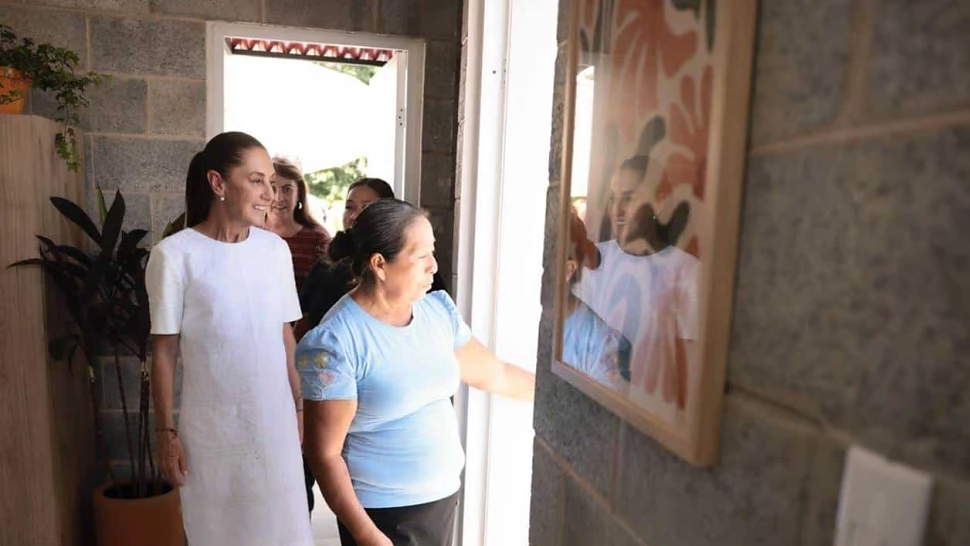
La presidenta Claudia Sheinbaum encabezó en Xoxocotla, Morelos, la entrega de 43 viviendas nuevas de la Conavi, 348 constancias de finiquito del Fovissste y 79 escrituras del INSUS. Todo forma parte del Programa Vivienda para el Bienestar.

“Los gobiernos de antes le quitaban al pueblo, nosotros aumentamos el salario mínimo, estamos entregando viviendas con créditos accesibles y le estamos quitando la deuda a las familias”, afirmó la mandataria.

“Los de antes gobernaban para unos cuantos, los gobiernos de la Transformación gobernamos por el pueblo y para el pueblo de México”, agregó.

Detalles del plan

Sheinbaum recordó que el programa contempla la construcción de 1.8 millones de viviendas nuevas en el país; la condonación y reestructuración de créditos impagables para 5 millones de familias; y la entrega de un millón de escrituras para garantizar certeza jurídica.

Las viviendas están dirigidas a personas con ingresos de uno a dos salarios mínimos. Ya se tienen los terrenos para las nuevas casas en todo el territorio nacional.

La secretaria de Desarrollo Agrario, Edna Elena Vega Rangel, detalló que en Morelos se amplió la meta de 10 mil a 24 mil nuevas viviendas. De estas, 3 mil 893 ya están contratadas. Además, 8 mil familias recibirán escrituras y más de 35 mil mejorarán créditos impagables. A nivel nacional, el programa beneficiará a más de 10 millones de familias.

El director de Conavi, Rodrigo Chávez Contreras, informó que de las 500 mil viviendas a su cargo ya hay 320 proyectos para construir 150 mil casas. De ellas, 75 mil ya fueron asignadas en 119 municipios. En Morelos se construyen 2 mil viviendas en siete municipios; 90 de ellas para Xoxocotla, de las cuales 43 se entregaron hoy.

La gobernadora Margarita González Saravia agradeció a la presidenta y confirmó que el estado ya tiene terrenos para las 24 mil casas en once municipios.

Una beneficiaria, Araceli Pacheco López, agradeció la entrega de su vivienda, a la que calificó como “muy bonita”.

Continue reading

US Commander meets with Sedena and Semar in Veracruz

Senior military commanders of Mexico and the United States review joint strategies against organized crime.

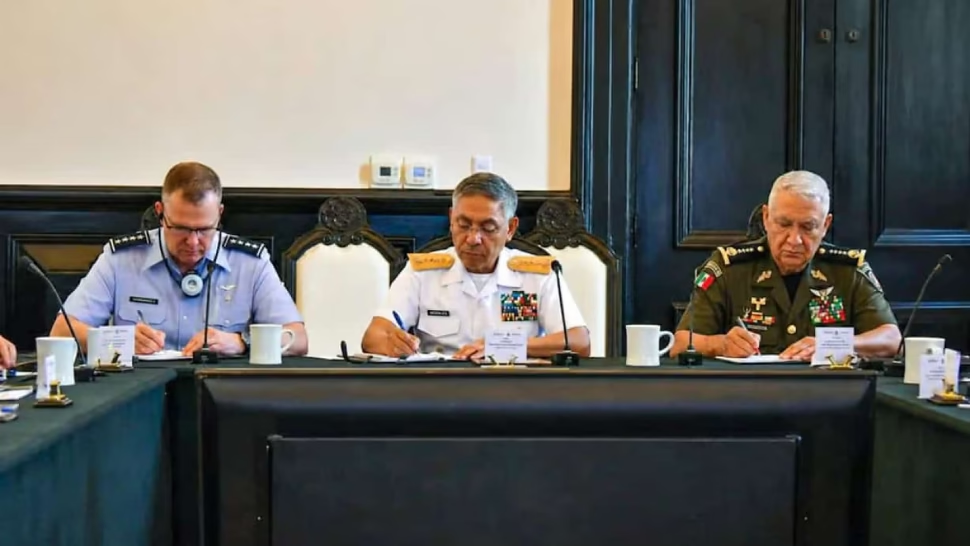
The commander of the United States Northern Command, General Greg Guillot, visited Mexico to meet with senior officials from the Secretariat of National Defense (Sedena) and the Secretariat of the Navy (Semar). The meetings occurred on July 22 in Veracruz.

Bilateral security cooperation

Guillot met with the head of the Sedena, General Ricardo Trevilla, and with the Secretary of the Navy, Admiral Raymundo Pedro Morales. The US embassy described the meetings as progress in the defense relationship between both countries.

Among the topics addressed are specialized training in special operations and against organized crime, the exchange of information, and cooperation to counter unmanned aerial systems. The North American Maritime Security Initiative was also reviewed.

“The security of North America depends on the strength of its alliances and the ability of its members to act with common objectives,” said General Guillot.

Both nations reiterated their commitment to expanding cooperation, respecting sovereignty, territorial integrity and shared responsibility for security.

Continue reading

T-MEC negotiations: tariffs and regional content on the table

Third round of dialogue between Mexico and the US addresses labor mechanisms and strategic rules.

Key points from the third round

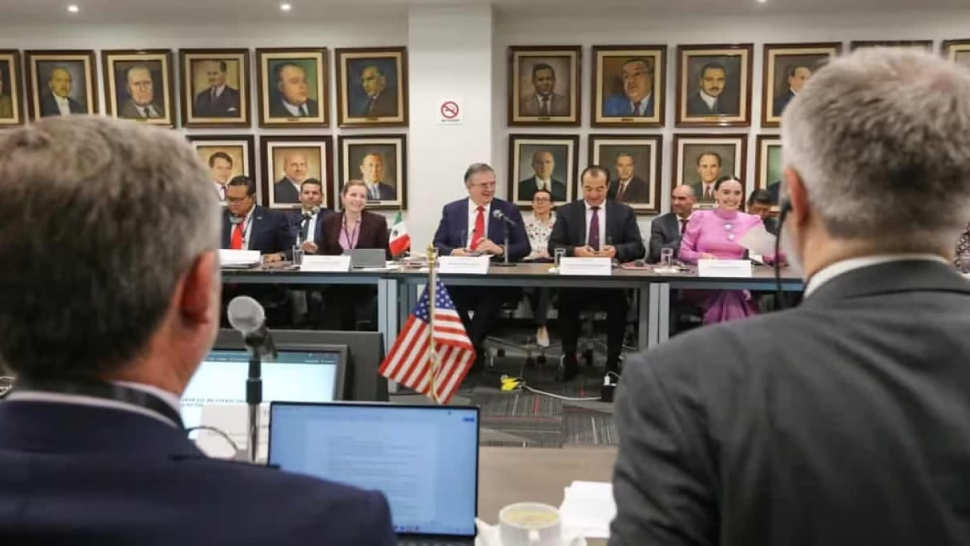
Between July 21 and 23, Mexico and the United States held the third round of negotiations towards the review of the T-MEC. The central issues were tariffs, labor mechanisms, regional content and rules for sectors such as automotive, steel and aluminum.

The president of the Business Coordinating Council (CCE), José Medina Mora, explained that it was proposed to modify the Rapid Response Labor Mechanism to make it reciprocal. Currently, the investigations only apply to companies in Mexican territory.

“It is necessary that the mechanism be applied equitably between both countries,” said Medina Mora.

Another point of discussion was the United States’ intention to increase American content in products made in the region. Mexico defends the concept of regional content and rejects changes that reduce trilateral integration.

The leader added that the seasonality of agricultural products and the impact of tariffs on steel, aluminum and the automotive industry were also reviewed. Some US automakers in Mexico face higher export costs compared to competitors from Japan, Korea and Europe.

For his part, the president of Coparmex, Juan José Sierra, expressed uncertainty regarding the possibility of annual reviews of the treaty, but valued the dialogue between the partners. He indicated that Mexico requires strengthening legal and energy security and the conditions to attract investment.

“It is positive that communication continues, but we need certainty for investors,” said Sierra.

Concamin pointed out that the joint statement between the Secretary of Economy, Marcelo Ebrard, and the US trade representative, Jamieson Greer, confirms that both countries maintain an institutional work path.

Continue reading