Sheinbaum avoids commenting on Bolsonaro’s sentence

The Mexican president avoids any assessment of the historic court ruling, focusing her speech on unwavering support.

The Diplomacy of “It’s Not Our Fart”, Presidential Version

In a display of diplomatic balance worthy of a tightrope walker on a lava, President Claudia Sheinbaum Pardo today offered a master’s degree in the art of not getting wet. The hot topic: the 27-year prison sentence of former Brazilian president Jair Bolsonaro for an attempted coup against his successor, Luiz Inácio Lula da Silva. An unimportant little thing, right?

From the majestic National Palace, in her now traditional morning conference this Monday, September 22, our president used what is perhaps the most versatile phrase in international politics: “We do not have to take a position”. Tachan! Here is the magic formula to avoid any uncomfortable question. Doesn’t it remind you of when they ask you about your mother-in-law at a family gathering and you respond “it’s an issue that strictly concerns my husband’s family”?

RelatedLula rejects Trump’s tariffs and defends Brazilian democracy

Unconditional Support (but with Conditions of No Opinion)

The strategy was as subtle as an elephant in a china shop, but with better vocabulary. First, the disrespect of neutrality: “It’s Brazil’s decision,” he declared, as if a political earthquake of that magnitude in the largest nation in Latin America were a small municipal matter about garbage collection schedules. Of course, with the technical-legal addition that it is “a decision of the Court of Brazil“, in case someone thought that the sentence had been issued by a popular jury on a television program.

And then, the script twist. After washing his hands with the elegance of Pontius Pilate on a particularly diplomatic day, he proceeded to declare his unwavering and unconditional support for President Lula. Of course, that support is, I quote, “independent of giving an opinion on a particular trial in Brazil.” A marvel of modern logic: “We support you wholeheartedly, dear ally, as long as our support does not imply having to specifically refer to the monumental event that has consolidated you in power and shaken the foundations of your country.” Can we be clearer?

One can almost imagine the scene: “Lula, brother, you can count on us for whatever you need. What about Bolsonaro? Oh, no, we don’t even mention that. It’s as if that man who was in prison for 27 years had simply gone on a perpetual vacation to a maximum security prison. Hugs, not bullets (and no opinions either)!”

The rhetorical question that floats in the air, heavier than an hour and a half speech, is: what the hell does “support” really mean in the lexicon of the Mexican Foreign Ministry? Does it consist of sending strong positive vibes and a bouquet of flowers by diplomatic mail, but stopping any value judgments about the fact that defines your colleague’s presidency? It’s like saying “I fully support your divorce” but refusing to comment on the lover your friend found in the closet. An ethereal, abstract, almost philosophical support.

Sheinbaum, with the precision of a surgeon avoiding a vital organ, achieved the goal: not to alienate anyone (or maybe everyone a little bit). Neither to the Bolsonaristas who could be listening (although probably not in La Mañanera), nor to the Lulistas who expected an open celebration. It is the dance of diplomacy at its finest: many side steps, a turn on oneself and a smile that does not compromise anything. Bravo for the performance. The Oscar for Best Escape in a Political Drama is more than deserved.

What does this realpolitik lesson flavored with morning coffee leave us? Well, in the international arena, sometimes silence (or its first cousin, the empty declaration) is golden. Meanwhile, Bolsonaro packs his bags for a long stay and Lula thanks the “support” which, to be honest, sounds more like “we’re watching the game from the stands, but with your team’s shirt on.” Of course, without shouting joints.

Are you intrigued by how these geopolitical storms are navigated with such fine humor? Share this analysis with your contacts and discover more content about the twists and turns of global diplomacy on our social networks.

Mexico deploys aid brigade to Venezuela after earthquakes

Mexico sent 250 soldiers and medical supplies to Venezuela after the earthquakes.

Humanitarian aid to Venezuela

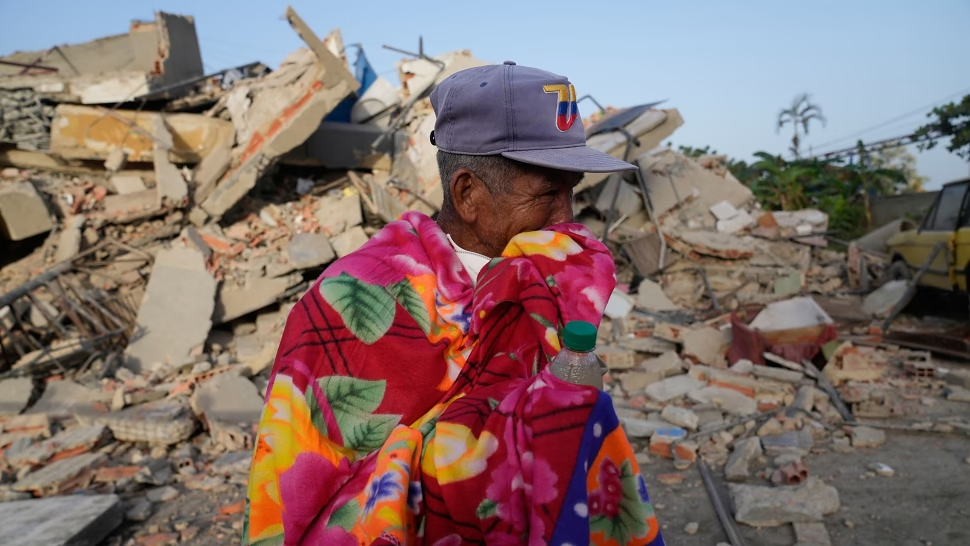
Mexico sent a support contingent to Venezuela to address the damage caused by two strong earthquakes that shook the north-central region of the country.

President Claudia Sheinbaum confirmed the measure and reiterated the solidarity of her government.

“Our solidarity with the people of Venezuela. A team of rescuers and medical personnel from the Ministry of Defense leaves today. Once they are established there and after talking with the authorities, we will determine the additional personnel necessary.”

The first emergency brigade is made up of 250 soldiers, five canine units, four aircraft, a drone, specialized investigation equipment and medical supplies.

No collection centers for now

When asked about the possible opening of collection centers, the president clarified that “for the moment, they have asked us for rescuers and health support; they have not asked us for food aid.”

Sheinbaum added that so far no compatriots have been injured, missing or died in the tragedy, and that the situation remains under surveillance.

Continue reading

Telephone line registration: new calendar until December

New staggered calendar to register telephone lines in Mexico. Know the dates according to your number.

The Telecommunications Regulatory Commission (CRT) extended the deadline to register telephone lines until December 2026. So far, only 63 million users (39.1% of the total) have completed the process. Of them, 40.2 million are prepaid and 22.8 million are postpaid.

Calendar by last digit

Registration will be done in stages according to the last digit of the telephone number:

  • 0: August 15
  • 1: August 31
  • 2: September 15
  • 3: September 30
  • 4: October 15
  • 5: October 31
  • 6: November 15
  • 7: November 30
  • 8: December 15
  • 9: December 31

Consequences of not registering

If you do not register before the deadline, your operator will suspend the line within 72 hours. You will only be able to make emergency calls, to citizen services and receive seismic alerts. You will lose access to mobile data, although you will be able to use Wi-Fi networks.

After expiration, you can register your line and service will be fully restored. The procedure is carried out with your operator and requires the CURP. Check your company’s official site for more details.

Continue reading

Mexico receives King Felipe VI with honors at the National Palace

Sheinbaum and the Spanish monarch discuss the bilateral relationship in the National Palace.

Welcome ceremony at the National Palace

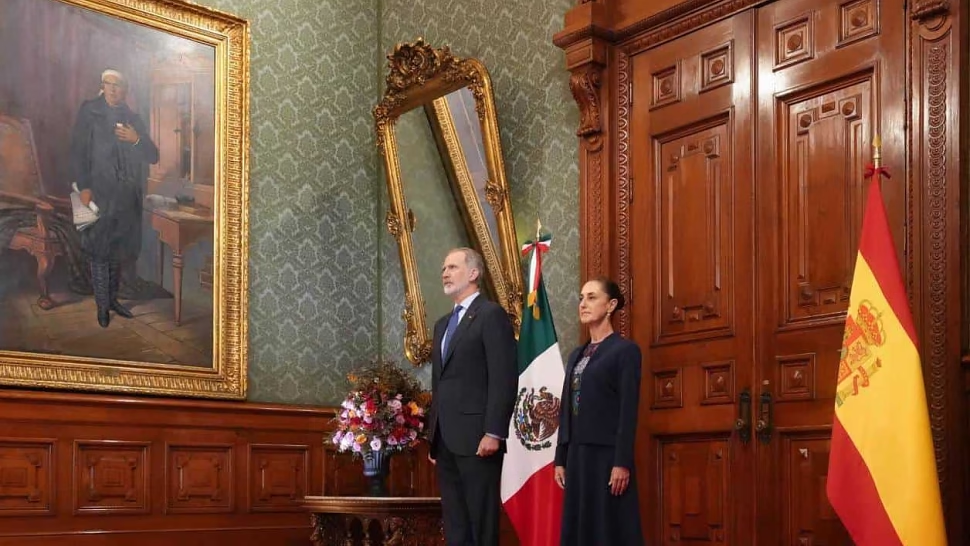
President Claudia Sheinbaum Pardo received King Felipe VI of Spain this day in the Ambassadors Room of the National Palace. During the official ceremony, the national anthems of both countries were sung, followed by the official photograph of the meeting.

Bilateral meeting

Sheinbaum and the monarch will hold a dialogue about the state of the relationship between Mexico and Spain. Senior officials from both governments attend the meeting.

On behalf of Mexico: the Secretary of Foreign Affairs, Roberto Velasco Álvarez; the head of the Office of the Presidency, Lázaro Cárdenas Batel; and the Mexican ambassador to Spain, Quirino Ordaz Coppel.

For Spain: the Minister of Foreign Affairs, European Union and Cooperation, José Manuel Albares Bueno; the Minister of Education, Vocational Training and Sports, Milagros Tolón Jaime; the head of the King’s House, Camilo Villarino Marzo; the ambassador of Spain in Mexico, Juan Duarte Cuadrado; the diplomatic advisor of the King’s House, Carmen Castiella Ruiz de Velasco; and the head of the Minister’s Office, Sergio Cuesta Francisco.

The visit of King Felipe VI takes place within the framework of his official tour of Mexican territory. Both leaders are expected to address issues of cooperation, trade and culture.

Continue reading