Sheinbaum and FMF launch national football training strategy

Government and FMF present a plan to promote soccer from childhood with academies and scholarships.

President Claudia Sheinbaum and the Mexican Football Federation (FMF) presented the National Training Strategy, a program that seeks to ensure that girls, boys and young people have access to sport from an early age to high performance. The announcement was made within the framework of the 2026 FIFA World Cup.

“The commitment to start a different stage of Mexican soccer is good news; above all, that girls and boys participate,” Sheinbaum said in the morning conference.

RelatedSheinbaum and FMF agree on national football training strategy

How will the plan work?

The strategy starts with school football: in 2026, 28 thousand schools and more than 1.13 million students participated. It includes federated competitions and talent detection to channel them to professional club academies. The FMF will certify academies; There are already 2 thousand registered with about 168 thousand minors, and 510 more in process.

Mikel Arriola, commissioner of the FMF, explained that the system will accompany the soccer player from the age of 5 or 6 to high performance, with discipline and values. “Communities will be forged and they will be kept away from risky contexts,” he noted.

The 18 Liga MX clubs will reinforce sports and academic scholarship schemes in secondary, high school and university. Support will also be provided for registration and monthly payments, so that young people continue studying while they develop.

In 2025, more than 11 thousand players were observed through the national detection network. There were 315 invitations to tryouts in professional clubs and 97 to national teams. In youth teams, women represent 94% of the calls.

Rommel Pacheco, director of Conade, indicated that this coordination seeks to guarantee that girls, boys and young people can fulfill their dreams.
World Cup 2026: piracy floods the streets of Mexico City

Piracy of 2026 World Cup items skyrockets in CDMX due to high prices and impunity.

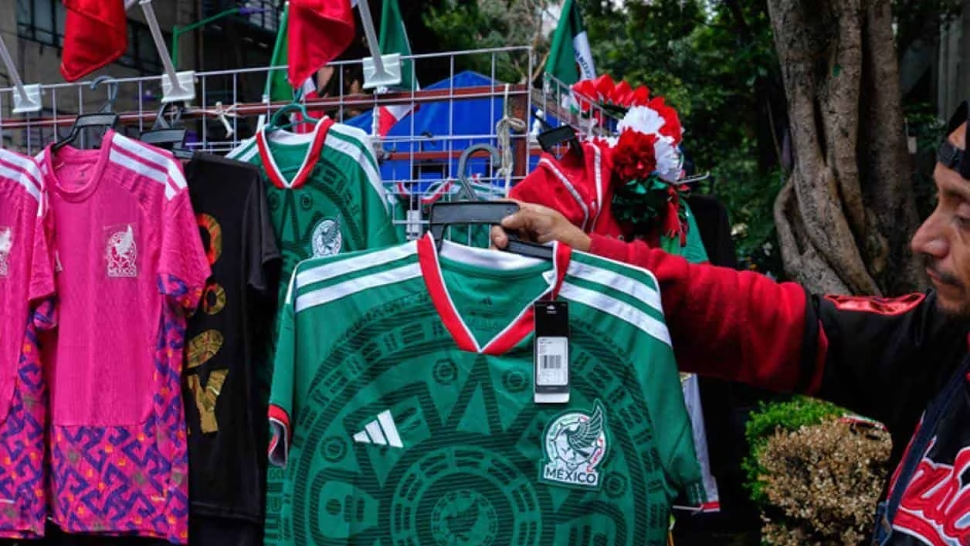
The furor for the 2026 World Cup has overflowed the stadiums. In Mexico City, the sidewalks are filled with vendors selling unofficial t-shirts, trophies and mascots. The phenomenon, although not new, has intensified. Specialists attribute this to impunity, corruption in customs and the high prices of original products.

“We have more and more problems related to piracy,” said Francisco Rivas, general director of the National Citizen Observatory. According to Rivas, the progress is also due to the fact that organized crime forces formal merchants through extortion.

Alarming figures

Mexico is the seventh largest buyer of unauthorized copies worldwide, according to a report by the OECD and the EUIPO. An official Mexican national team jersey costs more than 2,000 pesos ($117), equivalent to a week’s minimum wage. In the informal market, the price is around 250 pesos (14 dollars).

“People leave because of the economy,” said Lizeth Herrera, a 26-year-old physical education teacher, while looking for T-shirts at a stall in the historic center.

Insufficient official actions

Claudia Sheinbaum’s government has made million-dollar seizures and approved a regulation to accelerate patents. But Rivas considers that these measures are not enough due to the complexity of the phenomenon and corruption. In the La Lagunilla market, in Tepito, the police circulate without intervening due to the massive sale of unofficial items.

Mariana Villalobos, an online seller, commented: “This World Cup has gone very well for me.” His sales of pirate t-shirts multiplied after Mexico’s triumphs. Faced with criticism, he responded: “There are tastes of everything and there is economy for everyone.”

The cultural challenge

The informal sector represents more than half of the economically active population in Mexico. Companies like the B2B corporation have had to strengthen their digital communication to compete. Gabriela Valdés, deputy general director, pointed out that the problem must be addressed as a cultural issue: “It is sad to know that behind a design and sewing effort it is not given the deserved value.”

Continue reading

Sheinbaum orders to review FBI donation of small plane used in capture

Sheinbaum asks to review the FBI's donation of the aircraft used in the transfer of Zambada and Guzmán López.

Official review after FBI donation

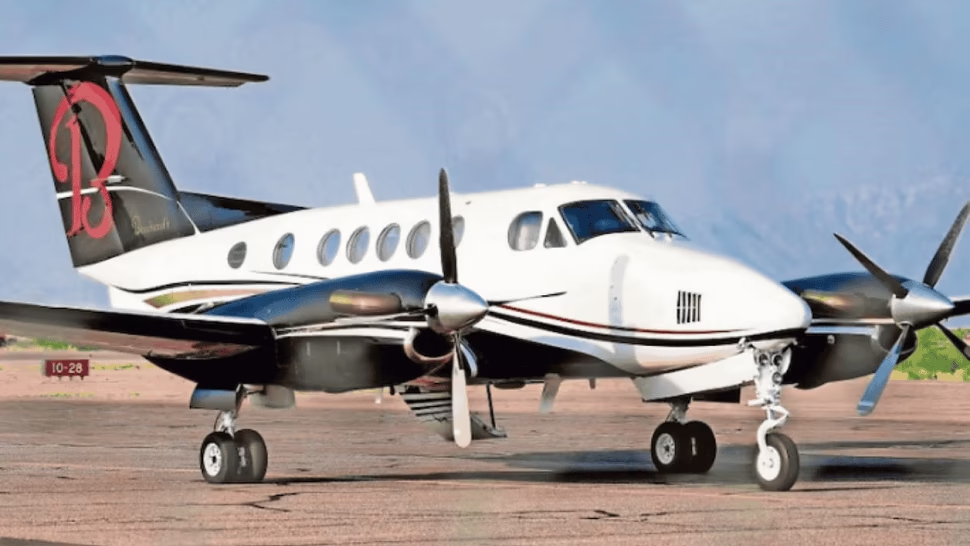
President Claudia Sheinbaum instructed the Ministry of Foreign Affairs (SRE) and the Security Cabinet to analyze the case of the small plane that the FBI donated to a museum in New Mexico. The aircraft transported Ismael “El Mayo” Zambada and Joaquín Guzmán López from Mexico to the United States in July, where they were detained.

During his morning conference in Morelia, Michoacán, Sheinbaum indicated that he will speak on the issue next week. “I asked the SRE and the Security Cabinet to carry out this review and, if they agree, we will comment next week,” he said.

Questions about FBI involvement

Given the insistence of the press on whether the donation confirms the FBI’s participation in the operation, the president avoided advancing conclusions. “Let’s review. Yesterday we saw the Pie de Nota report,” he added.

The plane was delivered by the US agency to a cultural venue, which has generated debate about the role of US authorities in the capture of the kingpins. Sheinbaum did not provide more details until the requested analysis was available.

Continue reading

Sheinbaum details Plan Michoacán: 54 billion and 850 thousand services

Sheinbaum presents progress of the Michoacán Plan with 54 billion in investments and more than 850 thousand services.

Sheinbaum heads the evaluation of the Michoacán Plan

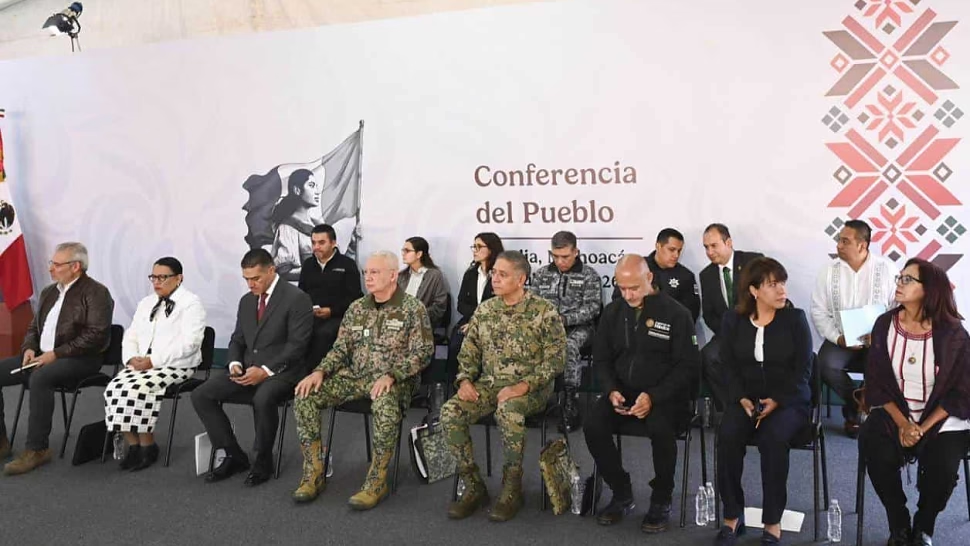
President Claudia Sheinbaum led the presentation of progress of the Michoacán Plan for Peace and Justice in Morelia. The federal deployment seeks to consolidate the development of the state hand in hand with the Justice Plan of the P’urhépecha People.

“We are going to continue looking at Michoacán with the objective of advancing peace and justice for the people of Michoacán,” he stressed.

More than 850 thousand services at Wellness Fairs

The Secretary of the Interior, Rosa Icela Rodríguez, reported that from November 19, 2025 to July 2, 2026, 850,679 services and procedures were granted in 68 municipalities, with 77 federal and state agencies.

He also detailed that the Welfare Markets delivered more than 2 million basic necessities to 27,050 families.

Million dollar investment in infrastructure

The global investment is around 54 billion pesos, of which 16 billion correspond to 2026. They are allocated to the conservation and modernization of 411 kilometers of highways, artisanal roads and the “MegaBachetón” program.

In education, the “Rita Cetina”, “Benito Juárez” and “Gertrudis Bocanegra” scholarship programs provide 5.7 billion pesos for 842 thousand students.

In addition, 1,627 million pesos were dispersed in favor of 166,000 agricultural and fishing producers through Production for Wellbeing and Free Fertilizers.

Indigenous development in the P’urhépecha region

The construction of the National Guard barracks in Cherán, the construction of hospitals, credits for artisans and the publication in the Official Gazette of the geographical indication of the avocado to protect its value stand out.

Continue reading