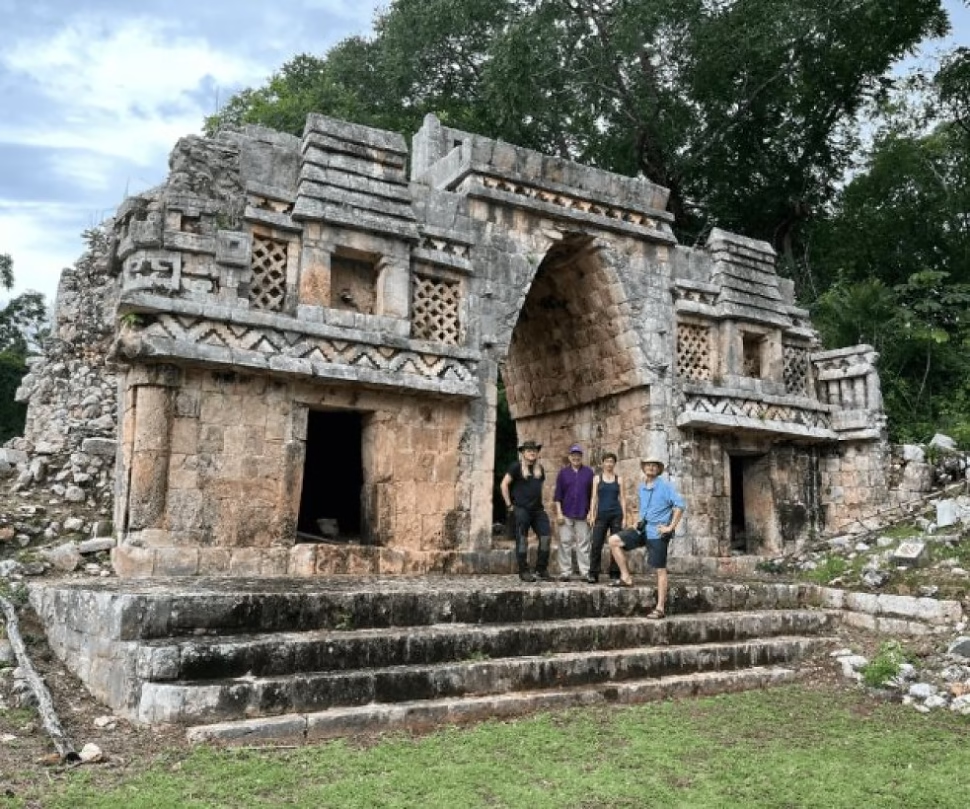
Climate impact on Mayan decline: a rigorous analysis
The Mayan civilization, renowned for its advances in astronomy, mathematics and architecture, experienced a systemic collapse between the 8th and 10th centuries AD. Recent research published in Science Advances confirms that 44 years of extreme droughts during the Classic Period (250-900 AD) were a determining factor in this process. The study was based on the isotopic analysis of a stalagmite from the Yok Balum cave (Belize), located near key urban centers such as Chichén Itzá and Caracol.
Revealing climate data
Paleoclimatic records identified eight drought events between 870 and 1100 AD, defined by:
- Absence of wet season during complete annual cycles.
- 70% reduction in precipitation, based on oxygen-18 levels in the stalagmite.
- Critical periods of up to 13 consecutive years without rain (event of 929 AD).
These conditions devastated an agricultural system dependent on corn, a crop that required 900 mm of annual rainfall—a threshold that was not reached for decades. Mayan hydraulic engineering, although advanced, was insufficient in the face of the magnitude of water stress.
Sociopolitical consequences
The collapse was not abrupt, but a multifactorial process where the climate acted as a catalyst:
- Social fracture: The elites lost legitimacy by failing to guarantee crops.
- Mass migration: Between 950 and 1050 AD, cities like Tikal saw their population reduce by 90%.
- Wars over resources: Inscriptions on monuments reflect conflicts over water and arable land.
Interestingly, areas with access to cenotes (such as Chichén Itzá) survived two more centuries, evidencing the correlation between water availability and urban resilience.
Lessons for the present
This historical case offers parallels with current challenges:
- The vulnerability of agricultural systems to sudden changes in rainfall patterns.
- The risk of civilizational collapse when multiple pillars fail (climate, governance, economy).
Subsequent investigations in caves in Campeche seek to specify how droughts varied between regions, a key piece of information to understand the heterogeneity of the collapse.
Are you surprised by how climate shapes history? Share this analysis and discover more studies on ancient civilizations on our social networks. #ClimaticArchaeology