Digital health: health centers with internet and single file in 2026

Government of Mexico will connect all health centers to the internet and modernize hospital equipment.

President Claudia Sheinbaum announced that this year all IMSS, ISSSTE and IMSS Bienestar health centers will have an internet connection. The objective is to implement the Digital Clinical Record, a system that will centralize the information of each patient.

“Connectivity and the single file will facilitate the integration of health services for the Universal Service,” he said in his morning conference.

The plan includes the purchase of state-of-the-art medical equipment. Zoé Robledo, director of the IMSS, detailed five innovation programs:

RelatedIMSS hospital inaugurated in Chiapas for one million beneficiaries
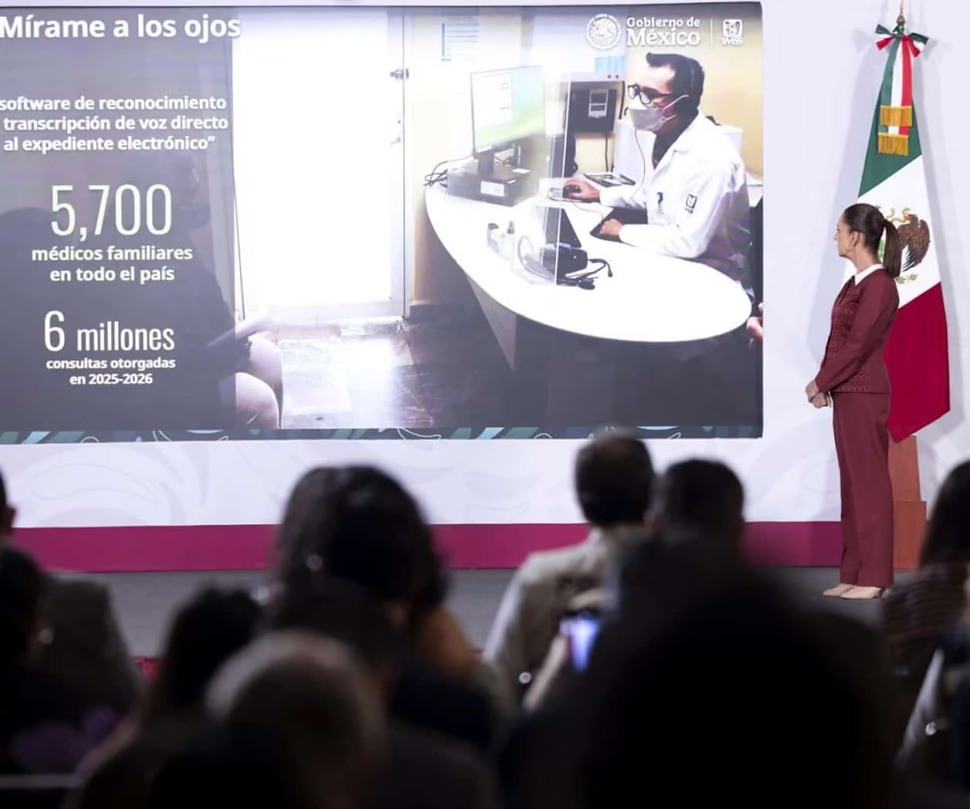
  • Look me in the eyes: voice recognition software used by 5,700 doctors. From 2025 to 2026, 6 million consultations were granted.
  • Digital Consultation: available in 402 units; In 2025, 813 thousand consultations were carried out by video call.
  • Tomographs: 41 teams with 256 sections in 39 hospitals in 20 states.
  • Robotic surgery: 68 surgeons trained in five hospitals, including La Raza and Siglo XXI.
  • CyberKnife: first team in Mexico and third in Latin America, it has already treated 354 patients.

Investment and new units

Alejandro Svarch, director of the IMSS Bienestar, reported that in 2026 13 billion pesos will be invested to incorporate 32 thousand pieces of equipment, including eight linear accelerators, 11 magnetic resonance imaging and 70 breast scanners with artificial intelligence. In addition, 8,400 health centers will have internet and a digital platform with clinical records and laboratories.

Martí Batres, director of ISSSTE, announced four Blue Rooms: mammography interpretation rooms with AI, capable of reading more than 400 thousand studies a year from 98 units, and will reach 180 in 2027.

Sheinbaum highlighted that 29 hospitals, 20 health centers and family medicine units will be inaugurated, in addition to the hiring of personnel with better salaries and consolidated purchases of medicines. “Not just free care, but the best care,” he concluded.


They discover a tunnel to extract illegal fuel in Mineral de la Reforma

They find clandestine infrastructure connected to the Pemex pipeline in a state operation.

Tunnel found for hydrocarbon theft

Elements of the Hidalgo Public Security Secretariat (SSPH) located a tunnel used for the illegal extraction of fuel on a property in the El Saucillo neighborhood, in Mineral de la Reforma.

The discovery occurred after a citizen complaint. Agents carried out an operation that led to the arrest of five people and the seizure of three properties. They also seized approximately 500 meters of high-pressure hose and doses of alleged drugs.

The detainees tried to flee when they noticed the police presence, but were captured. As part of the investigations, three searches were carried out. In one of the properties, a tunnel six meters deep and 50 meters long was found, connected to a Petróleos Mexicanos (Pemex) pipeline to illegally extract hydrocarbons.

In another property there was a warehouse that was allegedly used to store the extracted fuel. The secured hose was used for clandestine intakes.

The actions were coordinated by the SSPH, the Attorney General’s Office of the State of Hidalgo (PGJEH), the Secretariat of National Defense and the National Guard. The detainees were placed at the disposal of the Federal Public Ministry, which will integrate the corresponding investigation folders.

With this discovery, during the current state administration there are 19 tunnels located in Hidalgo intended for the theft of hydrocarbons. These have been detected in municipalities such as Cuautepec, Pachuca, Tepeji del Río, Tlanalapa, Tlaxcoapan, Tula, Mineral de la Reforma, Tepeapulco, Tepetitlán, Nopala and Atitalaquia.

Continue reading

SEP rejects militarized education after tragedy in Tamaulipas

The SEP clarifies that militarized education is not authorized after the death of a minor in Tamaulipas.

SEP reiterates ban on military education

The Ministry of Public Education (SEP) stated that education under military or military modalities is not permitted in Mexico. The statement came after the death of a teenager at a summer camp with military characteristics in Ciudad Madero, Tamaulipas.

The head of the SEP, Mario Delgado Carrillo, condemned attempts to justify acts of violence or mistreatment with the argument of a supposed military education. He pointed out that these practices are not training methods and violate the human rights of children and adolescents.

Through a statement, the agency clarified that no basic education institution is authorized to teach teachings labeled as military or military. He explained that military education is exclusive for personnel of the Armed Forces and the National Guard.

Regarding the incident, state educational authorities will take measures to protect the rights of minors. According to family testimonies, the teenager entered the camp on July 13 in good health and days later she was reported fainted after a fall. The minor died inside the facilities.

The SEP reiterated its rejection of any practice of abuse or degrading treatment against minors. The case has generated a call to review supervision mechanisms in extracurricular activities.

Continue reading

Imports of Mexican cattle to the US resume

Following a health agreement, the US will reopen the port of Douglas, Arizona, for Mexican cattle.

President Claudia Sheinbaum reported that the United States will resume importing Mexican cattle starting the last week of August. The decision came after an official communication from the US Secretary of Agriculture, Brooke Rollins.

Reopening schedule

The reopening will begin at the border port of Agua Prieta, Sonora, linked to the Douglas crossing, Arizona. August 24 will be the first date of operation. Later, two additional points will be enabled in Chihuahua, subject to compliance with the Joint Action Plan against screwworm.

Sheinbaum instructed federal agencies to accelerate coordination with US authorities. He highlighted the work of the Secretary of Agriculture, Julio Berdegué, and the director of Senasica, Columba López, to strengthen health measures.

  • The animals will enter with complete inspections to verify that they do not show signs of the plague.
  • Later, the opening of the ports of Santa Teresa and Columbus, in New Mexico, will be evaluated.

The president described the news as positive for Mexican ranchers, who for months contained the spread of the screwworm. He appreciated Rollins’ willingness to maintain an institutional relationship.

Rollins, for his part, stated that the protection of the US livestock industry remains a priority and that the temporary closure of crossings was necessary to reduce risks. The reopening is possible thanks to binational collaboration.

Continue reading