Salinas Pliego ironically talks about accusations of money laundering in Mexico

The Mexican tycoon responds with irony to the US Treasury's accusations against three local banks.

The US Treasury points the finger at Mexican banks and Salinas Pliego does not remain silent

The US Treasury Department decided to bring out the big guns on June 25: it accused CIBanco, Intercam and Vector—yes, three Mexican financial institutions—of being the undeclared tax haven for money laundering linked to opioid trafficking. He called them “top concern” and, as if it were a scene from Breaking Bad, cut off their access to certain transfers. Reason? Million-dollar movements that, according to them, benefited Mexican cartels and even financed chemical precursors to cook that fentanyl that no one asked for but everyone fears.

Salinas Pliego: between sarcasm and corporate defense

While the financial world was wondering if this was the beginning of a bureaucratic soap opera, Ricardo Salinas Pliego—the man who could sell ice in the Arctic—decided to enter the chat. And he did it with that style of his that oscillates between the serious CEO and the guy on WhatsApp who shares political memes. After Claudia Sheinbaum‘s request that the US present evidence, he released on 24 hours.” Free translation: “See? We do act quickly… when we are pressured.”.

RelatedFox supports the possible presidential candidacy of Salinas Pliego

But as a good influencer in the business world, he was not satisfied with a single tweet. In a second act, he dropped an ironic gem about the withdrawal of visas for employees of those banks: “For God’s sake! Apparently, there will soon be several mega-mansions for auction sale in the US. We will have to be ready to take advantage of the opportunities.” In other words, if drug trafficking leaves luxury homes cheap, does that count as a flash deal? Questions that only Salinas Pliego can ask without being canceled.

The background: Real operation or geopolitical theater?

Beyond the acid humor, the setting is murky. That the US targets Mexican banks is not new, but this time they targeted the pocket of organized crime. And although local authorities—like the CNBV—acted quickly (or so Salinas says), the doubt persists: is this a real blow to drug trafficking or just a diplomatic move to pressure Mexico? Because, let’s be honest, if fentanyl were a hashtag, it would already be a trending topic years ago.

The truth is that Salinas Pliego’s message, between the lines, reflects that mixture of skepticism and sarcasm that many Mexicans feel in the face of these accusations. Conclusive evidence? Concrete actions? Or, as he would say: “So, do they think we are more capable of laundering money than of laundering our reputation?”.

Are you surprised by Salinas Pliego’s reaction? Share this note and discover more about how the financial world and organized crime sometimes seem to share a bank account. #DirtyMoney #FinancesWithoutFiltro
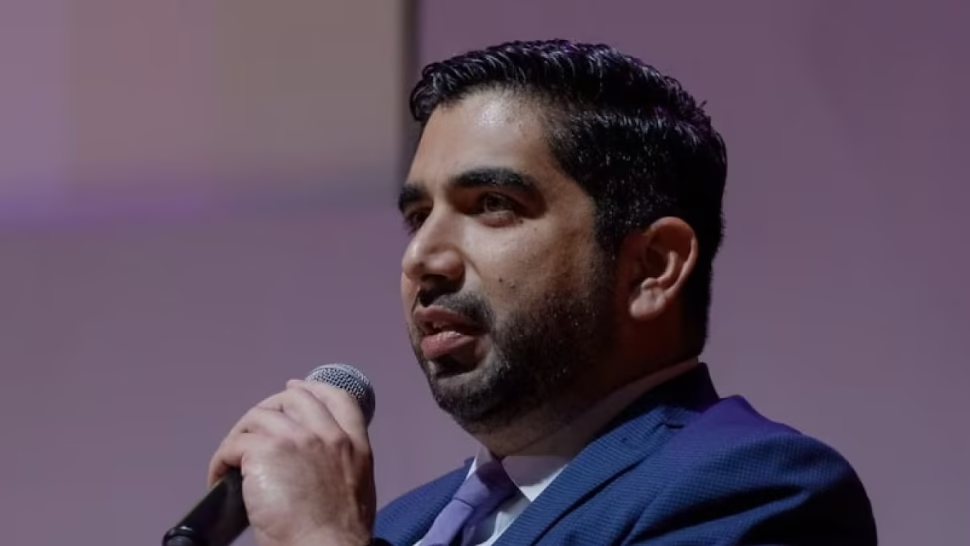
Roberto Lazzeri begins management as ambassador with call for cooperation

The diplomat participated in a Trump event where a 66% reduction in fentanyl was reported.

First public intervention

Roberto Lazzeri participated this Wednesday in his first public event as Mexican ambassador to the United States. It was during an event organized by Donald Trump on the National Mall for the 250th anniversary of American independence.

There he heard the message from President Trump, who highlighted a 66% reduction in the flow of fentanyl into his country. Lazzeri pointed out that these results strengthen bilateral security cooperation, promoted by President Claudia Sheinbaum based on respect for sovereignty and coordination.

A 35% decrease in overdose deaths in the United States was also mentioned, as well as the seizure of nearly 30,000 firearms. The ambassador attributed these figures to the joint work between both nations.

Trump used the event to refer to the 2026 FIFA World Cup, which will be played in North America. Lazzeri assured that Mexico contributes to the project with actions in security, connectivity and tourism, with an estimated economic benefit of more than 18 billion pesos.

Continue reading

New calendar for registration of mobile lines

More than 63 million lines already registered; new staggered term until December 2026.

The Telecommunications Regulatory Commission (CRT) postponed the mandatory registration of mobile lines. The deadline, scheduled for June 30, was extended to facilitate the process for millions of users.

New registration calendar

The new term applies only to unregistered prepaid lines. It will be staggered according to the last digit of the number. The dates range from August 15 to December 31, 2026.

So far, more than 63 million lines are registered: 40.2 million prepaid and 22.8 million postpaid. Millions are still missing.

Unregistered lines will be suspended by telephone companies within a period of up to 72 hours. During that time they will only be able to call emergencies, citizen services and their operator. Service is restored upon completion of registration.

Mexico closed 2025 with around 161.6 million active mobile lines, a penetration of more than 124% of the population. Additionally, if a line is used to commit a crime, authorities may request information directly from companies.

Continue reading

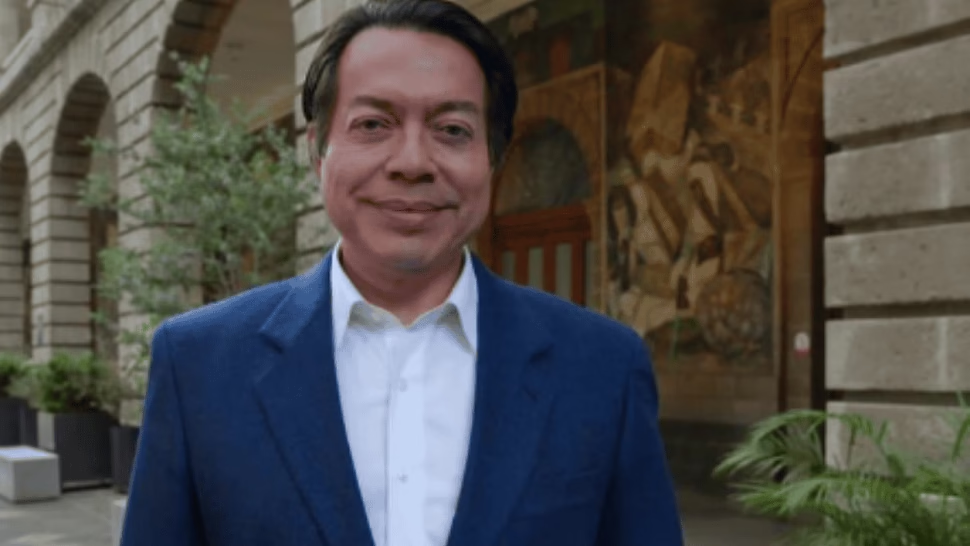
SEP reports record investment in schools and scholarships in the 2025-2026 cycle

One million teachers participated in CTE; 23 billion pesos for schools and 10 million scholarships.

Achievements of the 2025-2026 school year

The Secretary of Public Education, Mario Delgado, presented the results of the 2025-2026 school year. Nearly a million teachers participated permanently in the School Technical Councils (CTE). The federal government allocated 23 billion pesos for works and equipment in 72 thousand schools.

“Looking back is looking at what we are and what strengthens us: a constant conversation between authorities and educational personnel,” said Delgado during the Eighth Ordinary Session of the CTE.

The CTEs were consolidated as learning communities to improve teaching, the official highlighted. In terms of support, the Rita Cetina Scholarship benefited 10 million public primary school students. In addition, eight million girls and boys received free comprehensive care through the Live Healthy, Live Happy strategy.

Investment and reforms

Delgado reported that 23 billion pesos were channeled through the School is Ours program and the Participatory Administration School Committees. The resources were used in infrastructure, works and equipment in Basic Education, Higher Secondary and special modalities schools.

In labor matters, rights were recovered for teachers: salary increases, creation of the Pension Fund for Wellbeing and modifications to stop the increase in the retirement age. The USICAMM will disappear to make way for a new model that guarantees transparency and eliminates influence, nepotism and the sale of positions.

Other actions

The national health strategy valued 10.7 million students in 82 thousand primary schools (96% of enrollment). The Mundialito Escolar 2026, linked to the 2026 FIFA World Cup, brought together more than 1.1 million students. The finals were held at the University Olympic Stadium.

The National Campaign for Peace and against Addictions “Stay away from drugs. Choose to be happy” integrated artistic and sports activities. More than six million people participated in the National Days, and 25 million in the Reading Marathons.

Finally, the SEP published an agreement to eradicate abuse in basic education, strengthening the prevention of school violence.

Continue reading