Republicans push massive sale of public lands amid criticism

A controversial measure sparks the battle for the future of federal lands in the US, pitting conservationists and developers against each other.

The fate of public lands: an epic battle beneath the Capitol

As if the Wild West itself were reborn in the halls of power, Republicans in the House of Representatives drew their most controversial legislative weapon. In a twist that shook the foundations of environmental policy, they snuck an explosive provision into their tax cut package: the sale of thousands of acres of federal lands in Nevada and Utah. The roar of outrage from Democrats and environmental groups echoed like thunder in the mountains, accusing the measure of being a betrayal of America’s natural heritage.

The master move that divides the nation

Under the shadow of the Natural Resources Commission, Republicans Mark Amodei and Celeste Maloy hatched a plan that would make John Muir tremble. Thousands of hectares of public lands, those that hold the secrets of the bison and the open skies, would be auctioned off to the highest bidder. “Profoundly irresponsible!” cried Rep. Joe Neguse, like a prophet warning of the coming ecological apocalypse. Meanwhile, Athan Manuel of the Sierra Club raised a rallying cry: “Public lands are priceless.” His words, sharp as knives, denounced a conspiracy to deliver the sacred places of the West to the clutches of corporations eager for oil and minerals.

RelatedRepublicans promote mining and oil expansion on public lands

The vote was a political duel to the death: 26 to 17. With each hand raised, the future of forests, deserts and nature reserves hung in the balance. Not only was the door opened to drilling, mining and logging, but extraction royalties plummeted, erasing the Biden era’s efforts against climate change in one fell swoop. It was as if the environmental clock turned back decades in a matter of minutes.

Among the rubble of the discussion, an unexpected figure emerged: Ryan Zinke, Trump’s former Interior Secretary, raising his metaphorical sword. “Not now, not later, not ever!” he swore, drawing a red line in the sand. But even his voice seemed to be drowned in the gale of economic interests that were driving the measure. Meanwhile, in a corner of Congress, a new Bipartisan Public Lands Caucus was trying to be born among tears and promises, as a last bastion of hope.

The project not only threatened to transform the Arctic National Wildlife Refuge into an industrial battleground, it resurrected the ghost of coal with a monstrous concession: 6,250 square miles, a territory larger than Connecticut, ready to be devoured by bulldozers. The Republicans defended their move with the argument of “redemptive development,” but their words rang hollow in the face of mental images of felled forests and polluted rivers.

As the clock ticks toward Memorial Day, the deadline for passage of the package, one question hangs in the air like smoke from a wildfire: Will this be the beginning of the end of public lands as we know them, or will the American people raise their voices to stop the tragedy?

Share this story and join the conversation about the future of our natural spaces! Explore more content on conservation and environmental policy.

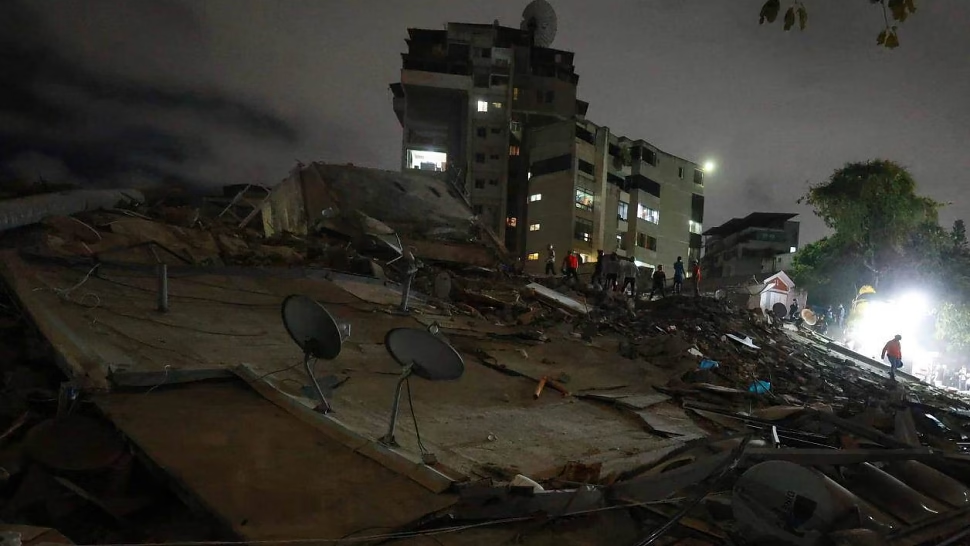
Earthquakes in Venezuela: 188 dead and 40 thousand missing

Two earthquakes in Venezuela leave 188 dead and 40,000 missing, according to estimates.

Official balance and independent estimates

Two earthquakes of magnitude 7.1 and 7.5 shook Venezuela on Thursday, leaving a provisional toll of 188 dead and 1,520 injured, according to Jorge Rodríguez, president of the National Assembly. Around 2,000 families lost their homes. The first tremor occurred at a depth of 20 km; the second, stronger, only 10 km away.

An independent civil initiative estimates that the missing people could reach 40,000. The government has not validated that figure. The coastal area of ​​the state of La Guaira and the west of Caracas were the most affected.

“Everything was falling on us. It looked like a horror movie. It lasted about two minutes,” a resident told the local press.

International response and solidarity

Interim President Delcy Rodríguez declared a state of emergency, closed schools and courts, and mobilized all health personnel. Communications and the airport are collapsed; many bridges were damaged.

International help arrived quickly: rescue teams from the United States, the European Union, Türkiye and Mexico. The IMF allocated 200 million euros for reconstruction. Italy will send firefighters and civil protection.

The lack of supervision in construction—few projects meet anti-seismic standards, without urban planning—would have aggravated the damage, according to local complaints. Venezuela is located on the fault between the Caribbean and South American plates, an area of ​​high seismic risk.

Continue reading

Earthquakes in Venezuela: damage to more than 700 buildings according to citizen reports

Volunteers document 204 total collapses and hundreds of damages in La Guaira and Caracas.

Citizen report after the earthquakes in Venezuela

An open source platform, driven by civilian volunteers, has recorded as of Thursday afternoon 204 total building collapses, 216 with serious structural damage and 298 with partial damage. The information comes from the site earthquakevenezuela.com.

The damage is mainly concentrated in La Guaira and the east-north of Caracas. The tool allows you to collaboratively document damage in homes, hospitals, schools and businesses.

The news outlet El Bus TV validated the initiative by broadcasting it publicly this Thursday and confirmed the responsible actions of the activists. Journalist Tony Frangie Mawad endorsed the open data map, highlighting its usefulness in assessing the extent of infrastructure damage.

These citizen actions complement official efforts in the face of the emergency. The authorities have momentarily reported 188 deaths and some 2,000 homeless families, although it is estimated that the numbers will increase. The platforms continue to receive reports to locate affected people and coordinate humanitarian aid.

The collaboration of the population is key to evaluating the magnitude of the crisis. Tools like earthquakevenezuela.com provide updated information on the hardest hit areas.

Continue reading

Three brothers rescued after earthquake in La Guaira, Venezuela

Three brothers rescued from the rubble after the double earthquake in Venezuela.

Rescue in La Guaira after the earthquake

Early Thursday morning, a double earthquake shook the Vargas state, in Venezuela. In La Guaira, a coastal town 20 kilometers north of Caracas, search teams worked tirelessly among the rubble.

The first survivor to emerge was a child, thin and covered in dust. Shortly after, a young woman managed to say: “There are three of us.” And so it was: a teenager emerged with difficulty. Three brothers, apparently unharmed, were pulled from a crack in what remained of a home.

The video of the rescue was recorded by Mario Ruiz, a neighbor who participated in the tasks. “God, you are merciful,” he exclaimed when he saw them safe. The images went viral on social networks as a symbol of hope.

“Look, we just saved a child,” is heard at the beginning of the video. The little boy, about six or seven years old, emerges from the wreckage. Behind him, his older sister climbs with help. “Are they brothers?” they ask. “Yes, there are three of us,” she replies. The third, the oldest, manages to get out without visible injuries.

The children’s father, exhausted and sweaty, only nodded when asked if his son was there. An older rescuer calmed him: “Let’s go step by step. Help is on the way. You must have faith.”

Hope after tragedy

La Guaira has about 40 thousand inhabitants, although the actual census will be uncertain until the dust settles. The night was long; Rescuers are still searching for more survivors. The miracle of these three brothers keeps hope alive.

Continue reading