Rains in Mexico leave 78 dead and 23 missing

The number of fatalities increases while economic support is activated for families affected by the emergency.

Updated Balance of the Emergency Due to Intense Rains

The situation in Mexico derived from the torrential precipitation of recent days maintains a critical evolution. As of this Wednesday, October 22, the official number of people who died due to the floods and landslides has risen to 78. At the same time, the authorities are still actively searching for 23 individuals reported as not located, which further darkens the humanitarian panorama. This extreme meteorological event has severely impacted five states: Hidalgo, Puebla, Querétaro, San Luis Potosí and Veracruz, where entire communities have seen their normality drastically altered.

The vulnerability of the territory to hydrometeorological phenomena has become evident, exposing the limitations in the civil protection infrastructure and the immediate response protocols. The accumulation of water in basins and tributaries, added to the saturation of the soil, generated sudden floods in rivers and streams that exceeded the natural and artificial containment capacity. This scenario highlights the need for comprehensive risk management that prioritizes prevention and adaptation to climate change, the effects of which are manifesting with increasing frequency and intensity.

RelatedFloods in Mexico leave 83 dead and 16 missing

Implementation of Economic Support for the Affected Population

From the Treasury Room in the National Palace, the Head of Government, Claudia Sheinbaum Pardo, offered a detailed report during her morning conference. One of the central announcements was the formal start of the distribution of direct economic support, for an amount of 20 thousand pesos per family, destined for the victims in four of the impacted states. The federal president emphasized the methodology implemented for this delivery, designed to guarantee transparency and efficiency.

“There are no intermediaries,” declared Sheinbaum Pardo, “there is no one who could falsely say that they are affected when they are not. It is a very dedicated job that is done, and at the same time very expeditious in the delivery of resources.” This mechanism seeks to avoid duplication of beneficiaries and ensure that financial assistance reaches directly those who have lost their homes or belongings due to the contingency. The digitalization of processes has been key; An updated official microsite has been enabled that centralizes information on the effects, which serves as a verification and monitoring platform.

In this portal, constant data purification is carried out. “There have been people already located, some who, with the review of 079 or the state government itself, have searched. And two people who had not been identified and who had unfortunately died,” the official explained. This exercise of contrasting information is essential to refine the figures and correctly orient rescue and aid efforts.

Logistics and Challenges in Aid Distribution

The implementation of this relief plan is not without significant obstacles. The chronology of the distribution shows the logistical challenges imposed by geography and the state of the communication routes. While the delivery of resources begins this Wednesday in the states of Veracruz, Puebla, Querétaro and San Luis Potosí, the start of the same actions in Hidalgo has been scheduled for next Sunday.

The reason for this gap lies in the complex accessibility that persists in several locations in the Hidalgo state. “Hidalgo is the state that still has the most locations that have not been accessible by land,” Sheinbaum mentioned. This situation describes a scenario where humanitarian assistance must be transported by air or alternative routes, which increases operational complexity and response times. Rescue and damage assessment teams continue to work to establish safe corridors that allow the arrival of food, medicine and support personnel to currently isolated areas.

The resilience of the affected communities is being tested. In addition to the loss of human life, property damage includes destroyed homes, flooded crops, loss of livestock, and the destruction of basic infrastructure such as roads, bridges, and drinking water systems. Full recovery will require not only the immediate relief phase, but also a medium and long-term reconstruction strategy that considers the relocation of settlements in high-risk areas and the strengthening of drainage and containment works.

This catastrophic event serves as a forceful reminder of the force of nature and the urgent need to invest in more robust early warning systems and in a culture of prevention that involves the three levels of government and citizens. Coordination between federal, state and municipal authorities, as well as with civil society organizations, will be the pillar on which the successful overcoming of this crisis is based.

Share this crucial information on your social networks to keep your community informed and help us amplify the message about the importance of preparedness for natural disasters. Explore more content related to emergency management and climate change on our site.
Floods in Aguascalientes after intense overnight rains

Storm in Aguascalientes left vehicles stranded and families rescued. Authorities activated protocols.

Rains collapse roads in Aguascalientes

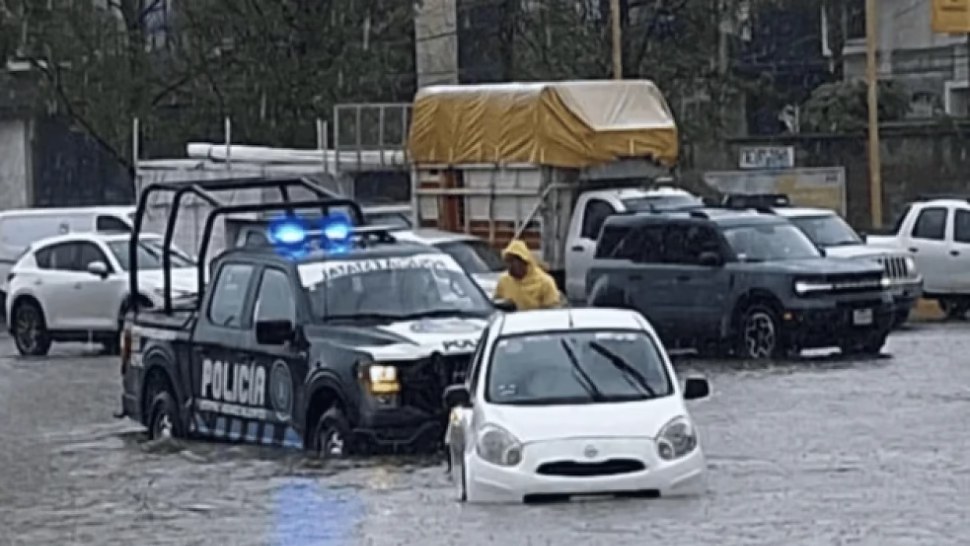
On Saturday night and early Sunday morning, intense rains affected Aguascalientes, Jesús María and Rincón de Romo. Boulevards and avenues were flooded, vehicles were covered in water and entire families were trapped.

Rescues and attention to the population

The greatest impact occurred in the capital. Firefighters and Civil Protection worked for hours to rescue people stranded in different parts of the metropolitan area. They provided assistance to occupants of cars stuck in neighborhoods such as Parques Industrial del Valle, San Francisco de los Romo, the first ring overpass and the exit to Zacatecas.

The overflowing of some channels concentrated the water in the avenues. The State Government reported that security corporations from several municipalities maintain a coordinated operation to provide timely support.

Recommendations and road closures

During the early morning, the authorities asked to avoid driving through flooded areas and to follow official information. The Municipal Public Security Secretariat detailed that the Road Police attended to 42 stranded vehicles and carried out 18 road closures to prevent risks to drivers and pedestrians.

Municipal agents moved entire families, women and minors who could not move due to the storm and flooding to their homes.

Continue reading

CNTE raises a sit-in after 20 days of protest in the Zócalo

The dissident teachers left losses of 410 million pesos and freed up spaces in the Historic Center.

End of the CNTE sit-in

The National Coordinator of Education Workers (CNTE) ended its national strike this Saturday. For 20 days, the mobilizations and the camp in the Historic Center of Mexico City generated losses of more than 410 million pesos to established businesses, according to sector estimates.

Although it did not achieve the repeal of the ISSSTE Law of 2007 or the repeal of the educational reform, the CNTE obtained commitments, financial resources, places, recategorizations and support for education workers in several states.

The leaders assured that the withdrawal is not a defeat. They advanced a stage of reorganization to strengthen the movement and prepare new actions. They insisted that the federal government did not present a proposal to eliminate the ISSSTE Law of 2007 or to reverse the educational reform, demands that will remain in force.

Starting this Monday, around 1.4 million students who remained without classes will be able to return to classrooms in the entities where the CNTE had suspended activities.

Space release

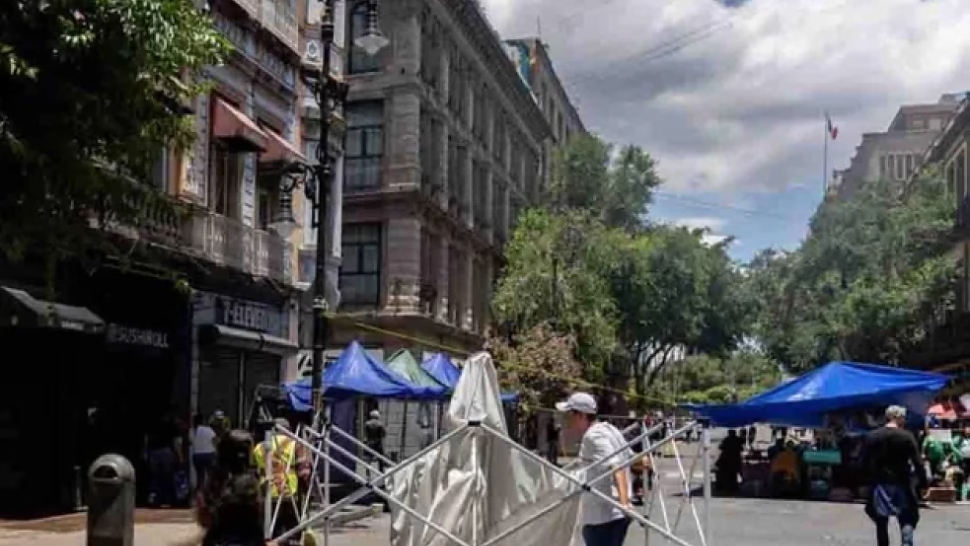
Public space has been gradually freed up. Cleaning workers from the Government of Mexico City removed garbage in streets such as 5 de Mayo, Belisario Domínguez, 20 de Noviembre and República de Cuba. In some areas, the withdrawal was almost total; In others there were still tarps and tents.

A teacher from section 34 of Zacatecas declared: > “We are going to clean it, don’t say that we are going to leave it dirty.”

Merchants expressed relief at the departure of the teaching profession. A worker at the La Blanca restaurant, on May 5, commented: > “It’s good that they’re leaving, it was a very hard month; here we had like a 90% drop in customers.”

A snow seller on the same street indicated that they expected higher sales with the FIFA Fan Fest in the Zócalo, but the arrival of the CNTE reduced their income by 50%.

For his part, the Secretary of Education, Mario Delgado, rejected that the government had “bribed” Section 22 of Oaxaca to hold the sit-in.

Continue reading

Five deaths in bars in CDMX during the early hours of the morning

Two attacks in bars in the capital leave five dead and six arrested.

The early morning left two violent episodes in different parts of the capital

A man lost his life from gunshots outside a bar located in Plaza Garibaldi, Cuauhtémoc mayor’s office. According to the Secretariat of Citizen Security (SSC), the victim was attacked directly in the Lázaro Cárdenas Central Axis and the Republic of Honduras. After the attack, he ran inside the establishment, where he died.

The suspects fled in a gray car, but later returned to the scene along with a blue truck and a subject on a scooter. Agents approached and, after a search, they found packages with one and a half kilos of marijuana and a firearm. They were arrested.

In another incident, an alleged fight inside a bar in the Álvaro Obregón mayor’s office left four people dead and two arrested. One of them was taken to a hospital injured.

Data from the SSC indicate that several people began arguing inside the establishment, in the San Bartolo Ameyalco neighborhood. One of the subjects pulled out a firearm and shot several people. The detainees were placed at the disposal of the authorities.

Continue reading