Pumas presents six reinforcements with their sights on the Clausura 2026 title

The Auriazul club officially presents its six new additions with the clear goal of ending a 14-year drought without a title.

The National University Club has formally begun its preparation for the Clausura 2026 tournament with a strategic move in the transfer market. The Auriazul board has proceeded to the official presentation of six new footballers, a number identical to that of the previous competition, which demonstrates a consistent and planned sports policy. The objective declared by the institution maintains an invariable line: conquer the Mexican soccer championship and put an end to a prolonged trophy fast that spans fourteen seasons.

Analysis of the profile and statements of the new additions

The list of reinforcements is made up of Juninho Vieira, Robert Morales, Jordan Carrillo, César Garza, Antonio Leone and Jesús Rivas. Each one was presented in a formal ceremony where the responsibility of wearing the university shirt was highlighted. The sports vice president, Antonio Sancho, was in charge of welcoming them, emphasizing in his speech the double competitive demand that the team will face. “The reinforcements that came are thinking about competing in the two tournaments [Liga MX and Concacaf Champions Cup],” he declared, thus establishing a framework of ambition that transcends the domestic sphere.

RelatedPumas reinforces its squad with six signings for Clausura 2026

A detailed examination of the initial statements offers valuable insights into the mentality of the locker room. Juninho Vieira, identified as the star signing of the winter market, acknowledged that the collective motivation to break the drought was a determining factor in his decision. “Everyone knows that Pumas has been without a title for 14 years and I see people very motivated [to break the drought]; that made me want to come here,” said the Brazilian forward, committing with dedication and commitment.

For his part, Robert Morales, who arrives after being part of the two-time champion Toluca, revealed that the influence of technical director Efraín Juárez was crucial. The Paraguayan center forward highlighted the confidence transmitted by the strategist from the first contact. His arrival represents not only a scoring contribution, but also experience in high-pressure scenarios. Jordan Carrillo and César Garza, for their part, emphasized the excitement and enormous historical responsibility that defending this shield entails. Garza delved into a key concept: “Pumas is the club in Mexico that has the most marked DNA”, alluding to the identity values ​​of determination and effort that should be pillars of the project.

Historical context and sporting projection for the next tournament

To fully understand the magnitude of the challenge, it is necessary to contextualize this campaign within an institutional trajectory. The team’s last lightweight conquest dates back to Clausura 2011. Since then, fourteen years have passed marked by lost finals and irregular campaigns, generating an urgent social demand from one of the most numerous and passionate fans in the country. This drought contrasts with the historical status of Pumas as one of the four big clubs in Mexican soccer.

The strategy reflected in these signings seems to seek a balance between youth with projection (like Garza or Carrillo) and players with experience and immediate impact (like Vieira or Morales). This combination aims to strengthen different lines of the field and provide coach Efraín Juárez with greater tactical and rotational alternatives, especially vital to face a calendar that includes international commitments.

Official statements have made it clear that there is no room for intermediate goals. The internal message, according to the players themselves, is forceful: they only benefit from being champions. This approach eliminates any hint of conformity and places the team before a definitive test. The success or failure of this sporting investment will be measured exclusively based on whether or not they manage to lift the trophy at the end of Clausura 2026.

The integrative process during the preseason will now be the next critical factor. The coaching staff’s ability to quickly amalgamate these new elements with the existing core will determine the team’s initial pace. The university fans watch with renewed expectation; He hopes that this new injection of talent will finally be the catalyst that reverses more than a decade of frustration.

Do you think these reinforcements are the right ones to return Pumas to the top? Share this analysis on your social networks and explore more content about the teams’ preparation for the next tournament.


World Cup 2026: the round of 33 begins

Brazil, Germany and the Netherlands are fighting for their place in the round of 16. Canada has already qualified.

The 2026 World Cup enters its knockout phase. This Monday, June 29, the round of 32 will be played, with three matches that will define the next qualifiers for the round of 16. Canada already secured its place after winning 1-0.

The day of Monday, June 29

The first duel pits Brazil against Japan at Houston Stadium at 11:00 am. Brazil starts as a favorite, but Japan is betting on speed and tactical order to surprise.

Later, Germany and Paraguay meet at Boston Stadium at 2:30 p.m. The match pits the German attack against the Paraguayan defensive solidity. The winner will remain alive in the tournament.

The closing will be at the Monterrey Stadium at 7:00 p.m., with the Netherlands and Morocco. A balanced clash that will deliver the last ticket of the day.

Each match is decisive. A victory maintains the World Cup illusion; a defeat, goodbye.

Broadcasts: Brazil vs Japan on ViX Premium World Pass. Germany vs Paraguay on Channel 5, Azteca 7, TUDN and ViX Premium. Netherlands vs Morocco on the same channels.

Continue reading

Mexico faces Ecuador in the Azteca with height as an ally

Mexico arrives without goals received; Ecuador faces the height of the Aztec.

Mexico bets on Azteca’s height against Ecuador

With perfect progress in the group stage, Mexico has already secured its place in the direct eliminator. Now, Javier Aguirre’s team faces Ecuador with two key weapons: the Azteca Stadium and its 2,240 meters of altitude.

El Tri has not conceded a goal in the tournament and is looking to extend that streak. Their rival, Ecuador, has just surprisingly beaten Germany 2-1 and qualified as third in the group. The Ecuadorian press described Mexico as a dangerous rival, highlighting the experience of “Vasco” Aguirre, who leads the team for the third time in a World Cup.

Altitude factor: advantage for Mexico

More than 80,000 voices in the Santa Úrsula colossus will support the local team. But the atmosphere is not the only thing that works in favor of El Tri. The height of Mexico City, 2,240 meters above sea level, represents a physical challenge for Ecuador.

Sebastián Beccacece’s team was based in Ohio and has not competed at similar elevations during the tournament. His attempt to advance the trip to acclimatize was rejected; They will arrive in the capital just 24 hours before the duel. Sports specialists recommend, in the absence of time, the “arrive and leave” method to mitigate the effects of thin air.

Ecuador trusts in its figures who play in the Mexican league. Enner Valencia, forward for Pachuca, is the main striker of his team. Pedro Vite, Pumas midfielder, shone against Germany by qualifying for the next round.

The Mexican dream of reaching the “fifth game”—that is, the quarterfinals—is reborn at Azteca. Ecuador is the first obstacle.

Continue reading

Canada advances to the second round of the World Cup after agonizing victory

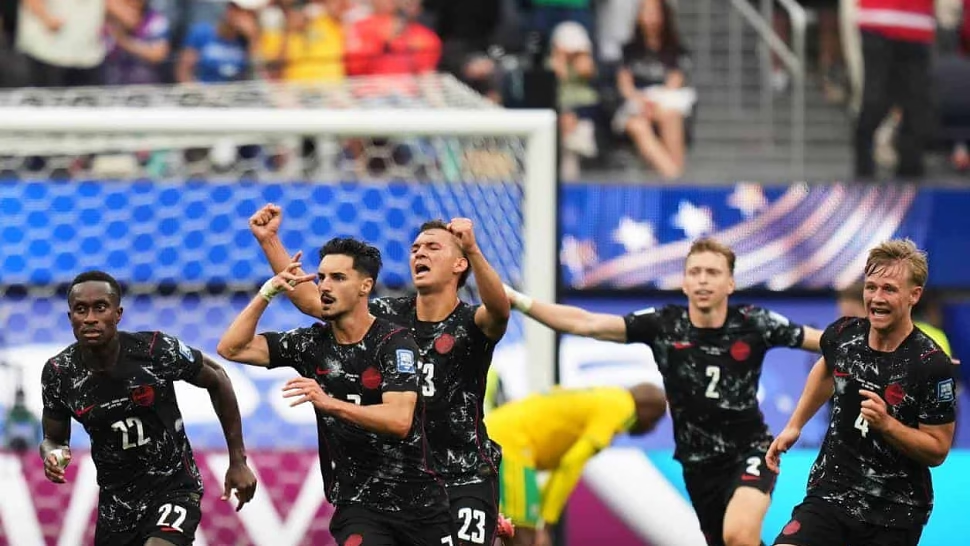
Canada beats South Africa 1-0 with a goal in stoppage time and advances to the round of 16 for the first time as hosts.

Canada makes history at the 2026 World Cup

An injury-time goal from Stephen Eustaquio gave Canada a 1-0 victory over South Africa, securing their place in the round of 16 for the first time as hosts. The LAFC midfielder hit a right cross in the 90+2 minute, after a cross from Jacob Shaffelburg and a clearance from Ime Okon.

The match, played at SoFi Stadium in Los Angeles, had Canada dominating. The Canadian fans filled the stands celebrating the historic victory. South Africa, which also advanced from the group stage for the first time in this edition, sought to respond in the complement. A shot by Oswin Appollis went wide in the 62nd minute, and Mbekezeli Mbokazi prevented David’s goal after a save by Williams from Tani Oluwaseyi. Promise David shot just wide in the 76th minute, and Jonathan David tested Williams two minutes later. Crépeau stopped another Appollis attempt in the 85th minute.

At 74 years and 79 days, South Africa coach Hugo Broos became the oldest coach to coach a direct elimination match in the history of the World Cup, surpassing Óscar Tabárez (71 years, 125 days in Russia 2018).

Canada now awaits in Houston, on July 4, the winner of the duel between the Netherlands and Morocco, who face each other today in Monterrey.

Referee note

FIFA appointed the Slovenian Slavko Vincic as referee for tomorrow’s match between Mexico and Ecuador, corresponding to the round of 32.

Netherlands-Morocco: high-voltage duel in Monterrey

The Sultana del Norte says goodbye to the World Cup with an intense match. Both teams arrive with seven points: the Netherlands leads its group after tying with Japan and beating Sweden and Tunisia; Morocco second of its own, only behind Brazil on goal difference. The record is even: two wins per side. In World Cups, they only met in 1994, with the Dutch victory 2-1. Ronald Koeman declared:

“Morocco is a strong rival, an early and high-level duel. We respect them, but we know how to compete with them. The best wins.”

Continue reading