Protest at Pachuca high school demands measures after student suicide

The educational community demands urgent action after a tragedy that reveals systemic failures in the protection of minors.

Demonstration at Pachuca high school after teenage suicide

The educational community of a secondary school in Pachuca, Hidalgo, is in a state of shock after the suicide of a 13-year-old student that occurred last Monday within the school facilities. This tragic event triggered a protest organized by parents, who demand the immediate implementation of emotional care protocols and safety guarantees for students.

Concrete demands and confrontation with authorities

During the morning demonstration, parents entered the school grounds to confront teachers and the principal, demanding urgent solutions to structural problems that, according to their testimony, have been repeatedly ignored. Among the main concerns are:

RelatedStudent attacks teacher and sparks protest in Coahuila
  • Recurring cases of school bullying without adequate follow-up
  • Alleged sale of illicit substances in the educational environment
  • Chronic lack of teaching staff in various groups

The protesters, including students, carried banners with slogans such as “Justice for Misael” and “We do not want apologies, we want justice and prevention”, evidencing the climate of generalized discontent. A tarp displayed at the site contained a strong message: “Institutional silence is violence. Where were the adults when they were needed most?”

Systemic failures and specific demands

The analysis of the demands reveals worrying patterns in school management:

ProblemSpecific request
Lack of follow-up on complaintsImplementation of anti-bullying protocols with legal support
Vulnerability in facilitiesInstallation of closed circuit video surveillance system
Psychological neglectPermanent emotional support program for students

According to testimonies collected, a mother had presented two formal reports for cases of harassment without receiving a response, which suggests deficiencies in the mechanisms for handling complaints.

Educational context and institutional challenges

This incident occurs in a national context where, according to data from the SEP, 32% of basic education students report having suffered some type of school violence. Pedagogy experts point out that the lack of:

  • Teacher training in early detection of emotional crises
  • Budget allocated to mental health programs
  • Effective anonymous reporting channels

they contribute to preventable risk scenarios. The case of Pachuca reflects a problem that goes beyond the local, showing failures in the systems of protection for minors in educational environments.

What’s next? State educational authorities announced the formation of an interdisciplinary group to evaluate conditions in all high schools in the region, a measure that parents consider insufficient without specific deadlines or measurable goals.

Share this information to make visible the urgency of reforms in student protection systems. Explore more content about education and mental health on our social networks.
Audit detects control failures in the Women’s Secretariat

Failures in hiring and lack of manuals in the Women's Secretariat, according to official audit.

Failures in internal controls

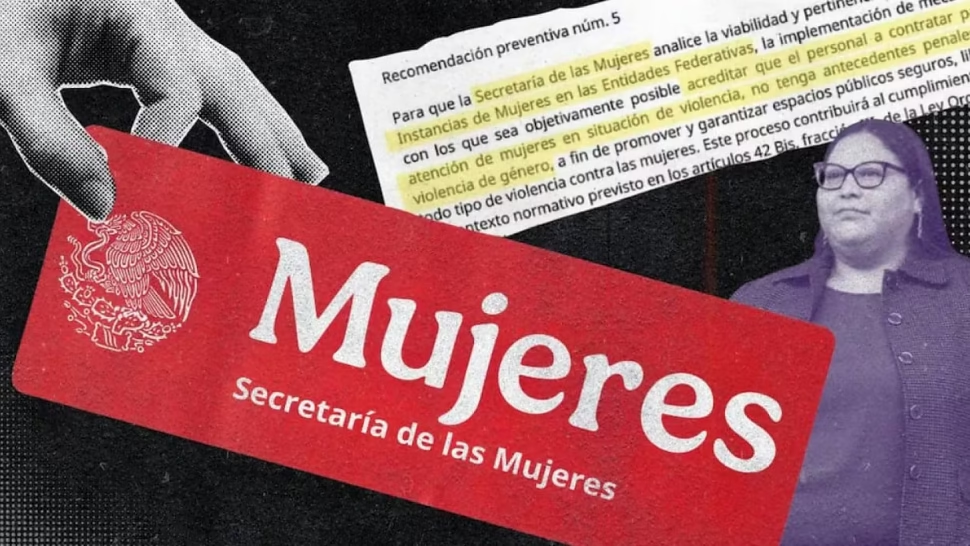
An audit of the Anti-Corruption and Good Government Secretariat identified multiple deficiencies in the Women’s Secretariat. Among them, the absence of mechanisms to verify that the personnel in charge of caring for victims of violence did not have a criminal record or gender violence record.

The report “A PROCESO-006-074-2025” also indicates that there were no clear hiring procedures in the Women’s Instances in the Federal Entities (IMEF). For this reason, a preventive recommendation was issued to strengthen entry filters.

Pending manuals and organization

The agency lacked an updated General Organization Manual and a Procedures Manual, mandatory documents for its operation. The audits recommended developing and updating them.

Although the Secretariat reported that several areas had already sent projects to integrate these manuals, until now their complete implementation has not been accredited. In addition, another review detected inconsistencies in job profiles in the Information Technology area.

These observations occur in a context of institutional transition: the Women’s Secretariat has not had a head since April 2026. This situation has generated administrative and operational pending issues in the new structure of the federal agency.

Continue reading

Harfuch products dominate sales at WTC

Itinerant merchants find a new business in the image of the official.

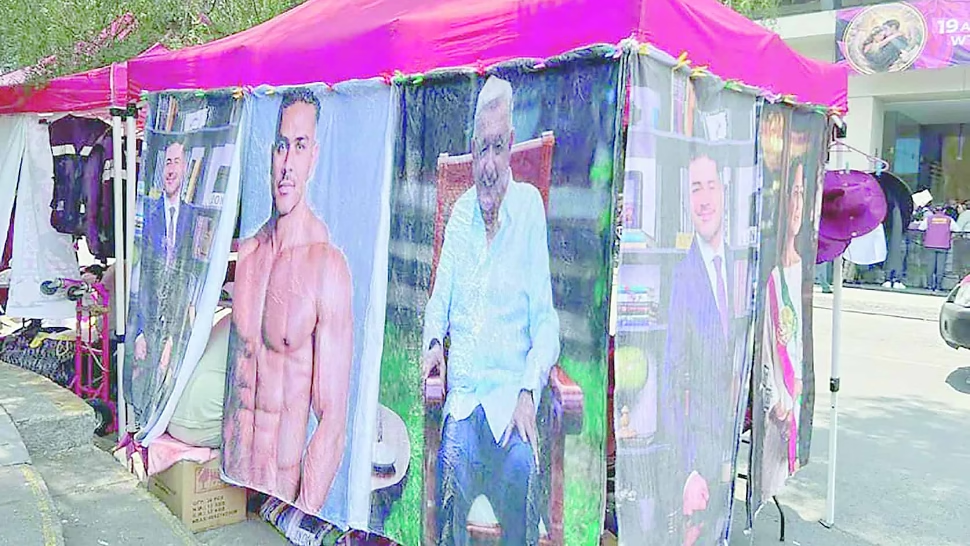
Blankets and keychains with the face of Omar García Harfuch

Outside the World Trade Center, where Morena holds its internal catwalk of aspiring state candidates, street vendors have found a gold mine: the image of the Secretary of Citizen Security.

Prices range from 50 pesos for key chains to 200 for blankets. According to merchants, these items are the most in demand at the event. They even surpass those of Andrés Manuel López Obrador and Claudia Sheinbaum.

The popularity of the official is reflected in sales. The sellers adapted their offer to the interest of the attendees. The variety of products has captured the attention of those who come to the venue.

The Morenoist catwalk not only moves politics. It also generates a direct impact on street commerce in the area. Sellers take advantage of each trend to increase their income.

Continue reading

UAT students win bronze for gum against HPV

Natural gummy project against HPV wins bronze medal in Ibero-American final.

Two students from the Autonomous University of Tamaulipas (UAT) achieved third place in the Ibero-American Final of Infomatrix 2026, one of the most important science and technology competitions in the region.

Juan Pablo Hernández Hernández and Yuridia Guadalupe Ruiz García, from the Tampico Faculty of Nursing, presented “V-Guard Gummies”, a gummy made with natural extracts that seeks to strengthen the immune system and support the prevention and treatment of the human papillomavirus (HPV).

High level competition

The event was organized by the Latin American Society of Science and Technology (SOLACYT) at the Tecnológico de Monterrey, San Luis Potosí Campus. It brought together 610 exhibitors and representatives of 250 finalist educational institutions from all over Latin America.

The young people reached this stage after obtaining the gold medal in the Gulf North regional phase. Their project received direct accreditation to the international phase thanks to the high score, quality and medical impact of the prototype.

The rector of the UAT, Dámaso Anaya Alvarado, promotes research and academic excellence as part of university education. This result reflects the work of students and teachers in developing accessible solutions to public health problems.

Continue reading