Ban on animal sales boosts illegal market

The judicial measure triggers warnings about an increase in illicit activities and a greater risk to the well-being of species.

Analysis of the Commercial Prohibition in the Sonora Market

A detailed analysis of the resolution of the Administrative Justice Court of Mexico City, which prohibits the commercialization of animals in the emblematic Mercado Sonora, reveals a complex web of unintended consequences. The order, supported by the deadline established by Mayor Venustiano Carranza for tenants to modify their commercial activity before the end of the year, is considered by the direct actors as an unviable measure. The research identifies that the lack of a robust transition plan and insufficient financial support are the critical factors that undermine the effective implementation of this policy.

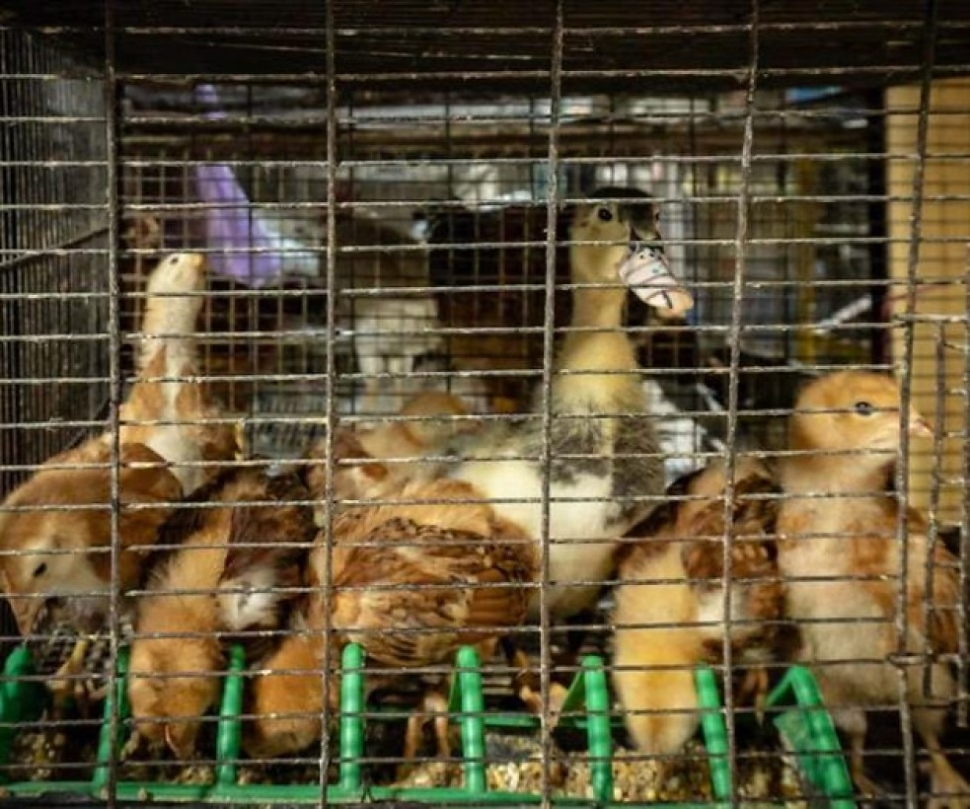
Traders, veterinary professionals and experts in environmental law agree that the provision, far from achieving its primary objective of animal protection, will generate a counterproductive effect. The closure of formal sales channels will not eliminate the existing demand for pets and various species. On the contrary, this demand will be redirected towards clandestine circuits, where health supervision and animal welfare conditions are non-existent. This shift towards the black economy will lead to an increase in the rates of corruption, abuse and black market practices, situations that the law aims to eradicate.

RelatedFederal government promotes new Animal Care Law with broad participation

Socioeconomic Impact and Regulatory Void

From a socioeconomic perspective, the measure will directly impact an extensive value chain. Civil society organizations, such as Monacoso, have quantified the scope, warning that more than 300 establishments in the Mercado Sonora and other points of sale will be affected. The job retraining of thousands of people involved—from breeders and sellers to transporters and input suppliers—is not a trivial process. The bureaucratic procedures, the costs of repurposing the premises and the absence of working capital constitute practically insurmountable barriers for the majority of micro-merchants, whose livelihood and that of their families, estimated at more than 100 thousand people, depend on this secular activity.

The regulatory and supervisory vacuum that is created is perhaps the most serious element. In a formal setting, health and animal protection authorities can exercise controls, establish quarantine protocols and verify health conditions. Without a regulated space, this surveillance capacity is completely diluted. The logical consequence is a general deterioration in the state of health and well-being of the specimens marketed, since illegal actors operate outside any regulatory framework. Prohibition, in this sense, not only fails in its purpose, but activates mechanisms that exacerbate the original problem it was trying to solve.

Was this analysis of public policies and their real impact revealing to you? Share this article on your social networks to expand the conversation and explore more content related to economics and regulation on our site.


AICM taxi drivers refuse to apply discounts agreed for the World Cup

Three AICM taxi drivers groups refuse to apply discounts of up to 18% during the World Cup.

Three groups of taxi drivers that operate at the Mexico City International Airport (AICM) refused to apply discounts of up to 18% on their rates during the World Cup. The measure contradicts previous agreements announced by airport authorities and part of the union.

The companies Nueva Imagen, Porto Taxi and Sitio 300 issued a statement to clarify their position. They argued that they have no contractual relationship with the Grupo Aeroportuario Marina (GAM), the entity that promoted the benefits for airport users.

According to permit holders, the announced discounts do not represent a direct reduction in rates. They are, they say, adjustments derived from compensation for improper charges and administrative processes for maintenance work at the AICM.

They demand transparency

The taxi drivers asked the AICM authorities to make public the documents that support these measures. They also called on the GAM to make transparent the minutes and contracts where the application of discounts had been agreed upon. They questioned the legal validity of the obligations attributed to them.

The refusal could affect users who expected more affordable rates during the sporting event. Until now, there is no certainty about the real cost of service at the AICM during the World Cup.

Continue reading

Morena opens the door to a coalition with the PVEM in San Luis Potosí

Morena conditions alliance on PVEM ruling out Ruth González for the governorship.

Morena-PVEM Coalition for 2027?

The state leadership of Morena in San Luis Potosí left open the possibility of an alliance with the Green Ecologist Party (PVEM) for the local elections of 2027. The condition: that the PVEM present a different profile from that of Senator Ruth González.

Rita Ozalia Rodríguez Velázquez, state president of Morena, explained that if the PVEM discards Ruth González—wife of Governor Ricardo Gallardo—the green party could lead the coalition, which would also integrate the Labor Party (PT).

The leader clarified that the relationship with the PVEM at the local level does not face a conflict, although she admitted that there is no direct communication between both state leaders. Decisions about alliances, he said, are made by national leaders.

The possible agreement arises in the midst of the debate about nepotism, after Ruth González’s intention to succeed her husband in the state government was questioned. Morena looks for profiles that avoid that controversy.

Rodríguez Velázquez stressed that there is coordination between the party leadership to define the electoral strategy. For now, the panorama in San Luis Potosí remains open.

Continue reading

Morena accuses INE advisors of being ‘ill-wishers’

The Morena leader accuses INE advisors of being 'ill-wishers' and defends her affiliation system.

Morena questions the impartiality of the INE

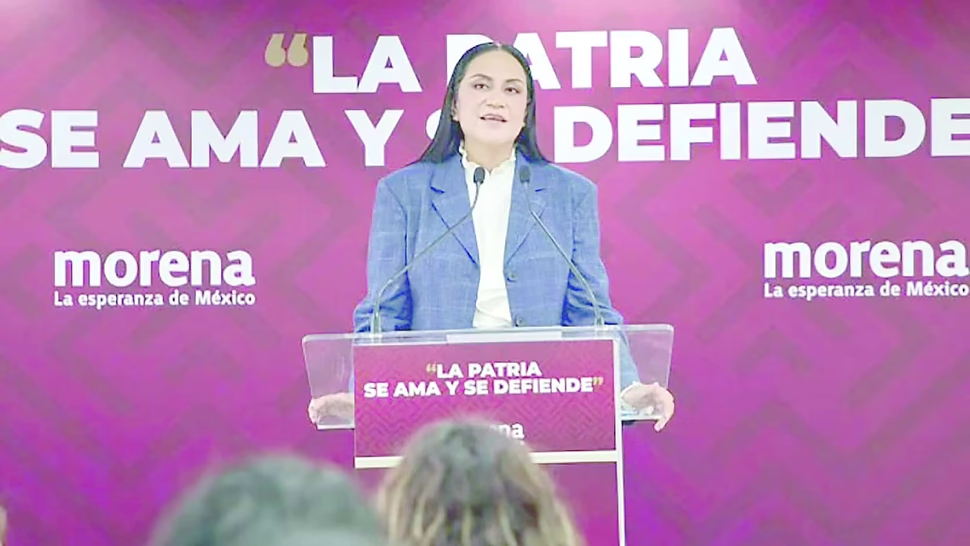
The national leader of Morena, Ariadna Montiel Reyes, pointed out that within the INE there are advisors with critical positions towards her party. He described them as “Morena haters” during a press conference where he addressed recent resolutions on duplicate affiliations.

Montiel affirmed that his party abides by the determinations of the Electoral Court. The authority ordered the elimination of more than 93 thousand affiliate records and leave under review about 19 thousand cases that the INE must verify.

The leader demanded that the institute adhere to the resolutions of the General Council and not to individual opinions. He accused that there are figures close to past electoral administrations who maintain a critical stance towards the movement.

Regarding the affiliation system, Montiel defended that Morena’s application is efficient. He assured that it surpasses that of the INE in functionality, since it allows duplications in the records to be detected.

He also proposed that the INE should have real-time verification mechanisms to cross-check affiliation data. However, he acknowledged that there are different processes between parties and the electoral authority.

Continue reading