Profeco warns about fraud in offers for the 2026 World Cup

The agency detected fake sites with unrealistic prices for tickets and tourist packages.

The Federal Consumer Prosecutor’s Office (Profeco) warned about misleading promotions related to the 2026 FIFA World Cup. In a statement, it noted that offers with very low prices for tickets, exclusive experiences, tourist packages and accommodation are circulating on social networks. These come from accounts without verifiable means of contact or clear change or cancellation policies.

Protection measures

Profeco explained that it has identified sites that appear to be trustworthy, but do not comply with electronic commerce requirements to guarantee secure transactions. Therefore, it recommended purchasing products and services only from official or authorized suppliers, and avoiding secondary markets.

RelatedProfeco resolves 53 complaints and recovers 232 thousand pesos in El Buen Fin

In addition, the agency constantly monitors digital platforms and responds to complaints to punish those who spread misleading advertising. It urged consumers to report any suspicious practices, which allows unsubstantiated ads to be modified or removed. Citizen collaboration is key to protecting their rights in large-scale events such as the World Cup.

They seize more than three tons of methamphetamine in Sonora

Record seizure in Sonora: more than three tons of methamphetamine seized.

The Secretary of Security and Citizen Protection, Omar García Harfuch, reported on the seizure of more than three tons of methamphetamine in Sonora. The seizure was the result of coordinated intelligence and investigation efforts between federal authorities.

Impact of confiscation

Through social networks, García Harfuch pointed out that this amount represents millions of doses that “will no longer reach the streets.” He added that the action prevents significant economic income from criminal organizations.

The seizure is considered a relevant step in the fight against drug trafficking in the country. The coordination between different security forces to confront this problem stands out.

Continue reading

Sheinbaum presents hospital plan with 152 works and 181 thousand million pesos

152 projects and 181 billion pesos to add 9,139 new beds in six years.

Hospital infrastructure plan 2024-2030

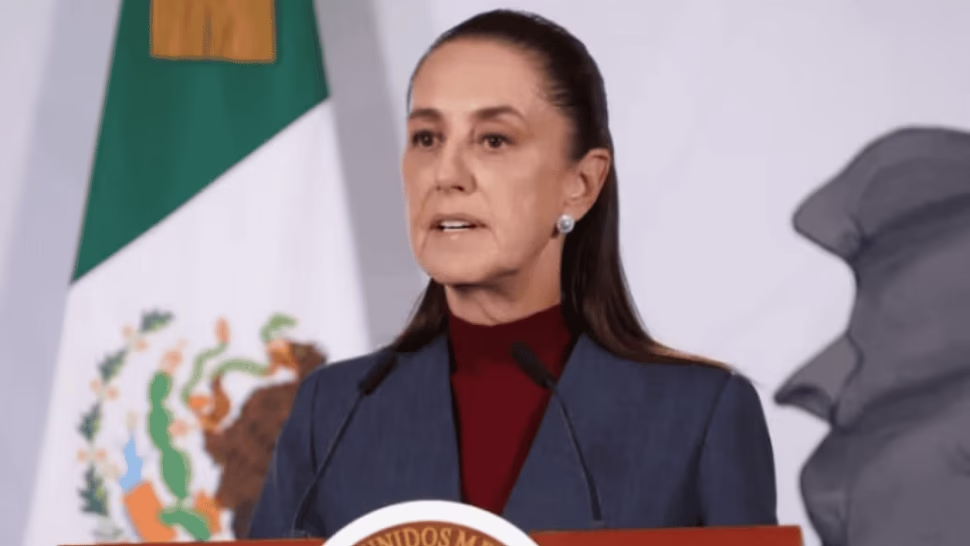
President Claudia Sheinbaum presented the 2024-2030 Hospital Infrastructure Plan, which includes 152 projects with an investment of close to 181 billion pesos. In the morning conference from the National Palace, Sheinbaum announced that what was done during the neoliberal period in this area will be compared.

“Next week we are going to present how this compares with the neoliberal period. How much was built from 1982 to 2018 and how much we are going to build,” he stated.

Undersecretary Eduardo Clark explained that the plan contemplates 50 completely new hospitals, with 6,364 additional beds; 47 expansions that will add 1,000 beds; and 55 substitutions and major improvements, with 1,774 beds. In total, 9,139 beds will be added.

“It will be the largest growth in the number of beds since we have data to compare,” Clark highlighted.

From October 2024 to date, 30 projects have already been completed, adding 1,474 beds in service. Of them, seven correspond to the IMSS, 19 to the IMSS-Bienestar and four to the ISSSTE.

By 2026, 33 more projects are under construction, which include four new IMSS hospitals, five replacements and two expansions. In the IMSS-Wellness, a new hospital, eight substitutes and three expanded ones are planned; in the ISSSTE, one new, two substitutes and seven expanded, with 1,163 additional beds.

Martí Batres, director of ISSSTE, pointed out that 20 hospitals will be reconstructed or rescued, with nine works underway. Zoé Robledo, from the IMSS, indicated that by 2030, 47 hospitals will be built, seven already operating and 21 in process. Alejandro Svarch, from IMSS-Bienestar, reported 87 strategic projects with 46.8 billion pesos.

Continue reading

Sea lion returns to the sea after two months of rehabilitation

Sea lion specimen was rescued, rehabilitated and returned to the sea in San Felipe.

Rescue and recovery in Baja California

The Federal Environmental Protection Agency (Profepa) confirmed the release of a sea lion (Zalophus californianus) that spent five months stranded in the Roca “Consag” sea lion shelter, in San Felipe, Baja California.

The specimen was rescued at the end of May and transferred to the Veterinary Sciences Research Institute of the Autonomous University of Baja California (UABC). There, professionals and student volunteers diagnosed the female with severe dehydration and nutritional loss.

Daily care and return to habitat

For almost two months, doctors and Profepa staff provided food, medications and daily cleaning. The actions allowed the animal to regain its mobility.

Once rehabilitated, she was released in the same Roca “Consag” kennel, with the support of UABC Veterinary students. The transfer was carried out on a Profepa vessel with its inspectors.

In addition, Marines, observers from the civil association “Pesca ABC”, students and volunteers participated in another vessel of the Secretary of the Navy (Semar).

Profepa highlighted in a statement: “This successful result of rescue, rehabilitation and return was possible thanks to the combined efforts of government, educational and civil institutions that go in the same direction: safeguarding the wildlife of our country.”

Continue reading