Petrobras and Pemex prepare strategic alliance in key visit

The president of Petrobras will visit Mexico to meet with Pemex and explore an energy alliance between both countries.

The curtain opens on a new energy alliance

Mexican foreign policy is about to take a strategic turn. After President Lula’s offer of collaboration to Claudia Sheinbaum, now comes the concrete movement: the president of Petrobras, Magda Chambriard, will visit Mexico soon.

Its mission is clear and forceful. He will hold direct meetings with the senior management of Pemex. The objective is not a diplomatic courtesy, but to lay the foundations for a real and deep energy collaboration between the two largest oil companies in Latin America.

“Chancellor Viera thanked and recognized the success of the implementation of the electronic visa for Brazilian nationals, which will allow increasing tourism to our country”

This approach does not come from nowhere. Foreign ministers Juan Ramón de la Fuente and Mauro Vieira have already refined the details in Colombia. They reviewed the entire bilateral agenda with a magnifying glass, from energy to health.

RelatedBrazil protests US visa restrictions on its minister

Beyond oil: a comprehensive agenda

The visit is not limited to hydrocarbons. The trip to Brazil of the Secretary of Health, David Kershenobich, was also coordinated. They will seek to advance health regulation and develop medicines and vaccines together.

It’s a smart move. While the energy alliance is woven, other pillars of the relationship are strengthened. The electronic visa for Brazilians is already a success that will boost tourism.

And there are gestures that are worth their weight in diplomatic gold. De la Fuente thanked Brazil for protecting Mexican interests in Peru during recent tensions. They are signs of a trust that goes beyond speech.

The stage is set. The main actors take a position. When Chambriard sets foot on Mexican soil, it will not be just a protocol visit. It will be the first visible act of what could become the most powerful energy axis on the continent. The lights are on and we are all waiting to see what happens behind the curtain.
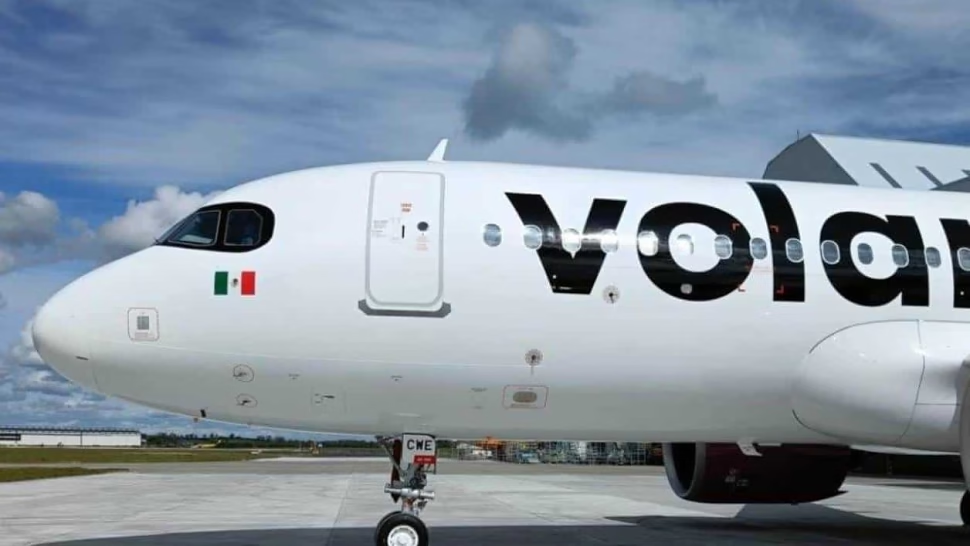

Loss of $127 million for Volaris in the second quarter

Despite a 24% increase in revenue, the high cost of fuel hit the airline's finances.

Mixed results for Volaris

Volaris reported a net loss of $127 million in the second quarter of the year. However, its total operating income grew by 24%, reaching $859 million. This increase was due to the increase in rates.

The cost of fuel was decisive. The average price of jet fuel increased by 70%, standing at $4.18 per gallon. The company faced one of the most challenging fuel environments in recent years.

Enrique Beltranena, president and CEO of Volaris, said:

“We acted decisively, driving strong performance across our network and cash flow generation, despite operating in one of the most challenging fuel environments in recent years.”

Beltranena highlighted that each flight operated contributed positively to cash flow. Domestic and international demand remained strong. The airline is focused on its capacity plan for the third quarter, concentrating flights in July and August to capture the peak season.

Perspectives and adjustments

Volaris expects available seat mile growth of approximately 5% for the full year. Capacity in the second quarter increased 2%. Operating expenses totaled $958 million, a significant increase compared to $715 million in the same period last year.

The company is confident in the actions taken during the first half of the year. Beltranena stated:

“Actions taken during the first half of the year are generating tangible progress, supporting stronger results in the second half and the restoration of our EBITDA margin guidance for the full year.”

Total cash, equivalents and short-term investments totaled $824 million, equivalent to 25% of trailing 12-month operating income. The projections include the compensation expected from the agreement with Pratt & Whitney, related to the inspection of GTF engines that keep some aircraft on the ground.

Continue reading

Six journalists have died in Mexico so far in 2026

Six communicators have been killed so far in 2026. Veracruz accounts for half of the cases.

Six journalists died in Mexico during 2026

At least six journalists have been killed in Mexico so far in 2026. All attacks were with firearms. Three of the cases occurred in Veracruz.

Carlos Castro was killed on January 9 in Poza Rica, Veracruz. He was 26 years old and was director of the Digital Code North portal, where he covered public security and red notice. The attack occurred in a restaurant where he was with his family.

Roxana Rivera was forcibly taken from her home in Nanchital, Veracruz, on June 2. The event was recorded on video. On July 3, authorities confirmed that remains found corresponded to his identity.

Luis Ángel López, a red note reporter for the newspaper Vanguardia, was deprived of his life on June 11 in Poza Rica. He had precautionary measures from the Commission to Protect Journalists.

Alex Serna, an environmentalist and communicator from Zihuatanejo, was reported missing and found dead on July 4. The Guerrero Prosecutor’s Office confirmed that the body showed signs of torture. He was in Semefo as unidentified.

Josué Martínez Contreras, director of the Noticias San Martín Texmelucan portal, was killed on July 16 in Puebla, in front of his 13-year-old son and his mother. Their outlet was a Facebook page with local information and security coverage.

Francisco Alejandro Leyva was killed on July 22 in San Pablo Etla, Oaxaca. Attackers on a motorcycle shot him while he was eating at a stall. He was director of Cortv and maintained his column “El Zumbido del Moscardón.”

The Mexican journalistic community faces a context of constant risk. Human rights organizations have reiterated the demand for justice and protection for those who practice journalism in the country.

Continue reading

Chihuahua seeks to consolidate Embraer investment with new incentives

Governor agrees to incentives and legal certainty to expand operations of the Brazilian firm.

The governor of Chihuahua, Maru Campos Galván, held a meeting with Embraer executives during the Farnborough 2026 Aerospace Fair. The objective: to strengthen the conditions for the expansion of the Brazilian company in the entity.

At the meeting, greater incentives, streamlining of supply chains and greater legal certainty were agreed. The president stressed her administration’s support for new investment projects that generate more and better jobs.

“We are ready with industrial infrastructure, services and specialized talent that supports the expansion of its current capabilities and operations,” Campos stated before Embraer representatives.

Strategic acquisition

On July 1, Embraer acquired Safran’s 50% stake in the EZ AIR plant, located in the city of Chihuahua. With this purchase, the firm became a majority shareholder and is now the only company in Mexico that manufactures all aircraft cabin components.

The Embraer delegation included Roberto De Deus Chaves (Executive Vice President of Global Purchasing), Bruna Wilbert (Director of Purchasing), Joao Pedro Taborda (Vice President of Government Affairs) and Andreza De Souza Alberto (Vice President of People, ESG and Corporate Communication).

Impact on employment

Currently Embraer generates around 1,100 direct jobs in the state. The figure could increase as its expansion plan progresses. The governor highlighted that Chihuahua offers “legal security and a stable environment for long-term investments”, a relevant aspect in the context of the T-MEC.

Campos was accompanied by the Secretary of Innovation and Economic Development, Ulises Fernández. With this management, Chihuahua reinforces its leadership in the national aerospace industry and consolidates itself as a reliable destination for international investment.

Continue reading